GENERAL plan of the animal body
Before studying the individual parts of the animal body, let's take a look at the overall arrangement of the body. Our focus is on the principle of bilateral symmetry, the two main cavities (spaces) in the body, and the levels of organization that make up the body.
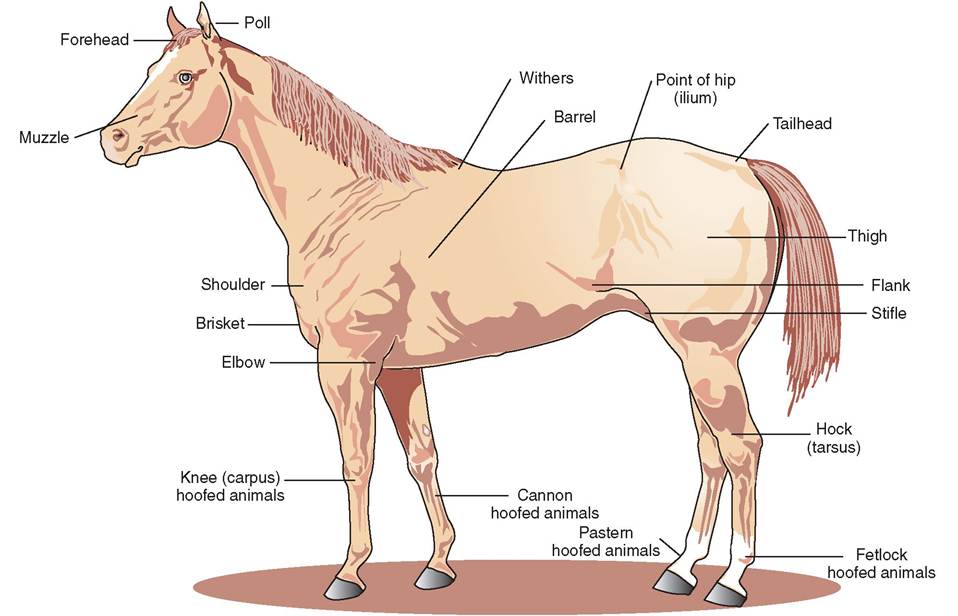
FIGURE 1-3 Common regional terms.
TEST YOURSELF 1-2
1. How does each of the anatomic planes of reference (sagittal, median, transverse, and dorsal) divide a cow's body?
2. If you are facing a cat head-on, is its left ear on your left or right side?
3. Why must the term rostral be used instead of cranial to describe structures on a hedgehog's head, but the term caudal works just fine?
4. If your left hand is on a goat's belly and your right hand is on its back, which hand is on the animal's dorsal surface and which is on its ventral surface?
5. The next time you see a dog, differentiate between the medial and lateral surfaces of one of its elbows and the proximal and distal ends of one of its legs.
6. If you insert a hypodermic needle into a horse's muscle to give it an injection, which end of the needle—the tip or the hub—is located deep in the muscle, and which end is located superficially?
7. What surface of a hamster's front leg is in contact with the ground when it is walking normally? What surface of the hind leg?
body. Paired structures, such as the kidneys, lungs, and legs, are approximately mirror images. For example, in looking at your hands, you see that they are not identical—the thumb of one of your hands is where the little finger is on the other hand—but they are mirror images of each other. Paired internal organs are similar.
Single structures in the body are generally found near the center of the body, near the median plane.
This is true of structures such as the brain, the heart, and the gastrointestinal (GI) tract. A first glance the GI tract does not seem to obey this rule. After all, it is extensively folded and more or less fills the abdominal cavity. Actually the GI tract is located near the median plane, but it is so long that it has to be intricately folded so it fits in the abdomen. If we were to stretch it out, it would form one long tube. Even with all its twists, turns, and convolutions, the GI tract does not wander far from the median plane.BODY CAVITIES
The animal body has two main cavities (spaces)—a small dorsal cavity and a much larger ventral cavity (Figure 1-4).
BILATERAL SYMMETRY
Bilateral symmetry means that the left and right halves of an animal's body are essentially mirror images of each other. Although not absolute, the principle of bilateral symmetry accurately reflects the basic inner and outer structure of the
DORSAL BODY CAVITY
The dorsal body cavity contains the brain and spinal cord, that is, the central nervous system. It consists of two parts: a somewhat spherical cranial cavity in the skull and a long, narrow spinal cavity running down the spine. The cranial cavity is also known as the cranium. It is formed from several
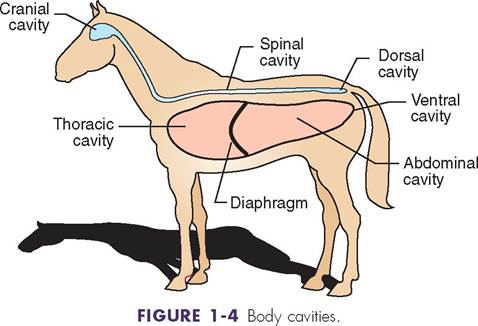
bones of the skull, and it houses and protects the brain. The spinal cavity is also known as the spinal canal. It is formed from the vertebrae of the spine, and it houses and protects the spinal cord.