DIRECTIONAL TERMS
Directional terms in anatomy provide a common language for accurately and clearly describing body structures regardless of the position of the animal's body. These terms generally occur in pairs that have opposite meanings and are used chiefly to describe relative positions of body parts.
Since humans walk upright, there are a few differences between human directional terms and those of nonhuman animals (Table 1-2).Left and right always refer to the animal’s left and right sides. The spleen, an organ with several important functions, is located on the left side of a cow's abdomen. The duodenum, the first short portion of the small intestine, exits the stomach on the right side of a dog's abdomen.
Cranial and caudal refer to the ends of the animal as it stands on four legs. Cranial means toward the head (cranium), and caudal means toward the tail (cauda). A horse's shoulder is located cranial to its hip. The caudal end of the sternum (breastbone) is called the xiphoid process.
In humans superior is used in place of cranial, and inferior is used in place of caudal.
Rostral is a special term used only to describe positions or directions on the head. The term cranial loses its meaning on the head because the cranium is part of the head. Caudal retains its normal meaning on the head because it still means toward the tail end of the animal. Rostral means toward the tip of the nose (rostrum). An animal's eyes are located rostral to its ears. In humans the term nasal means toward the nose.
Dorsal and ventral refer to “up and down” directions or positions with the animal in a standing position. Dorsal means toward the back (top surface) of a standing animal, and ventral means toward the belly (bottom surface) of a standing animal. Dorsal and ventral are easiest to visualize in a standing animal, but they retain their meanings regardless of the animal's position.
When one prepares to ride a horse, the saddle is placed on the animal's dorsal surface, and the cinch goes around the horse's ventral surface. In humans posterior takes the place of dorsal, and anterior takes the place of ventral.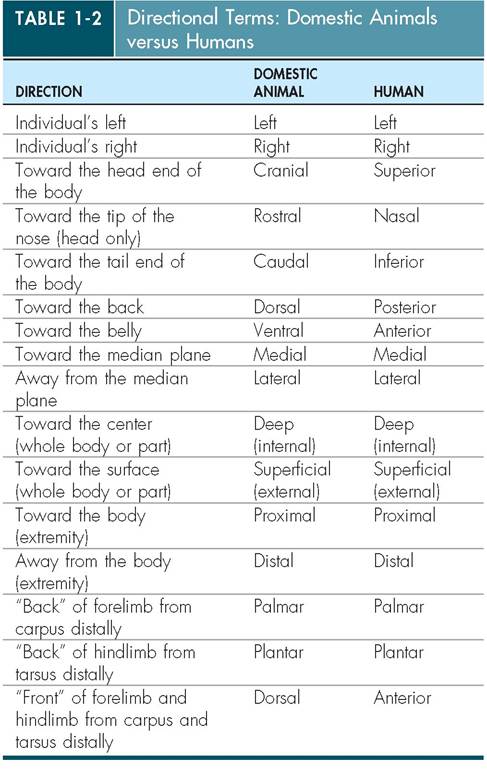
Medial and lateral refer to positions relative to the median plane. Medial means toward the median plane (toward the center line of the body), and lateral means away from the median plane. The medial surface of an animal's leg is the one closest to its body. The lateral surface of the leg is the outer surface.
Deep (internal) and superficial (external) refer to the position of something relative to the center or surface of the body or a body part. Deep means toward the center of the body or a body part. (Internal is sometimes used in place of deep.) Superficial means toward the surface of the body or a body part. (External is sometimes used in place of superficial.) The deep digital flexor muscle is located closer to the center of the leg than the superficial digital flexor muscle, which is located nearer to the surface of the leg.
Proximal and distal are used to describe positions only on extremities, such as legs, ears, and tail, relative to the body. Proximal means toward the body, and distal means away from the body. The proximal end of the tail attaches it to the body. The toes are located on the distal end of the leg.
When it comes to describing the front and back surfaces of the legs, things get just a little more complicated. There are different terms depending on whether we are referring to the distal or proximal parts of the legs. The
proximal-distal dividing line for the front leg is the proximal end of the carpus (equivalent to our wrist), and the dividing line for the rear leg is the proximal end of the tarsus (equivalent to our ankle). The back surface of the front leg from the carpus distally is called the palmar surface—like the palm of our hand—and proximal to the carpus it is the caudal surface. The back of the hind leg from the tarsus distally is called the plantar surface—like the plantar or ground surface of our foot—and proximal to the tarsus it is called the caudal surface, just like the front leg. The “front” surface of both the front and hind legs is termed dorsal from the carpus and tarsus distally and cranial proximal to them.
COMMON REGIONAL TERMS
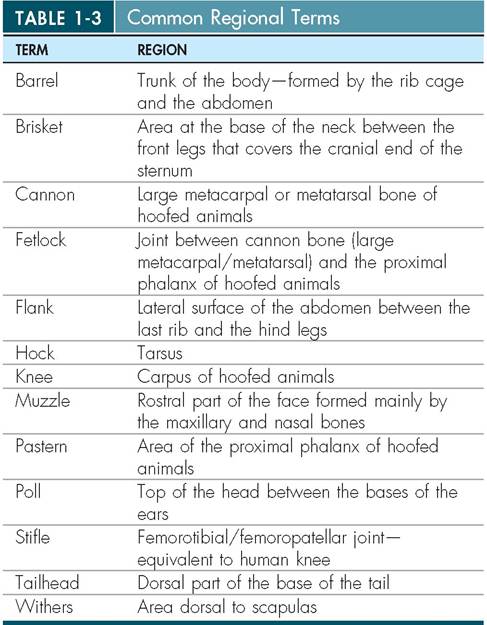
Common regional terms (Figure 1-3) give us a shorthand way of recording anatomic locations in veterinary records. It is easier to refer to the “fetlock” of a horse than to have to write “the joint between the large metacarpal or metatarsal bone and the proximal phalanx.” Table 1-3 gives the meanings of commonly used regional terms, including some that are unique to the horse and other hoofed animals.
More on the topic DIRECTIONAL TERMS:
- DIRECTIONAL TERMS
- Introduction to Anatomy and Physiology
- The Terminology of Anatomy
- Anatomical definitions
- Table of contents
- ANATOMIC PLANES OF REFERENCE
- Colville Thomas, Bassert Joanna M.. Clinical Anatomy and Physiology for Veterinary Technicians. 3rd edition. — Elsevier,2016. — 658 p., 2016
- Muscle system
- §73. The Empirical Reality of Relations
- THE THREE VIEWS CONCERNING HUMAN KNOWLEDGE REVISITED