INFECTIOUS KERATOCONJUNCTIVITIS in Caprinae
MARCO GIACOMETTI
Wildvet Projects, Stampa, Switzerland
Infectious keratoconjunctivitis (IKC) is a highly contagious infection of the eye characterized by inflammation of the conjunctiva and cornea and is common in some wild Caprinae species as well as in domestic sheep and goats.
The major single cause of IKC in chamois, ibex and in other Caprinae species, including domestic sheep and goats, is Mycoplasma conjunctivae^5). The term ‘infectious keratoconjunctivitis’ is used to describe a clinical condition that may be caused by more than one pathogen.AETIOLOGY
The aetiology of IKC in chamois and other wild Caprinae species is not fully understood. Several pathogens have been suspected to be aetiological agents of IKC. In domestic sheep however, pathogenicity has been demonstrated for two agents that have been isolated from the eyes: Chlamydophila psittaci and M. conjunctivae. The pathogenicity of M. conjunctivae has been demonstrated in domestic sheep, domestic goats, Alpine ibex ( Capra i. ibex) and European mouflon ( Ovis orientalis musimon )(5). This organism has also been implicated as an aetiological agent of IKC in Alpine chamois(6) and Pyrenean chamois (Rupicapra p. pyrenaicd)τ,. In the eastern Swiss Alps, the occurrence of Chlamydiaceae in Alpine chamois is low(8). It is now generally accepted that M. conjunctivae is the major single cause of IKC in domestic and wild Caprinae species. An association has been demonstrated between the mycoplasmal load in the eyes and the severity of clinical signs(9). Phylogenetically, M. conjunctivae belongs to the Mycoplasma neurolyticum cluster of the hominis group, and is closely related to M. bovoculi and M. ovipneumoniae.
Using a molecular method (DNA sequence determination of a variable domain within the adhesin gene lppS), more than 40 different strains of M.
conjunctivae have recently been subtyped and identified. It has been shown that Australian strains from sheep introduced to Croatia in 1995 belong to a distinct cluster that is different from all other isolates which originate from European Alpine countries(10).EPIDEMIOLOGY
The first outbreak of IKC in wildlife was reported in Alpine chamois in the Austrian Alps in 1916(11). Since then, numerous outbreaks have been described in wild Caprinae species in other European countries, including Switzerland, Italy, France, Slovenia, Spain, Andorra and Cyprus(5). IKC is frequently observed in Alpine chamois and in Alpine ibex, but it has also been described in other wild Caprinae species, such as Pyrenean chamois, European mouflon and Cyprian mouflon ( Ovis orientalis ophion).
In individual chamois and ibex, spontaneous recovery is the most prevalent course of IKC. At the population level, mortality is usually low (infections or to environmental predisposing factors (e.g. ultraviolet irradiation)(6).
In Alpine chamois, death associated with IKC is most often recorded in females and juveniles. Only a small number of affected adult males die, possibly reflecting a lower percentage of this sex/age-class within chamois populations. Furthermore, a lower probability for infected adult males could be caused by sexual segregation during most of the year(5,13).
Outbreaks in domestic caprinae associated with severe signs are usually observed when the agent is introduced into naive herds by infected animals from other flocks.
In chamois, IKC epidemics can progress rapidly largely because of the highly contagious nature of IKC. When changing from winter to summer range, individually marked Pyrenean chamois were recently shown to move distances up to 5 km within a few days, with Alpine ibex exceeding 10 km.
In some smaller locations, IKC cases are generally observed over a short period only (up to 2 years). In large mountain ranges, however, outbreaks may spread along the mountain chains for dozens of kilometres and persist for several years longer with hundreds of deaths before the epidemics stop.
Intraspecific transmission of M. conjunctivae occurs throughout the year. However, IKC losses in chamois are more frequent during summer and autumn. This coincides with the presence of domestic sheep grazing extensively on summer mountain pastures(5).
In the domestic sheep population, the infection is endemic and self-maintained worldwide. In Switzerland, at least one positive sheep was detected in 89% of the herds, and in positive herds that were tested, up to 5τ% of the individual animals tested positive(14). The mixing of sheep during grazing, shows and markets, the introduction of new animals to a flock and the presence of (susceptible) lambs during much of the year maintains M. conjunctivae infection within sheep populations.
The long-term maintenance of M. conjunctivae infection in chamois populations is not completely elucidated.
Seroprevalence in chamois subpopulations with no outbreaks within 2 years of sampling was low compared with subpopulations experiencing ongoing outbreaks. After an outbreak in Simmental- Gruyeres in 1997 to 1999, the seroprevalence dropped down to zero after 2 years. This may be the result of the limited contact of chamois from different herds, the strict seasonal birth period and the high mortality. Persistence of infection in individual animals does not exceed 3 to 6 months, as seen in domestic sheep)5). However, detection of M. conjunctivae in eyes without clinical signs has been reported in domestic and wild Caprinae individual animals and is not always associated with apparent outbreaks1-9).
TRANSMISSION
IKC is highly contagious within herds, with M. conjunctivae being excreted in ocular effusions, via aerosol and possibly by eye-frequenting insects)5). Mycoplasmas generally do not survive long in the environment, and therefore transmission must occur quickly through direct contact or vectors. Transmission of M. conjunctivae between the same host species (e.g.
between sheep and sheep, or chamois and chamois) does not require vectors and occurs predominantly or exclusively by contact.Mountainous habitats are shared by domestic and wild animals grazing on the same pastures, and short-distance encounters between free- ranging individuals of different Caprinae species, domestic and wild species, are not uncommon events in the Alps)9’15). In these circumstances, transmission of M. conjunctivae between domestic and wild Caprinae species is likely to be via aerosol infection or by eye-frequenting insects rather than direct contact. It is assumed that the probability of interspecific transmission increases as distance between animals decreases. Flies are likely to play a central role in interspecific transmission of M. conjunctivae on alpine meadows. Excessive lacrimation is an attractive source of proteins, salt and water for insects, and flies’ feeding habits are not species-specific, particularly when hosts graze in close proximity. Four genera of Muscidae were identified as potential vectors of M. conjunctivae: Hydrotaea, Musca, Morellia and Polietes)16). It is probable that flies play a role as accessory vectors, but their role might be of primary importance in the sporadically occurring interspecific transmission of M. conjunctivae on alpine meadows.
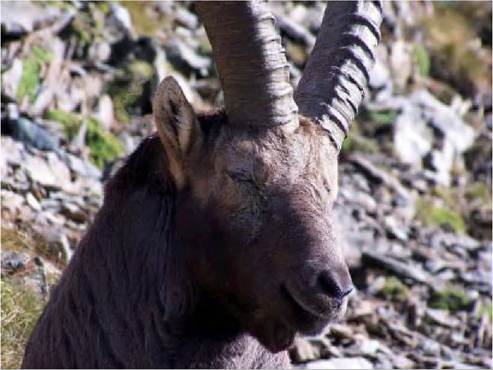
FIGURE 29.1 Infectious keratoconjunctivitis in an adult male Alpine ibex ( Capra i. ibex) the cornea shows oedema with sero-mucous ocular effusion; blindness is reversible. Photograph: Luca Pellicioli.
PATHOGENESIS, PATHOLOGY AND IMMUNITY
The period of incubation after experimental infection with M. conjunctivae is short (2—4 days))17). In early stages, IKC presents as a unilateral or bilateral conjunctivitis associated with serous or mucous effusions. Conjunctivitis can persist for some weeks without any sign of keratitis, but the disease may progress to more severe forms.
Mild keratitis is characterized by either oedema (Figure 29.1) or by per- ilimbic neovascularization, which can occur without preceding corneal oedema in the vertex area. Corneal ulceration may occur in severe cases, occasionally leading to corneal perforation. Ruptured corneas show anterior synechiae and melanin deposits forming staphyloma. The stages are progressive, but healing may commence at any time, except for eyes with ruptured corneas)18).IKC caused by M. conjunctivae is a specific ocular disease. The absence of brain lesions in blind ibex and chamois presenting with circling movements suggests that in wild Caprinae affected by IKC changes in behaviour are generally not a consequence of cerebral lesions but are probably the result of disorientation and stress in blind animals)13).
In Caprinae, the immune response to M. conjunctivae infection is frequently effective. In experimental infections, specific antibodies as detected by immunoblot analysis appear 2—4 weeks post infection1-19). Immunoblot analysis has revealed the major specific immunogenic proteins of M. conjunctivae of naturally and experimentally infected chamois, ibex and domestic sheep. Antibodies to the 175, 73, 68, 60 and 33kDa antigens appear to be specific to M. conjunctivae)19). However, little is known about the protective effect of acquired immunity, and it may be insufficient to resist natural infections.
CLINICAL SIGNS
In individual animals, clinical signs last from 2 weeks to some months. Although IKC usually provokes mild clinical signs in domestic Caprinae, it can have fatal consequences in wildlife. In wild Caprinae, the disease may progress to bilateral corneal rupture. Blind chamois and ibex inhabiting particularly treacherous steep rocky terrain may fall from cliffs, present abnormal behaviour such as disorientation and circling movements, and die of starvation. Occasionally, mortality can reach 30% and have a marked impact on demography.
In domestic sheep and goats, signs are generally moderate but occasionally severe in adult animals, and usually mild in lambs.After the disappearance of clinical signs, animals can act as healthy carriers of M. conjunctivae. The length of the period is not completely elucidated, but it might be limited to up to 6 months, as shown in domestic sheep)20). Detection of M. conjunctivae in eyes without clinical signs is common and has been reported in domestic and wild Caprinae individuals)9).
DIAGNOSIS
Diagnosis of M. conjunctivae infections can be done with isolation of the organism by culture and subsequent identification by immunological methods. For culture, eye swabs are dipped into Transwab® transport medium and processed within 24 hours of collection. Culture is performed on standard mycoplasma broth medium enriched with 20% horse serum, 2.5% yeast extract and 1% glucose)21). Culture of M. conjunctivae requires specialized technical expertise.
A polymerase chain reaction )PCR) assay was developed for rapid direct detection of M. conjunctivae in clinical material. Conjunctival swabs are dipped in tubes without transport medium and stored at —18°C until analysis. Nested PCR is based on unique sequences of the rrs genes )16S ribosomal ribonucleic acid )rRNA)) of M. conjunctivae and show a higher sensitivity than culture. Currently, the method of choice for diagnostic purposes is a TaqMan real-time PCR based on the lipoprotein gene IppS )EMBL/ GenBank accession number AJ318939), which provides a fast and a very sensitive detection of M. conjunctivaj'11'’.
An indirect enzyme-linked immunosorbent assay )ELISA) method based on the Tween 20 extracted fraction of M. conjunctivae strain HRC/581T has been developed to detect M. conjunctivae antibodies in sera of domestic sheep and Alpine chamois)5).
MANAGEMENT AND CONTROL
I n wild Caprinae, spontaneous recovery is the most frequent course of the disease. Therefore, shooting of all animals affected with IKC, regardless of the severity of clinical signs, is an inappropriate measure for disease control)20). However, individuals presenting with irreversible ocular lesions )corneal perforation) or being in poor general condition and/or injured should be shot by experts for humane reasons.
Treatment of affected free-ranging chamois or ibex should not be considered, because the prognosis in individuals is not known in advance; animals presenting with mild ocular lesions may show self-healing, and irreversible ocular lesions will not respond to treatment. Other control measures should include minimization of unnecessary human interference )e.g. cross-country-walks and uncontrolled hunting) in affected areas to avoid putting animals to flight )which could lead to falls and injury or death). Furthermore, long -distance movements of infected animals can disseminate the disease, potentially introducing it to new areas.
Prevention of IKC in wild Caprinae should focus on preventing the spillover of M. conjunctivae from domestic sheep. Thus, salt-lick use on mountain pastures should be controlled to reduce the frequency of encounters and physical contact between individuals of different Caprinae species. Diseased domestic sheep and goats should be reported and not be moved into habitats frequented by susceptible wild Caprinae.
ACKNOWLEDGEMENT
The author is grateful to Peider Ratti, Jacques Nicolet and Joachim Frey, who initiated and have supported the Swiss study on infectious keratoconjunctivitis since 1994. Special thanks go to many colleagues, laboratory personnel, wildlife services, state gamekeepers, hunters, sheep owners and veterinarians. The IKC study in Switzerland was supported by the Swiss Fund for Research on Infectious Keratoconjunctivitis, Chur, by the Swiss Federal Office for the Environment, Bern, and by the Research Fund of the Institute for Veterinary Bacteriology, Bern. The present contribution was financed by the Foundation for nature and wildlife conservation of Chasse Suisse, Basel.