Introduction
Bovine tuberculosis (BTB) caused by Mycobacterium bovis is globally also one of the most important zoonotic diseases, and it is of considerable public health importance (O’Reilly and Daborn 1995).
Infection with M. bovis has been reported in 69% of the tropical countries around the world and in 80% of African countries (OIE 2000), including Sudan (Awad et al. 1959; Awad 1962).The Republic of Sudan, situated in the northeastern part of the African continent, is vast (1.9 million km2), the second largest country in Africa (Fig. 20.1), and a substantial proportion of its inhabitants are nomads (FAO 2015). Sudan’s livestock population, estimated at about 105 million, consists of approximately 40 million sheep, 30 million goats, 30 million cattle, and 5 million camels (Fig. 20.1). After the separation of the Republic of South Sudan from the Republic of Sudan, increasing
Z. A. Ishag (*)
Key Laboratory of Veterinary Biological Engineering and Technology, Ministry of Agriculture, National Research Center for Engineering and Technology of Veterinary Bio-products, Institute of Veterinary Medicine, Jiangsu Academy of Agricultural Sciences, Nanjing, China
College of Veterinary Sciences, University of Nyala, Nyala, Sudan
E. T. Asil
College of Veterinary Sciences, University of Nyala, Nyala, Sudan
Faculty of Agriculture and Veterinary Medicine, Department of Veterinary Medicine, Qassim University, Buraydah, Kingdom of Saudi Arabia
A. Parsaeimehr
Laboratory of Biosystems Engineering, Institute of Biotechnology, Jiangsu Academy of Agricultural Sciences, Nanjing, Jiangsu, China
G.-Q. Shao
Key Laboratory of Veterinary Biological Engineering and Technology, Ministry of Agriculture, National Research Center for Engineering and Technology of Veterinary Bio-products, Institute of Veterinary Medicine, Jiangsu Academy of Agricultural Sciences, Nanjing, China
© Springer Nature Switzerland AG 2019 403
A.
B. Dibaba et al. (eds.), Tuberculosis in Animals: An African Perspective, https://doi.org/10.1007/978-3-030-18690-6_20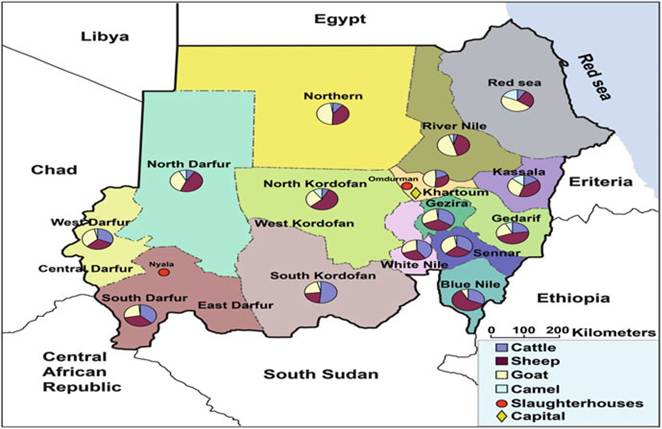
Fig. 20.1 Map of Sudan showing the estimated animal population by state and the location of the abattoirs
the number of livestock in the country as part of a program to stimulate the national economy and to increase exports became a national priority. To this end, the country’s livestock exports improved by 96.6% in 2012, generating an income of US$ 408 million, compared to the US$ 333 million earned in 2011 (Sudan Tribune
2013).
Unfortunately, in Sudan, livestock suffer from a range of diseases, many of which are endemic, including BTB, bovine farcy, and Johne’s disease (Awad 1962; Hamid et al. 2002; Mohammed and Mohammed 2009). As is the case in other developing countries, information in Sudan about the occurrence, distribution, risk factors, and the economic impact of BTB is insufficient, and because of financial constraints, programs to control tuberculosis in animals and humans have not been implemented.
Financial constraints limit the way in which mycobacterial infections in Sudan can be diagnosed. For this reason, the tuberculin skin test, bacteriology, and molecular biological methods are not routinely used, and information about the occurrence and prevalence of the disease in cattle is primarily deduced from abattoir records (Fig. 20.1) that reflect the presence of BTB-like lesions detected during routine meat inspection. Although flawed, this does provide some information about the presence and distribution of BTB in livestock in Sudan, and it provides the opportunity to control the disease in infected herds (Biffa et al. 2010).
The presence of, and extent of, human infections with M. bovis in Sudan is unknown, but the current lack of adequate control measures in livestock implies that BTB in cattle is likely to continue to spread in the country, and as long as poverty and malnutrition prevail, it will remain an important zoonotic threat (Moda et al.
1996). Co-infection of humans with BTB and HIV is an increasingly serious health problem in the developing countries (Narain et al. 1992). This situation is of particular concern given the known presence of HIV and HIV/TB co-infection in Sudan (Cosivi et al. 1998). The close association between the nomads and their animals further increases the risk of human infection by M. bovis, in addition to the likelihood of them also contracting other zoonotic diseases. For these reasons, there is an urgent need to step up, devise, and implement strategies to control BTB both in humans and in animals in Sudan.In this chapter, we review the available information about BTB in cattle in the Republic of Sudan, with a focus on the threat posed by zoonotic TB, and especially on the risk of HIV-infected patients becoming co-infected with M. bovis. We also propose a number of strategies that should help to effectively control and eradicate BTB in cattle, humans, and wildlife in Sudan.
20.2
More on the topic Introduction:
- 1 Introduction
- Introduction
- Introduction
- 19 Introduction
- Introduction
- Introduction
- INTRODUCTION
- Introduction
- Introduction
- Introduction