INTRODUCTION
Kai FROlich
Tierpark Arche Warder e.V. Warder, Germany
Pestiviruses represent causative agents of diseases that have a significant health and financial impact for the livestock industry worldwide.
Clinical signs of pestivirus infection include diarrhoea, respiratory problems and bleeding disorders.Pestiviruses have a single strand of positive-sense RNA, which is around 12.5 kb long and have spherical structures of 50—60 nm in diameter. The genomic RNA contains one continuous long open reading frame flanked by 5' and 3' non-translated regions. The molecular biology of pestivi- ruses shares many similarities and peculiarities with the human hepaciviruses. Pestiviruses are sensitive to drying (desiccation) and are rapidly inactivated by a pH of less than 3 and greater than 11. Temperatures of 70°C for a minimum of 60 minutes inactivate the virus.
One remarkable biological property of pestiviruses is the existence of two biotypes that are recognized according to the morphological changes they cause during growth in tissue culture cells: non-cytopathogenic (ncp) pestiviruses replicate without obvious cytopathic effect, whereas cytopathogenic (cp) viruses lead to lysis of target cells.
All pestiviruses are able to cross the placenta and to infect the fetus. Such intrauterine infections may lead to abortion, stillbirth, fetal malformation, or weak or apparently healthy offspring. Of particular importance is the capability of ncp pestiviruses to establish persistent infections in fetuses not yet immunocompetent. Such animals acquire immunotolerance to the virus, and they are persistently infected for the rest of their lives. Various pestivirus vaccines exist and the correct vaccine strain should be given, depending on the herd’s location and the endemic strain in that region. This vaccination must be given regularly to maintain immunity.
Based on the organization and expression of their genomes as well as their defined serological reactivity, Bovine viral diarrhea virus, Border disease virus and Classical swine fever virus are classified in the genus Pestivirus within the family Flaviviridae.
Pestiviruses have a broad range of hosts and primarily infect a wide variety of ungulates mainly belonging to the order Artiodactyla. Pestiviruses isolated from various species of wild ruminants and their phylogenetic relatedness are shown in Figure 10.1. In addition to various ruminant and pig species, camels (Camelus dromedarius), guanaco (Lama guanicoe), rabbits (Oryctolagus cuniculus) and wallaby (Macropus rufogriseus) appear to be susceptible to pestivirus infections.
Infectious Diseases of Wild Mammals and Birds in Europe, First Edition. Edited by Dolores Gavier-Widen, J. Paul Duff, and Anna Meredith. © 2012 Blackwell Publishing Ltd. Published 2012 by Blackwell Publishing Ltd.
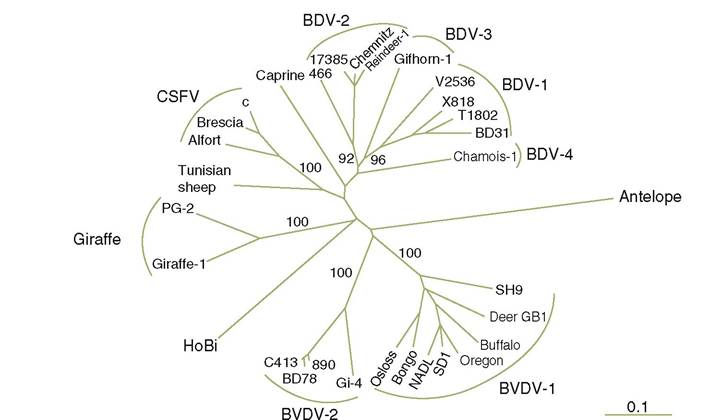
FIGURE 10.1 Phylogenetic tree indicating relatedness among pestivirus genotypes; after Vilcek & Nettleton (2006)(1).
Traditionally, pestiviruses are named after the host from which they were isolated and the diseases they cause. However, pestiviruses are not strictly host-specific. Thus, individual domestic species of artiodactyls can be infected by different pestiviruses.