Introduction
The capacity of animals to run from or disable potential predators is the essence of survival. Perhaps less apparent is the need to protect cells and tissues from attack by harmful agents—parasites, bacterial pathogens, toxins, or cells that have become cancerous.
Some everyday examples help us understand physiological processes involved in protection of animals from these various agents. Let's suppose that your puppy is playing in the yard, and he is splashed by your little brother as your brother rides his bicycle through a puddle of debris from the gutter. Secretions from the puppy's eyes and mucus membranes of his nostrils act to flush material away to prevent the chance of infection. Similarly, his hair covering, eyelashes, and thick skin prevent bacteria and debris from the dirty water from gaining entrance. Even sebaceous secretions of his skin or ear canals can produce conditions that limit the potential growth of harmful bacteria. These are all examples of nonspecific defenses.
Let's suppose that your puppy simultaneously steps on a broken bottle as he runs through the puddle chasing your brother. He manages to soak the cut with dirty bacterial-filled water. However, fortunately for him, he has received a good supply of antibodies from his mother's colostrum. This means that he likely has specific antibodies in his bloodstream from his mother. This allows his fledgling immune system to recognize and ultimately kill bacteria present in the dirty water. This would be an example of specific but passive immunity. As the puppy grows and is exposed to various materials in his environment he will develop his own complement of specific antibodies and the cells necessary to regenerate additional supplies of specific antibodies. Thus, defense mechanisms are divided into nonspecific and specific divisions. The immune system primarily concerns specific protection.
The basis for specific immunity arose from observations in the late 1800s, when scientists discovered that animals that had survived a bacterial infection had protective agents in their blood (now known to be immunoglobulins or antibodies) that defended the animal. It was also shown that if antibody-containing serum from the surviving animals was given to animals that had not been exposed to the pathogen, these animals were also protected against attack. It was initially believed that production of antibodies was the only critical requirement for protection. However, in cases where transfer of antibody-containing serum failed to provide protection, transfer of the donor's white blood cells often did provide protection. As experiments became more elaborate, it became clear that immunity involved both circulating agents as well as populations of white blood cells or leukocytes. Thus, the two overlapping arms of specific defense are humoral immunity (meaning blood derived) and cell-mediated immunity (Rodriguez et al., 2012).
Anatomy and Physiology of Domestic Animals, Second Edition. R. Michael Akers and D. Michael Denbow. © 2013 John Wiley & Sons, Inc. Published 2013 by John Wiley & Sons, Inc.
One of the major types of white blood cells includes the lymphocytes. Furthermore, there are two broad classes of lymphocytes. When they are activated, B lymphocytes, usually simply called B cells, are induced to divide to generate clones of cells. You may have read or heard of polyclonal or monoclonal antibodies being used in scientific experiments or more recently in some cancer treatments (Herceptin). Regardless, some of these clonal cells are retained in the body as memory B cells. Other B cells differentiate into plasma cells that synthesize and secrete large quantities of antibodies. The presence of the memory B cells explains the marked increase in antibody concentration (titer) in the blood when animals are exposed to the same pathogen or antigen a second time. Essentially, the pieces required for more antibody production are already in place.
Cell-mediated immunity depends on T lymphocytes, which include several subclasses of cells (helper T cells, cytotoxic T cells, and suppressor T cells). Other cells critical to functioning of both branches of the immune system include the antigen- presenting cells (fixed and wandering macrophages), neutrophils, and dendritic cells. For the most part, these various classes of cells have been identified based on their actions and on the fact that the cells express various classes of antigens or markers on their cell surfaces. When specific antibodies against these antigens are available, it allows researchers and clinicians to quantify and classify the various groups of white blood cells. Because these cells often circulate in the bloodstream or appear in secretions, it has been possible to use these markers and flow cytometry methods to identify and isolate populations of cells with specific marker characteristics. These techniques, along with cell culture and utilization of transgenic mouse models, have led to an explosion in detailed information about immune responsiveness in general and functional attributes of the classes of leukocytes in particular. The point is that understanding of immunity, disease interactions, and physiology is growing exponentially. Our purpose is to provide an overview and basic ideas, but, as with other topics covered in this text, please be aware of the rate at which current research is expanding all aspects of immunology.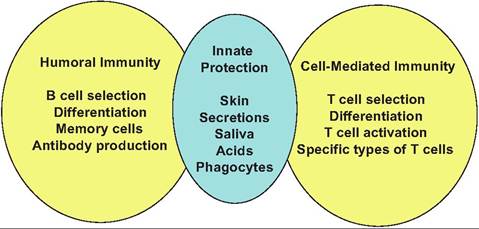
Fig. 15.1. Overview of defense mechanisms. Nonspecific or innate protection provides a first line of defense. The barrier derived from the epidermis of the skin or the stratified squamous epithelium of body openings and their secretions are a first line of protection. General effects of phagocytes, natural killer T cells, and antimicrobial proteins are also important. Humoral immunity involves activation of clones of B lymphocytes to produce memory B cells and daughter B cells that differentiate into plasma cells that synthesize and secrete large amounts of antibodies.
Cell-mediated immunity depends on selection of clones of T lymphocytes by the action of antigen-presenting cells which stimulate proliferation of the T cells. Subtypes of T cells (helper, cytoxic, and suppressor T cells) fine-tune cell-mediated immunity.Practically speaking, the actions of the two divisions of the immune system are closely interwoven. But generally, humoral immunity is most effective against bacteria and their toxins or free viruses because antibody binding can directly inactivate these attackers for example, causing precipitation or agglutination, or masking surfaces, to make them susceptible to destruction by phagocytic cells or complement activation. Cell-mediated immunity is a better weapon against cellular targets; examples include cells that have been infected by viruses or parasites, or perhaps cancer cells.
In subsequent sections we will consider some of these elements of the immune system in more detail. But let's begin by considering defense attributes of the immune system and physiological systems generally. Defense of the internal environment centers on three main functions:
• destruction or neutralization of bacterial, viral, or parasitic pathogens
• destruction of aged or damaged ; that is, consider the finite life of red blood cells
• surveillance to detect and eliminate abnormal, cancerous, or virally infected cells (Fig. 15.1).