Introduction
The endocrine system is a group of organs responsible for the production of hormones and proteins that contribute to and control metabolic body functions. Microscopically, these organs are primarily composed of epithelial cells; however, cytology from the endocrine organs is often distinctly different from cytology of other epithelial organs.
These organs have been given their own cytologic pattern termed ‘neuroendocrine’ or ‘naked nuclei’ because distinct borders between cells are often absent (Figure 16.1). Another common cytologic trait among these organs is that the malignant forms of neoplasia do not often show many criteria of malignancy, which makes a diagnosis of malignant endocrine neoplasia difficult by cytology alone. A diagnosis of carcinoma in these organs often requires histologic evaluation and the documentation of capsular and vascular invasion. Knowledge of common tumor types found within these organs in the dog and cat is helpful when cytologic findings are equivocal. Organs that will be discussed in this chapter include the thyroid gland (follicular and medullary portions), parathyroid gland, endocrine pancreas, adrenal gland (cortex and medulla), chemoreceptor organs, and a special group of endocrine neoplasia found in multiple locations, neuroendocrine carcinoma or carcinoids. 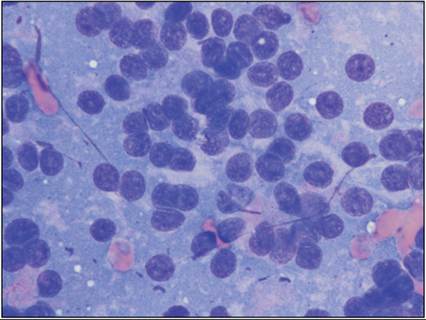
Figure 16.1 Bare nuclei. Dog. This figure shows the classic bare or ‘naked’ nuclei appearance noted on cytology of many endocrine tissues (Wright–Giemsa, 1,000? magnification).
More medical literature on Medic.Studio
More on the topic Introduction:
-
Infectious diseases -
Internal diseases -
Obstetrics and Gynaecology -
Pediatrics -
Veterinary medicine -
-
Conflictology -
Ecology -
Economy -
Finance -
History -
Law -
Medicine -
Philosophy -
Religious studies -