MYCOPLASMA INFECTIONS OF AQUATIC MAMMALS
ROBIN A.J. NICHOLAS
Mycoplasma Group, Animal Health and Veterinary Laboratories Agency (Weybridge), New Haw, Weybridge, UK
In 1988, more than18,000 harbour seals (Phoca vitulina) in the North and Baltic Seas died of an acute disease characterized by pneumonia, polyarthritis, nervous signs, abortions, diarrhoea and skin lesions(32).
Although influenza and influenza-like viruses were implicated as primary causes, the isolation of over 100 strains of mycoplasmas, many from diseased animals, coupled with the mycoplasma disease-like clinical signs, strongly suggested their contributory role in the disease process. Two new species were characterized and named: M. phocacerebrale (later respelled M. phocicerebrale) and M. phocarhinis (later M. phocirhinis). A few years earlier, a mycoplasma later characterized as M. phocidae3-333 was isolated during an outbreak of pneumonia in harbour seals off the coast of New England, USA from which an influenza virus was also detected. The ability of these mycoplasmas to cause disease in mice and induce cytopathic effects in organ cultures provided some evidence to link these mycoplasmas with disease. Moreover, M. phocicerebrale has also been strongly associated with severe lesions following biting by harbour and grey (Halichoerus grypus) seals in the wild and in captivity, which has led to infected wounds (Figure 29.3), sometimes requiring the amputation of flippers. This link was convincingly shown by the isolation of mycoplasmas from both the teeth and bite wounds of captured seals(34). It is not surprising then that M. phocicerebrale has also been detected in a human condition known as ‘seal bite finger’, a common injury seen in sealers, trainers and other occupations associated with the seal industry. This probably represents one of the few examples of zoonosis involving a mycoplasma.There are fewer reports of mycoplasmas in other sea mammals. One brief report described the isolation of two serologically different mycoplasmas from the lungs of harbour porpoises (Phocoena phocoena)(35). More recently
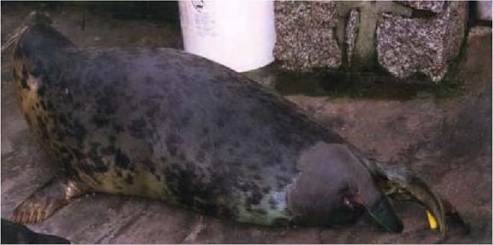
FIGURE 29.3 Grey seal (Halichoerus grypus) showing severe necrotic lesions of the flipper caused by a bite wound from which Mycoplasma phocicerebrale was isolated.
M. phocicerebrale and novel Mycoplasma species were isolated from harbour porpoises and a Sowerby’s beaked whale (Mesoplodon bidens) that had died following strandings on the Scottish coast; unusually one novel strain was isolated from the kidney of the whale(36). Many of these cetaceans had pneumonic lesions, suggesting a pathogenic role for mycoplasmas.