PORCINE PARVOVIRUS INFECTION IN WILD BOAR
CHRISTIAN GORTAZAR
IREC National Wildlife Research Institute (CSIC- UCLM- JCCM), Ciudad Real, Spain
Porcine parvovirus (PPV) is classified in the genus Parvovirus. This ubiquitous and resistant virus causes porcine parvovirus infection, a transmissible infection producing reproductive losses in pigs and Eurasian wild boar (Sus scrf)(30).
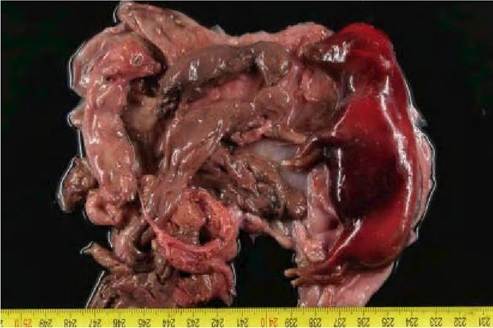
FIGURE 12.2 European wild boar, Spain, abortion and reproductive losses caused by porcine parvovirus infection. The abortion material has several mummified fetuses, which have died at different gestational ages. This type of loss is characteristic in PPV abortions in domesticated pigs.
PPV has a worldwide distribution. In wild boar and feral pig populations, seroprevalence ranges from 14 to 77%. It is highly transmissible and exhibits high seroprevalence at high population densities.
The infection is acquired by the oronasal, transplacental and venereal routes. In immune adult animals, the reproductive losses are generally not seen; however, the tropism of the virus for the reproductive tract in naive females may lead to mummified fetuses, resorptions and abortion (Figure 12.2), particularly in their first pregnancy and when infection takes place before mid- gestation. Acute infection of postnatal pigs is usually subclinical(30). Maternal antibodies last for about 3 months(31).
No lesions are detected in PPV-infected adult animals. Affected wild boar fetuses appear oedematous, and may show marked differences in size.
Screening is based on serum antibody detection (e.g. ELISA). PCR or virus isolation are the main antigen detection tools, frequently used on mummified fetal tissues.
Risk factors include fencing and feeding of wild boar populations, increasing density and spatial aggregation, and hence the risk of disease transmission. Natural management is therefore preferred.
Contact with PPV has been linked with lower ovulation rates in wild boar(32). PPV infection can be associated with post-weaning multisystemic wasting syndrome (PMWS), possibly triggering this disease in some cases. As PPV seroprevalences are usually higher in domestic pig herds than in wild boar populations, it is unlikely that the wild boar will frequently act as a PPV reservoir for domestic pigs. Nevertheless, transmission between domestic and wild populations could take place in both directions.