Protozoal Infections
Molecular methodology has unveiled the complexity of unicellular organisms to the point that the term protozoa is no longer strictly valid. Nevertheless, we use the term loosely in its historical context to collectively cover eukaryotic parasitic unicellular organisms.
As in other rodents covered in this text, rats are host to numerous commensal protozoa in their alimentary tract. Wild, pet, and laboratory rats are variably colonized by Giardia muris, Spironucleus muris, Hexamastix muris, Chilomastix bettencourti, Tritrichomonas muris, Tritrichomonas minuta, Tetratrichomonas microtii, Pentatrichomonas hominis, Entamoeba muris, Balantidium coli, and others. All of these agents are essentially nonpathogenic commensals. Sporozoa are eukaryotic parasites that belong within the phylum Apicomplexa, members of which are defined by the presence of an apical complex that is utilized for penetration and infection of host cells. Rat sporozoa include Hepatozoon muris, Toxoplasma gondii, Hammon- dia hammondi, Sarcocystis spp., Frenkelia spp., and several species of Eimeria. Although some of these agents have been recognized in laboratory rats, particularly decades ago, none are overtly pathogenic in rats under natural conditions.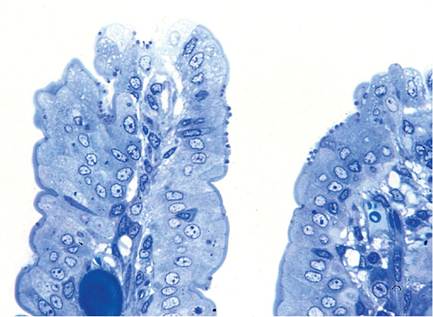
FIG. 2.48. Epon-embedded section of villus from a young rat infected with Cryptosporidium sp. Note the trophozoites embedded within the brush border.
More medical literature on Medic.Studio
More on the topic Protozoal Infections:
-
Infectious diseases -
Internal diseases -
Obstetrics and Gynaecology -
Pediatrics -
Veterinary medicine -
-
Conflictology -
Ecology -
Economy -
Finance -
History -
Law -
Medicine -
Philosophy -
Religious studies -