Rotavirus Infection: Infectious Diarrhea of Infant Rats
An epizootic of diarrhea in infant rats known as infectious diarrhea of infant rats (IDIR) has been attributed to a group B rotavirus that is morphologically identical but antigenically distinct from most previously characterized (group A) rotaviruses.
The agent is probably of human origin. Following oral inoculation of suckling rats, recipients developed diarrhea within 24-36 hours. Transient growth retardation, cracking and bleeding in the perianal region, and drying and flaking of skin were typical clinical signs. Rats were susceptible to experimental infection at all ages and to disease up to 12 days of age. They were resistant to clinical disease after 2 weeks of age. The stomach usually contained milk curd, with watery contents in the proximal small intestine. The distal small intestine and large intestine contained yellow-brown to green fluid and gas. Microscopic changes included intestinal villus attenuation, necrosis of enterocytes, and pathognomonic epithelial syncytia (Fig. 2.18). Changes were most evident in the ileal region. Eosinophilic intracyto- plasmic inclusions were variably present in syncytia. Viral antigen could be demonstrated in small intestinal enter- ocytes and rarely in colonic epithelium, but only for 1-2 days. Viral precursor material and rotaviral particles were visualized in cells by electron microscopy. The IDIR agent is probably of human origin, and inoculation of suckling rats with human isolates of group B rotavirus resulted in diarrheal disease identical to IDIR. IDIR has not been reported since the initial observation, but the potential for re-emergence remains, since the agent was likely of human origin.Reovirus Infection
Rats, in addition to a wide variety of other mammals, frequently seroconvert to reovirus, but natural or experimental disease does not occur in this species. Mice are the only laboratory animals that are susceptible to reo- virus-induced disease.
Endogenous Viral Integrations
Rats, like mice, hamsters, guinea pigs, and other species, are infected with endogenous retroviruses, which are
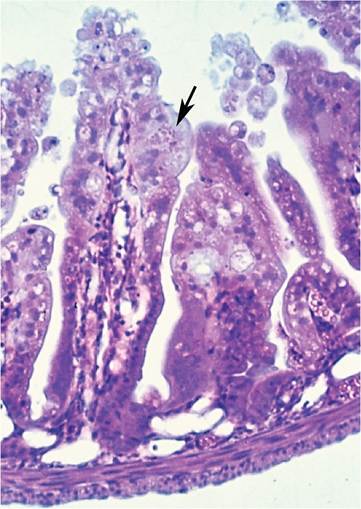
FIG. 2.18. Distal small intestine from a suckling rat following inoculation with rotavirus (IDIR virus). Note pathognomonic syncytia (arrow). (Source: S. Vonderfecht.)
transmitted vertically as provirus sequences in the genome. These viruses are of minimal practical significance but have been manipulated experimentally by combining with murine leukemia viruses and other rat leukemia viruses to form defective rat sarcoma viruses. Common laboratory sarcoma viruses of rat origin include the Harvey and Kirsten sarcoma agents. In addition, multiple Borna virus and parvovirus integrations have also been found within the genome of rats. The significance of endogenous viral integrations is minimal, but may influence PCR analysis for detection of parvovirus infection.
Viruses of Emerging Potential Astrovirus Infection
Astroviruses have recently been found to be common among laboratory mice without clinical signs. Although not yet described among laboratory rats, astroviruses have been found in wild urban rats in Asia. Astroviruses are a major cause of gastroenteritis in humans, and the rat agent that was described appeared to be closely related to human isolates, based upon genetic sequencing.
Hepatitis E Virus
Recently, hepatitis E virus has been detected serologically and by PCR in wild rats in Europe, Asia, and the United States. The genotypes appear to be unique and distantly related to other known hepatitis E strains. Their significance as human pathogens has not been ascertained, but infectivity to rhesus macaques was not shown. Laboratory rats inoculated with a Los Angeles isolate developed mild focal necrotizing hepatitis and portal inflammation. The significance of hepatitis E virus in rats, its zoonotic potential, and prevalence in pet or laboratory rats remain to be determined.