SYNCHRONISATION OF OESTRUS
As the words suggest, synchronisation of oestrus means that the oestrous cycle is manipulated so that all the cows or heifers in a group come bulling at the same time, and they can then all be inseminated on the
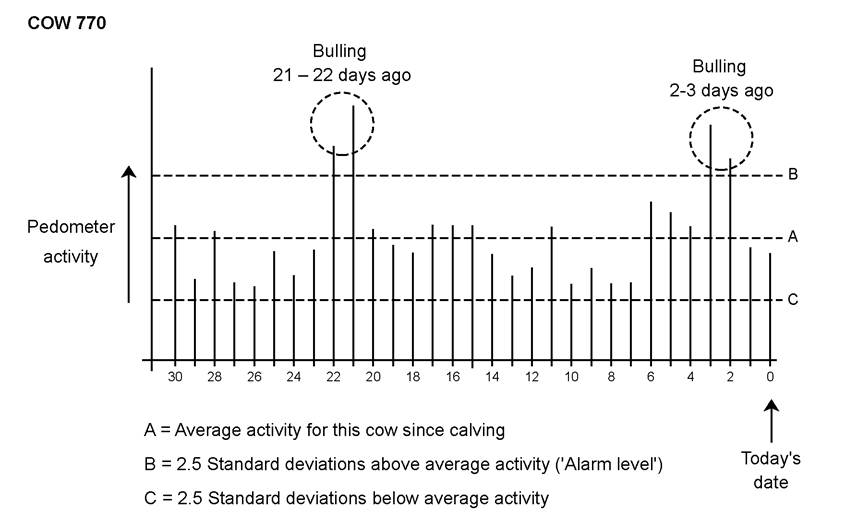
Figure 8.15.
Heat detection using the pedometer shown in Plate 8.19. Note the increased activity at days -3 and -21.same day. Synchronisation therefore removes the need for heat detection. It can be a very useful technique for heifers. If they are running outside, insemination on one day makes handling much easier, and batch calving can also be a big advantage. Using Holstein-Friesian semen means that an additional group of Holstein-Friesian heifer calves may also be available, and this is especially useful in an expanding herd. The two main products used in synchronisation are prostaglandin and progesterone releasing devices.
Prostaglandin (PG)
Prostaglandin (PG) acts only if the cow is cycling normally and when she is between days 5 and 15 of her cycle. An injection of PG dissolves the corpus luteum, progesterone levels fall and the cow comes bulling 3 or 4 days later. The hormone sequence is shown in Figure 8.4. Unfortunately the period between administration of PG and oestrus is not precise. This is partly due to the variation in response caused by the presence or absence of mid cycle follicular waves. The use of GnRH 2 days after the prostaglandin injection, followed by AI on the third day, has been shown to improve the synchrony between prostaglandin injection, ovulation and AI and will give better conception rates.
Two injections of PG are needed to synchronise oestrus in a group of cows or heifers, the second being given 11 days after the first. The reasons for this are shown in Figure 8.16 and are as follows: At any one time the cows will be at varying stages of their cycle, from 0 to 21 days, so following the first injection only those at 5-15 days of their cycle will respond, to come bulling 3-4 days later.
The second injection for synchronisation is given 11 days after the first, and Figure 8.16 shows the various stages of the cycle which the cows will be spanning at that stage. Cows which were originally at 0 and 4 days will now be at 11 and 15 days of their cycle respectively. Cows which responded to the first injection came bulling in 3-4 days, so after 11 days they will be 7-8 days into their next cycle (11 - 3 = 8 days). The cows which were originally at 16 days did not respond to the first injection, but came bulling naturally 5 days later, so after 11 days they are 11 - 5 = 6 days into their next cycle. Similarly, those cows originally at 21 days will
be 10 days into their next cycle. From this it can be seen that 11 days after the first injection, all of the cows in the group will be between 6 and 15 days of their cycle and are therefore sensitive to prostaglandin. Following the second injection they will all come bulling within 3 or 4 days and the group can be inseminated on both days.
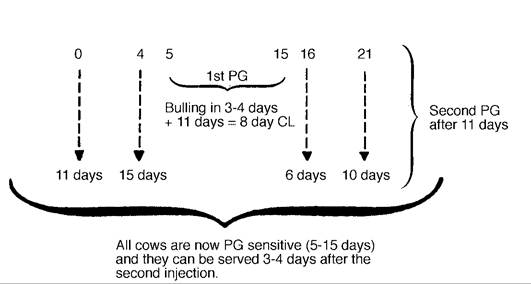
Figure 8.16. Prostaglandin synchronisation of heat.
An alternative is to give one insemination after 78-80 hours. Although this may result in a very small reduction (e.g. 3-4%) in conception rate, it is probably much less than the cost of an additional insemination.
The above describes the standard way of using prostaglandin for synchronisation, but there are several alternatives. For example, in a group of randomly cycling heifers, at any one time half will be between days 5 and 15 of their cycle and therefore sensitive to prostaglandin. Consequently, if the whole group is injected on day 1, half will come bulling on days 4 and 5 and with careful heat detection they can be served. Continue serving on sight until day 11. All unserved animals can then be given a second injection. These animals should come on heat on days 14 and 15 and again can be served on sight, perhaps with the additional use of Kamars.
It is best to discuss the system most suitable for your herd with your vet.Progesterone Releasing Devices (PRDs)
The various types of progesterone releasing devices (PRDs), their mode of action and their site of insertion (intravaginal or subcutaneous) were described on page 238. The cost of a PRD is approximately the same as two injections of prostaglandin (PG). The PRD is more difficult and therefore more expensive to administer; however, only one veterinary visit is required, since the herdsman normally removes the PRD, whereas two visits are required with prostaglandin. On a cost basis, therefore, the two treatments are approximately equal. Prostaglandins act only on cows which are already cycling, whereas a PRD will also stimulate ovarian activity and may cure any cysts present.
Probably the best synchronisation is achieved by a combination of PG and PRD, that is by injecting PG one day before the PRD is removed. Remove the PRD, wait one day and serve the following day. Intravagi- nal PRDs may cause a white, foul-smelling discharge in a proportion of animals. This is of vaginal and not uterine origin, and it is due to irritation by the PRD. It does not seem to have any effect on conception rate even though it looks rather unpleasant, and in most cases the discharge disappears a few days after the PRD has been removed. Occasional animals develop a severe vaginitis and the PRD has to be removed early.
Effective Synchronisation
Whichever system is used, there will be a small proportion of animals which fail to synchronise. The problem is worse with cows, because their normal cycle lengths are much more variable. Only 90% of normal cows have cycle lengths of 18-24 days. In other words, 10% of quite normal cows have cycles of less than 18, or more than 24 days. The enthusiastic reader might like to substitute these cycle lengths for those in Figure 8.16 and see for himself how a proportion will then fail to synchronise! If you are sure that a cow is standing to be mounted 1 or 2 days after she has already received a double AI, then she must be inseminated for the third time, because she clearly failed to respond to the synchronisation process.
Synchronisation of oestrus has provided a useful opportunity to study some of the factors affecting conception rate. Very good results are possible, but to ensure good fertilisation and implantation, it is essential to
ensure that the animals are on a rising plane of nutrition from 4 weeks before insemination, until 3 weeks after. Grazing heifers, or those on hay or silage, should be supplemented with 1.5-2 kg of barley or other cereals, and early lactation feeding of dairy cows needs to be such that weight loss over this period is minimised. Stress should definitely be avoided, so the idea of inseminating the heifers when they are being handled for worming or tuberculin testing is definitely not on; neither should they have their ration suddenly changed (for example, with housing) part way through the treatment.
Table 8.4. Comparing the theoretical performance of normal observation and synchronisation in 100 cows at the start of the service period.
| Heat detection rate (%) | Conception rate (%) | Cows pregnant after 3 weeks | |
| Observation and AI | |||
| Good heat detection | 80 | 60 | 48 |
| Poor heat detection | 50 | 60 | 30 |
| Synchronisation and AI | 95 | 55 | 52 |
When synchronisation was first introduced, a few people expected it to be a cure-all; insufficient attention was paid to husbandry, poor results were obtained and the technique fell out of favour. Because of the problems of heat detection, however, it can be an excellent way of starting the service period to get good batch calving, and trials have shown that it is cost-effective to do this. Table 8.4 shows the theoretical performance of 100 cows with good heat detection (80%) and conception (60%) rates. Even then, only 48 cows (100 x 0.8 x 0.6) would be pregnant at the end of 3 weeks.
If synchronisation was used, there may be a small proportion of cows which fail to respond (say 5%) and conception rates may fall slightly (again, say 5%) but the overall performance at the end of 3 weeks is significantly better. If heat detection was poor (say 50%), then Table 8.4 shows that the benefits of synchronisation are considerably greater. In fact if heat detection was poor, conception rates would also be poorer for the reasons given on page 264, and so even fewer than 30 cows would be pregnant after 3 weeks.Use of synchronisation in heifers
One of the most important aspects of maintaining a tight calving pattern is to introduce heifers into the herd at the start of the calving period. With the almost unavoidable problems of early lactation weight loss, it is only too easy to let cows ‘slip’ around the year a few weeks, and it is therefore logical to introduce heifers into the herd in a tight batch as early as possible. Oestrous synchronisation helps to achieve this. In addition, if Holstein-Friesian semen is used, the heifers will produce a valuable extra crop of heifer calves. These calves are being born at the very start of the calving season so that when they are introduced into the herd 2 years later they will be well grown, better able to compete with the cows and will probably get back in calf faster in their first lactation. Although calves from heifers may be smaller, there is good evidence to suggest that most of the size difference is made up during rearing. One survey showed that heifers reared from heifers gave more milk than heifers reared from cows:
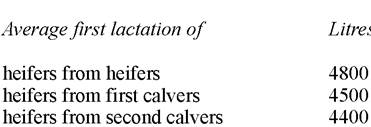
These yields are very low if compared to the modern Holstein-Friesian heifer, but the figures serve to emphasise the point. The difference is considerably more than would be expected from the normal rate of genetic improvement, although the reason is unknown.
Provided the bull is carefully selected and the heifers are well grown (see Chapter 5), there are no more problems calving heifers at 2 years than when they are older.
In fact, almost the reverse is true in that it is the bigger heifer which can attain a higher forage intake that is more likely to get overfat and| Age at Calving 2 years old | 3 years old | 3+ years old | |
| % calving problems | 16 | 13 | 22 |
| % calf mortality | 12 | 12 | 28 |
| % conception to first service | 69 | 55 | - |
| % not conceiving | 5.5 | 11.4 | - |
| Lifetime production | |||
| number of lactations | 4.00 | 3.84 | 3.78 |
| (i.e. average life in a herd) | |||
| total milk production (litres) | 18,708 | 17,927 | 17,621 |
Adapted from Esslemont, Baille and Cooper, Fertility Management in Dairy Cattle.
Table 8.5. Heifers calving at 3 years old have more calving problems, are more difficult to get back in calf in their first lactation and have an overall lower lifetime production than 2-year-old calvers.
produce an oversized calf, especially if she is fed concentrates pre calving in addition to liberal intakes of grass. Table 8.5 shows that not only does the older heifer have more calving problems, but she also has poorer subsequent fertility and an overall lower lifetime production than a heifer calving at 2 years old. If proven bulls are used, there is also a good argument that obtaining an additional crop of Holstein-Friesian heifer calves from heifers is increasing the rate of genetic selection by one generation. However, as the heritability of milk production is only 45%, it may be more profitable always to introduce well-grown heifers into the herd at the start of the calving season rather than trying to get a Hol- stein-Friesian calf from a late calver just because she is a high yielder.