The Epidemiology of BTB in Cattle in Cameroon
There are indications that the prevalence of BTB in Cameroon differs substantially between its regions. The reasons for these differences are not well understood and need further investigation.
Generally, the gathering of animals at communal sites, mixing of different age groups (adult and aging), stressors such as adverse environmental factors, and long trekking to grazing and drinking spots are some of the major factors that appear to influence the prevalence and distribution of BTB in cattle in the country. Further factors that may affect its prevalence include the lack of application of quarantine measures; uncontrolled animal movement and smuggling of live animals from neighboring countries like Nigeria, Chad, and the Central African Republic where BTB is widespread (Cadmus et al. 2006; Diguimbaye et al. 2006a; Muller et al. 2009); and the mass influx of refugees and their livestock (displacement of human and animals resources) due to social unrest and civil wars in neighboring countries.In Cameroon, many conditions favor the occurrence and spread of BTB in cattle (Awah-Ndukum et al. 2014; Kelly et al. 2016). For example, over 84% of cattle live to a very old age, and over 70% of cattle are kept in moderate to large herds, and in traditional, extensive (38%) or semi-extensive (58%) management systems. Many cattle trek at least 5 km daily for grazing and drinking (60%), and there are ample inter-herd intermingling and animal-animal contact (99%) when individual herds of the same or different owners come together (Table 12.2).
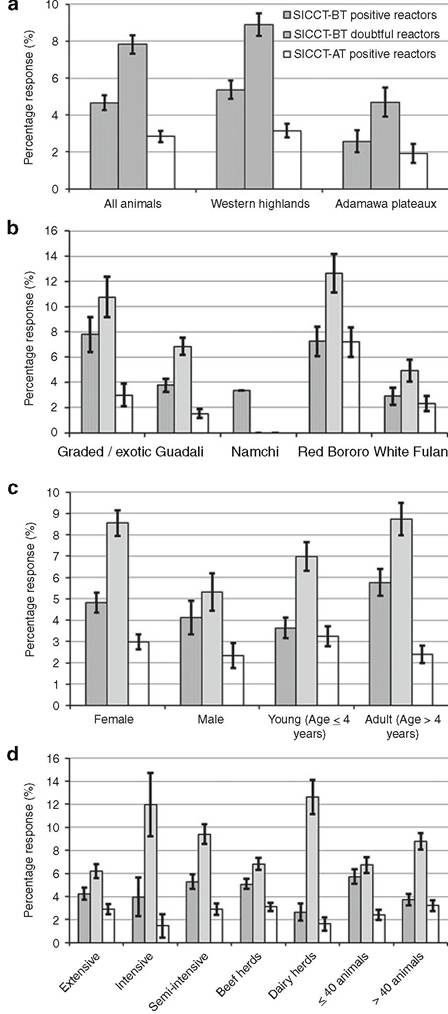
There are perceptions of apparent resistance of some of the indigenous African breeds in Cameroon to contracting BTB (Inangolet et al. 2008; Ameni et al. 2006; Oloya et al. 2006), although the prevalence of BTB in the predominantly zebu breeds of Cameroonian cattle still appears to be high. A lower prevalence of BTB was recorded in the Namchi, Gudali, and White Fulani breeds, compared to the Red Bororo cattle, suggesting that some of the local breeds may have a degree of innate resistance or tolerance to the disease.
There are similar differences between the Gudali and Fulani breeds (Egbe et al. 2016). The reasons for the perceived resistance to BTB of local breeds may be more complex and include the possibility of reduced virulence and infectiousness of the causative agent, perhaps because of M. bovis being exposed to the effects of the harsh tropical climate (Oloya et al. 2006).The burden of BTB is higher in the Northern Regions than in the Northwest (Fig. 12.1; Table 12.1), the odds of detecting gross TB lesions in carcasses being 4 times higher in cattle originating from the Northern Region compared to those
Table 12.2 Herd management and practices (values are in percentages)
| Variable | Contact with other herd (ιι = 318: Yes = 315, No = 3) | Average daily trekking distance (n = 316: ADP = 208, WHC = 108) | Husbandry system (ιι = 347: AD = 228, WHC= 119) | Reasons for removing cattle (ιι = 295: ADP = 199, WHC = 96) | ||||||
| Long OlO km) | Moderate (5 km - ≥ 10 km) | Short (< 5 km) | Extensive | Semi- intensive | Intensive | Old age | Income generation | Poor productivity | ||
| Highland region | ||||||||||
| ADP | 100.0 | 0.0 | 69.2 | 30.3 | 14.0 | 82.0 | 3.9 | 87.9 | 6.5 | 40.7 |
| WHC | 96.8 | 24.1 | 17.6 | 59.3 | 84.0 | 12.6 | 3.4 | 77.1 | 40.6 | 45.8 |
| Total | 99.1 | 8.2 | 51.58 | 40.2 | 38.0 | 58.2 | 3.7 | 84.4 | 17.6 | 42.4 |
Occupation
| Breeder | 98.9 | 9.2 | 53.6 | 36.0 | 38.1 | 57.9 | 4.0 | 84.9 | 17.9 | 39.8 |
| Butcher | 100 | 50.0 | 0.0 | bgcolor=white>50.066.7 | 0.0 | 33.3 | 50.0 | 50.0 | 50.0 | |
| "Buyem sellem,' | 100 | 0.0 | 0.0 | 75.0 | 71.3 | 28.6 | 0.0 | 66.7 | 50.0 | 50.0 |
| Herdsmen | 100 | 0.0 | 46.9 | 53.1 | 32.2 | 66.1 | 1.7 | 86.1 | 8.3 | 58.3 |
Educational level
| None | 99.5 | 7.0 | 58.1 | 34.9 | 29.8 | 53.9 | 0.4 | 89.4 | 11.8 | 37.6 |
| Primary | 98.9 | 9.9 | 50.5 | 39.6 | 39.5 | 54.1 | 5.5 | 79.3 | 23.9 | 38.0 |
| Secondary | 96.0 | 14.8 | 22.2 | 63.0 | 50.0 | 38.2 | 11.8 | 50.0 | 50.0 | 50.0 |
| Postsecondary | 100 | 100 | 0.0 | 0.0 | 40.0 | 60.0 | 0.0 | 60.0 | 40.0 | 60.0 |
| Not indicated | 100 | 0.0 | 0.0 | 100 | 28.6 | 42.9 | 28.6 | 0.0 | 100.0 | 0.0 |
ii total number of respondents, ADP Adamawa Plateau, WHC Western Highlands (Awah-Ndukum et al. unpublished; Awah-Ndukum et al.
2014)from the Northwest Region (Egbe et al. 2016). A number of factors may affect this distribution, such as the uncontrolled movement of cattle in the Northern Regions, including those from neighboring countries that are BTB-infected. Elsewhere, such as in the Western Highlands and Far Northern Regions, continuous close contact between animals due to increasing animal and human population densities, and limited grazing, influence the prevalence. A lower prevalence has been recorded in regions with lower population densities, abundant natural pasture, and low herd-herd (animal-animal) contact (Awah-Ndukum et al. unpublished data).
Though intensive husbandry practices create favorable conditions for BTB transmission by providing opportunities for closer and prolonged contact between animals than those in extensive management systems (Ayele et al. 2004; Inangolet et al.
2008), in Cameroon, more BTB-positive reactions to tuberculin tests were recorded in animals kept under semi-extensive management compared to the other systems. In the extensive and semi-extensive systems, increased transmission of BTB can result from close contact, particularly during periods of drought, between animals sharing common grazing, water, and salt licks. Additionally, the intermingling of animals from different regions at cattle markets or during veterinary interventions may also enhance transmission of the infection (Ayele et al. 2004).
An important feature of BTB in Cameroon is the higher prevalence of the disease recorded in beef compared to dairy cattle, and in small compared to large herds (Fig. 12.3). This seems to result from fewer sources of M. bovis, or the absence of diseased cattle in dairy herds, and reduced contact between animals in the large herds that are usually managed in extensive farming systems. The characteristics of the traditional pastoral systems in the tropics, such as close contact between animals in shared microenvironments, as animals gather at the few watering points and saltlicks, or congregate under trees or shaded areas to protect them from the intense tropical ambient temperatures, mimic conditions created by intensive management systems (Ayele et al.
2004). These conditions often create increased opportunities for nose-to-nose and mouth-to-mouth contact between cattle, and enhance transmission of the disease.Another important factor that favors the spread of BTB in the traditional pastoral husbandry system, is the high mobility of cattle herds, crisscrossing the regions during transhumance. Environmental stress associated with this movement and the ensuing mixing of transhumant and semi-intensive resident herds in the village, wildlife, and other domestic species create ideal conditions for exposure to and widespread transmission of M. bovis.
Although a wide diversity of wildlife and a vast livestock-wildlife interface exist in Cameroon, no data are available about the occurrence of BTB in its wildlife. Neither is there any information about the disease in the other economically important domestic species such as pigs, sheep, and goats. Several of these species, including wildlife, have been reported to serve as maintenance hosts for BTB in other countries (Courtenay et al. 2006). The need for a comprehensive investigation of the status of BTB in Cameroon, including establishing specific herd- and animallevel risk factors and identifying the maintenance hosts of the infection, and its zoonotic importance cannot be overemphasized.
Fig. 12.3 Single intradermal comparative cervical tuberculin skin test (SICCT) responses according to (a) study location, (b) breed, (c) sex and age group, (d) management systems, and herd sizes (Awah-Ndukum et al. unpublished data)
12.5