Control of BTB in Cameroon
Although BTB has enormous public health significance, it is a neglected zoonosis in Cameroon. Governmental resources are inadequate for monitoring animal diseases including the zoonoses, and the private sector lacks the necessary capacity and resources to assume or to share the responsibility.
Implementation of existing legislature governing BTB is poor. The existing control programs are poorly applied, and the control of BTB is mainly dependent on the regulation of animal movements and by the postmortal examination of carcasses for the presence of tuberculous lesions. Further constraints include the poor execution of a number of activities: regular tuberculin testing and the removal of positive reactors, strict meat inspection and removal of suspected lesions, tracing tuberculous cases to farms or areas of origin, and restricting the movements of infected animals. There is also an absence of the application of broad hygienic and biosecurity measures reflecting deep-seated problems with respect to inter-institutional veterinary and medical collaboration causing them to not best serve the needs of society.
There are attitudinal problems by stock owners too in controlling the disease. Many cattle owners endeavor to increase their livestock numbers (increasing the size of their “living banks”) but are unaware of the negative impact of BTB on animal productivity and health such as economic loss, lower production, and poor animal health (Table 12.3). Not many stockmen (≈30%) can recognize the presence of BTB in their or adjacent herds, and most cattle owners (>86%) report that they do not implement known control measures to deal with the disease in their communities that are predominantly rural in “seminatural” or “semi-wild” areas (Table 12.4). They do, however, accept condemnations at abattoirs as an acceptable governmental measure to remove BTB-infected animals from the food chain.
Tuberculin skin testing and the elimination of infected animals (test-and-slaughter) that have been used effectively in other parts of the world (Good 2006; Pavlik 2006) are not practicable in Cameroon because of the lack of compensation when infected animals are slaughtered. Instead, testing and segregation of positive reactors, with phased slaughtering of the infected animals, could be economically and technically achievable as an alternative to the conventional test-and-slaughter method (WHO 1994). In the interim, there is a need to intensify meat inspection for the detection of BTB, to maintain reliable abattoir records, and to validate the various diagnostic tests used for screening live cattle for the presence of BTB in Cameroon.
There is an urgent need for a multidisciplinary approach in Cameroon, based on the “One Health” philosophy (Kahn et al. 2007; Vallat 2009), to control BTB. Specific activities in this regard include enhancing public awareness through continuing education of cattle owners, medical and veterinary professionals, and the general public on the potential risk of BTB, proper food (animal products) handling, good husbandry practices, personal hygiene, and maintaining a healthy environment. Restricting movements of BTB-infected herds, cooperative efforts by veterinary and medical personnel to maximize TB detection rates, engaging the populations at risk, and good health surveillance systems are essential activities that should be implemented to ensure effective control of the disease in humans and animals.
Table 12.3 Factors affecting meat/milk consumption habit of cattle owners (values are in percentages)
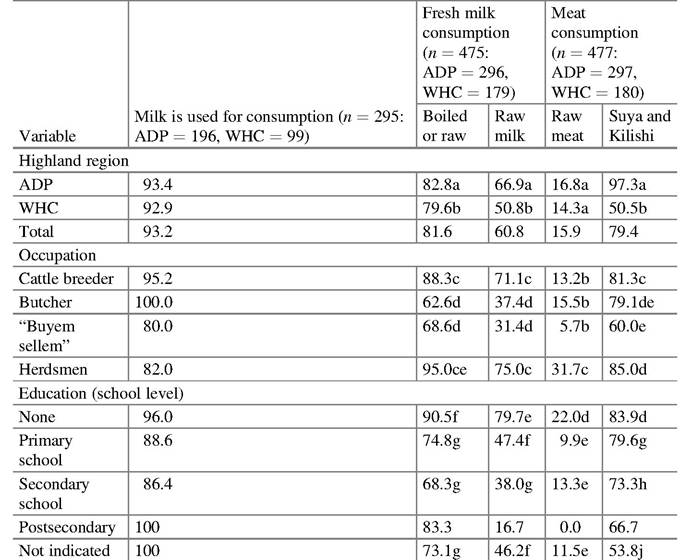
n = total number of respondents, ADP Adamawa Plateau, WHC Western Highlands, a-k: different letters in the same column are significantly different (P < 0.05) (Awah-Ndukum et al. unpublished data; Awah-Ndukum et al. 2014)
12.6
More on the topic Control of BTB in Cameroon:
- The Epidemiology of BTB in Cattle in Cameroon
- Prevention and Control of BTB
- Challenges for the Control of BTB in Tanzania
- Control of BTB in Ethiopia
- Control of BTB in Burkina Faso
- Prevention and Control of BTB in Sudan
- BTB Control in Cattle in South Africa
- Control of BTB in Free-Ranging Wildlife
- BTB Control in Wildlife
- Chapter 19 BTB Control Strategies in Livestock and Wildlife in South Africa
- Current Status of Human Tuberculosis in Cameroon
- Zoonotic (M. bovis) TB in Humans in Cameroon
- Bovine Tuberculosis in Animals in Cameroon
- Chapter 12 The Status of Bovine Tuberculosis in Cameroon
- Historical Perspective of BTB in Nigeria
- Reasons for Controlling BTB
- Sample Position Description—Critical Care Transport Medical Control Physician (also known as Medical Control or Command Officer)