The testis
The testis is the male gonad, with functions as follows:
To produce spermatozoa (sperm > by the process of spermatogenesis: these fertilise the ova produced by the female
To produce fluid to transport the sperm from the testes into the female tract and to aid their survival To secrete the hormone testosterone which influences spermatogenesis, the development of male secondary sexual characteristics and male behaviour patterns (see Ch.
6).There is a pair of testes which, in the adult animal, lie outside the body cavity in the scrotum. - a sac of relatively hairless and often pigmented skin. Spermatogenesis occurs most efficiently at temperatures below that of the core body temperature, so the testes are carried outside the body cavity in a C(M)Ierenvironment. In the dog. the scrotum lies between the hindlegs: in the cat it is attached to the perineum, ventral to the anus. Internally, the sac is divided into two. each part containing one testis: the left testis often hangs lower than the right one. Within the wall of the scrotum is the Dartos muscle. In cold weather this contracts and thickens the scrotal skin, raising the temperature: in warm weather, the muscle relaxes and the scrotum becomes thinner and thus cooler. /X constant temperature for spermatogenesis is therefore maintained.
Each testis is an oval-shaped structure wrapped in a double layer of peritoneum known as the tunica vayi- nalis(V∖g. 11.3). The testis tissue consists of numerous blind-ending tubules known as seminiferous tubules which arc lined by two types of cells:
1. Spermatogenic cells ~ these divide by meiosis to produce immature sperm or spermatids; each spermatid contains the haploid number of chromosomes (see Ch. 1)
2. Sertoli cells - these secrete oestrogen and nutrients which prolong the survival of the sperm.
Lying between the tubules are the cells of D,ι∣dig or interstitial cells.
They secrete testosterone and arc under the control of interstitial cell stimulating hormone (ICSFI) (see Ch. 6). produced by the anterior pituitary gland.'t he coiled seminiferous tubules make up most of the testicular tissue and eventually combine to form slightly larger efferent ducts. These drain into the epididymis, lying along the dorsolateral border of the testis. The cauda epididymis or tail is attached to the
caudal extremity of the testis and is the point at which the temperature of (he testis is lowest. It is here that sperm are stored and undergo a period of maturation ready for fertilisation (Fig. 11.4).
The blrosthitis and it results in a greenish-yellow discharge.The condition is so common that it is considered almost normal and is usually only treated if the mucous membrane becomes ulcerated or smelly.
The distal part of the penis is contained within a sheath of hairy skin known as the prepuce. This is suspended from the ventral abdominal wall and covers and protects the penis. It is lined with mucous membrane and is well supplied with lubricating glands. During mating, the prepuce is pushed back to reveal the glans penis. Afterwards, the retractor penis muscle pulls the penis back into the prepuce.
The tomcat
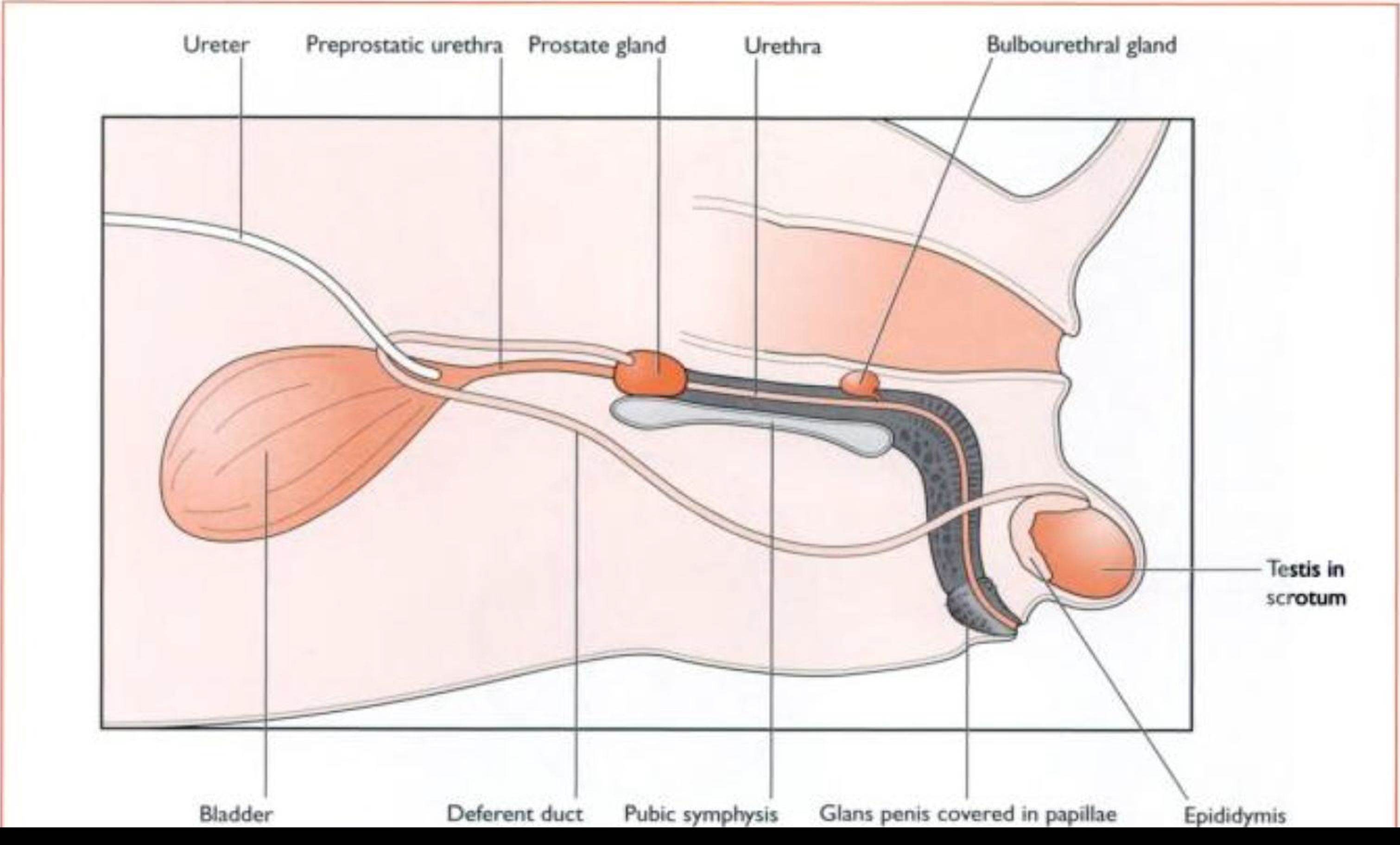
The main parts of the penis are similar to those of the dog. except that the cat penis is shorter and points backwards - the external opening is ventral to the anus (Fig. 11.2). The glans penis is covered with tiny barbs, which elicit a pain reflex as the male withdraws from (he female after mating. This stimulates the nerve pathway to the hypothalamus, resulting in ovulation approximately 36 hours later - known as inducedovulation. The os penis lies ventral to the urethra in the cat. During sexual excitement, the penis engorges and points Craniovenlrally so that the mating position in cats is similar to that seen in the dog.