Water: The universal solvent
Because mammals are composed largely of water (~70%), cellular biochemistry is governed by interactions of physiologically important molecules and water of the cell cytoplasm, the water surrounding the cells (interstitial fluid), or the aqueous environment of various cellular organelles.
We all appreciate, at least in a general sense, that water is essential to our survival. But remembering some of the physicochemical attributes of water emphasizes its physiological relevance. Water is an excellent solvent for many but not all physiologically important molecules. Blood plasma, which is about 90% water, transports a myriad of dissolved nutrients (e.g., glucose, amino acids), minerals (e.g., Na, Cl, and K), and gases (e.g., O2, CO2). Intra- and intercellular water is similarly filled with solutes. The urinary system maintains body water reserves to ensure that blood pressure and volume are adequate and that proper osmolality is maintained.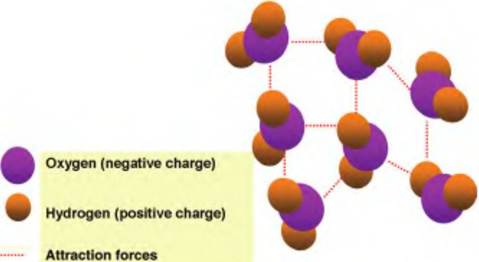
Fig. 2.1. Hydrogen bonds and water.
Water is touted as the biological universal solvent— but why? The answer lies in its abundance and structural properties of the water molecule. The chemical formula for water (H2O) is well known, but Figure 2.1 illustrates that water has a distinct dipole moment. This means that there is unequal sharing of electrons between the oxygen and hydrogen atoms of the molecule so that the molecule is polarized. The oxygen atom, because of its greater capacity to attract electrons, has a slight negative charge. The hydrogen atoms therefore have a slight positive charge. This polarity causes the water molecules to arrange themselves so that they form hydrogen bonds (opposite charges attract). Hydrogen bonds, while weak compared with covalent chemical bonds, are very important physiologically because of their abundance.
They also are important in attractions between many macromolecules. For example, the two strands of intact DNA are held together by hydrogen bonds between base pairs.Because of its dipole moment, there is a net negative charge associated with the oxygen atoms of the water molecule. This charge separation allows water molecules to organize to form attractant bonds with other water molecules. This property explains many of the attributes of water as the so-called universal solvent and the ability of other polar molecules to readily dissolve in water.
This attribute explains the commonsense example of oils not dissolving in water. Most common oils or lipids are composed of hydrocarbon chains that exhibit equal sharing of electrons between atoms and therefore are of little or no polarity. Such nonpolar molecules cannot associate with water and are described as hydrophobic (water-fearing molecules). Polar molecules, in contrast, readily associate with water and are described as a hydrophilic (water-loving molecules). Interestingly, many cellular and tissue macromolecules have both hydrophobic and hydrophilic regions. For example, the three-dimensional shape of a protein in the cell is determined by physicochemical forces that act to shelter groupings of hydrophobic amino acids away from water while at the same time allowing hydrophilic amino acids' hydrogen bonding interactions with water. This fundamental property of water means that it can form highly oriented layers or shells around charged areas of large macromolecules, for example, nucleic acids, proteins, or proteoglycans, and thereby impact structure, organization, and function. Biochemists can take advantage of these properties to isolated macromolecules from homogenates of tissues or cells. For example, if the shielding of protein or nucleic acid charges by water is reduced by adding a water-miscible solvent that reduces hydrogen bonding, proteinprotein or nucleic acid interactions are enhanced, and precipitation of the macromolecules occurs. This is often achieved by the addition of ethanol or acetone.
Other physiologically important properties of water include specific heat, thermal conductance, and surface properties. Briefly, water can absorb substantial amounts of heat energy without a drastic change in temperature. Alternatively, a significant amount of heat energy can be lost without a dramatic effect on temperature. This temperature buffering is important since most biochemical processes are temperature sensitive. Evolutionarily, the greater success of warm-blooded mammals compared with cold-blooded animals reflects the appearance of physiological mechanisms to maintain body temperature, and therefore water temperature. Since the water content of animal tissues is so high, the total capacity to store heat energy is correspondingly high. Energy needed to vaporize water is also relatively high. Think of how quickly you feel the cool effect of an alcohol swab on your skin compared with a simple water-moistened swab. This property can be viewed as both an advantage and a disadvantage, depending on the physiological circumstances. In hot environments or with excessive work, thermoregulation depends on sweating or panting in many animals to reduce the thermal load. Too much loss and there is dehydration. New visitors to hot, dry desert environments must be admonished to drink often to make up for unrecognized insensible water losses. Many animals have adapted specialized physiological mechanisms and behaviors to minimize insensible water loss and to maximize efficient use of water. As another example, seal pups reared in polar seas (in many respects a "desert" environment with regard to water availability) depend on water derived from the metabolism of high-fat milk to supply much of their water requirement. Consider the impact of water on accumulation of milk in the mammary gland, blood in the cardiovascular system, or perhaps urine production. There are also numerous moist surfaces on many organs. The surface properties of water also affect fluid movement and the capacity of tissue surfaces to interact.
This phenomenon is evident in the meniscus characteristic of a test tube filled with water.Another commonsense example is the appearance of beads of rainwater on the surface of a waxed car; the wax is very hydrophobic so the molecules of water in the droplet are much more attracted to one another than the nonpolar wax. The spherical shape is a reflection of the physics of attractions between the molecules and the fact that the sphere is the optimal shape to minimize forces. Surface tension describes these forces and is expressed in force per length or newtons (N) per meter. Pure water has a surface tension of 7N∕m, but dilute detergent reduces this to about 4N∕m. Surface properties of water play a critical role in many physiological processes. Surface-acting amphipathic molecules reduce surface tension. These molecules have distinct polar and nonpolar domains. When placed onto a moist surface environment, the molecules disrupt association between water molecules and at liquid-vapor interfaces limit water-to- water connections and thus the strength of the surface tension. For example, the capacity of the lung alveoli to expand in the newborn requires that the surfaces of the epithelial cells lining the internal surface of the alveolar air sacs be coated with a surfactant. This minimizes the attraction of the surfaces and therefore allows expansion. In fact, the surface tension of lung extracts can be as low as 0.5N∕m. Specialized alveolar cells (Type II cells) scattered among the normal epithelial cells secrete surfactant. Production is stimulated by the secretion of glucocorticoids (steroid hormones produced in the adrenal gland), near the time of parturition. Animals that are born prematurely often have respiratory problems because of failed surfactant production.