Boosting global competitiveness in Indonesia: Is Industry 4.0 the answer?
K. Gupta
Australian National University, Canberra, Australia
I. Vierke, A. Ibrahim, J. Suwandi & A. Selowidodo
Politeknik APP, Jakarta, Indonesia
ABSTRACT: The Fourth Industrial Revolution, or Industry 4.0, is coming.
It allows us to further utilize information technology, such as networking and cloud computing, to manufacturing principle. Indonesia responds the wave with the launching of Making Indonesia 4.0. It discloses how Indonesia can utilize Industry 4.0 to boost manufacturing and expand market to a growth-led export level. It claims to help increase GDP growth by 2% from the baseline and improve manufacturing productivity. The plan seems bold especially since Indonesia’s technological readiness is lagged behind and its economy is relatively not open. We argue that the plan is not concise enough in explaining how Indonesia can adopt Industry 4.0 to Indonesian manufacturing. Making Indonesia 4.0 needs to have better indicators and specific action for businesses to make sense of the plan.1 INTRODUCTION
The Fourth Industrial Revolution, which is a combination of information and technology to manufacturing, is big. Germany was the first nation, specifically in 2011, which dubbed the Fourth Industrial Revolution with the term “Industrie 4.0”, which shapes their high- technology vision for 2020 (Hermann et al. 2016). Industrie 4.0 would change the way how we live in the future, and boost economic growth in general (Hermann et al. 2016). This concept then was adopted by World Economic Forum, and generalized the idea with the term “Industry 4.0”. It is only natural for many countries to join the race to develop such plan for themselves, including Japan, China, United States, and ASEAN countries, Indonesia included (Kearney 2018).
Indonesia joins the train. In the early second quarter of 2018, Indonesia launched its own Industry 4.0.
The natural question to emerge is, Will the plan be successful? We review some literatures on the definition of Industry 4.0, and find out what we need Industry 4.0 to succeed. Furthermore, we review Indonesia’s presentation about “Making Indonesia 4.0”, Indonesian’s Industry 4.0. Benchmark from literatures is used to evaluate this plan’s success.This article starts with the concept of Industry 4.0 (in general), including what it means, the challenges, and the opportunities. Second, we briefly describe “Making Indonesia 4.0”. Next, we evaluate whether it will be successful, and we analyze further, how the plan affects business and Indonesia in general.
2 WHAT IS INDUSTRY 4.0?
Since Germany first launched Industrie 4.0, many scholars devote their time and effort to research about this field. However, many stakeholders seem to have diverse understanding on what they mean by Industrie 4.0, especially for non-German-speaking people (Lasi et al. 2014). However, Lasi et al. (2014) and Hermann et al. (2016) are able to neatly summarize the term to a general understanding. Our description of Industry 4.0 mainly focuses on their view. For further discussion, we will use Industry 4.0 to avoid confusion with Germany’s Industrie 4.0.
Industry 4.0 is characterized by quicker “time to market”, personalized products, flexibility, and higher resource efficiency (Lasi et al. 2014). We are seeing a very fast blueprint-to-product time, where design can quickly be marketed to consumers. It also offers personalized products, in a sense that we might no longer see a classification of textile products amid the ability to match the products exactly as the size of a particular consumer. This will, in turn, increase efficiency greatly.
To be called an Industry 4.0 adapter, a factory needs to have four fundamental concepts (Hermann et al. 2016). First, there must exist interconnections among humans and machines. This is the core of cyber-physical system. Second, the factory has to adapt information transparency.
This ensures big and contextualized data for a system to learn and to adapt. Third, decision-making needs to be decentralized to a level where even a machine make decisions. Finally, technical assistance is where high-skilled labor comes, which only needed to fix specific issues.Globally, countries’ readiness in adapting Industry 4.0 varies. Martin et al. (2018) developed a metric called Country Readiness Index (CRI). The index mainly consists of two components, namely structure of production and drivers of production. On a twodimensional Euclidean space, the two components create four quadrants of country archetypes: Leading, High-potential, Legacy, and Nascent. Using this framework, they assess 100 countries on how ready are they in reaping the benefit of Industry 4.0, and divide those countries into four archetypes. Figure 1 shows the graphical position of the countries in the Euclidean space, taken from Martin et al. (2018).
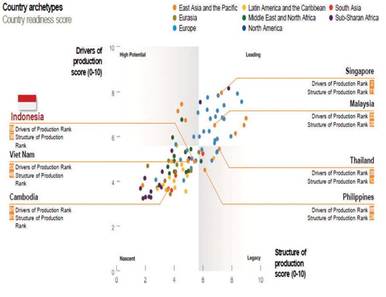
Figure 1. CRI of 100 countries in 4 quadrants.
There are currently only 25 countries, which are ready for Industry 4.0, and are located in the Leader quadrant. Unfortunately, Indonesia is not among them. Indonesia is included in the Nascent archetype, along with Cambodia and Viet Nam (Martin et al. 2018). Indonesia is lagged behind with respect to its neighbors, namely, Philippines and Thailand (Legacy); and Malaysia and Singapore (Leading).
Nascent archetype is the archetype that requires much more catching-up due to many fundamental problems. For Indonesia’s case, the problems are its human capital, R&D spending, limited Internet connection, low-quality infrastructure, and its relatively protected economy. The only driver of Indonesia’s readiness is its high demand amid high population and positive net-export of manufactured goods.
Table 1. Indonesia’s CRI.
| Components | Rank | Score |
| DRIVERS OF PRODUCTION | ||
| Technology & Innovation | 61st | 4.0 |
| Human Capital | 55th | 5.0 |
| Global Trade & Investment | 61st | 5.1 |
| Institutional Framework | 69th | 4.6 |
| Sustainable Resources | 94th | 4.1 |
| Demand Environment | 15th | 6.4 |
STRUCTURE OF PRODUCTION
| Complexity | 73rd | 4.3 |
| Scale | 6th | 7.1 |
Table 1 summarizes Indonesia’s CRI taken from Martin et al.
(2018). Industry 4.0 is not without its problem. According to Marr (2016), some problems related to technologies are data security, and reliable communication between cyber and physical. Maintaining the integrity of a system can also be a hard work, especially in a decentralized, near-fully automated system with smaller human supervision. Industry 4.0 would also raise the bar for skill-intensive producer and labor. Progressive countermeasure towards less tech-savvy producers (such as Small and Medium Enterprises) and low skilled labor should not be taken lightly.3 MAKING INDONESIA 4.0
Indonesia makes sure it is ready for the future and has its own Industry 4.0 plan. On early April 2018, Indonesia held an event called “Indonesia Industrial Summit 2018”, which is the first time Indonesian government introduces the concept called Making Indonesia 4.0. The event was opened by the President and keynoted by mostly ministries in his cabinet. The speak revolves mainly on the ideas of how to implement Making Indonesia 4.0 by each stakeholder (i.e., Ministry of Higher Education on how to build a curriculum supporting Making Indonesia 4.0).
According to Ministry of Industry (2018b), 4IR gives Indonesia the opportunity to not only revitalize its industry, but also the way people do things. With no intervention, there is a good chance of Indonesia’s manufacturing sector to contribute less and less fraction of GDP, compared to the growing service sector (Ministry of Industry 2018b). 4IR is said to help Indonesia to have top 10 highest GDP in the world by 2030, and to have a 10% of GDP worth of net-export (Ministry of Industry, 2018b). The Minister proposes 5 main sectors to be focused on, namely food and beverage, textile and apparel, automotive, electronics, and chemical (Ministry of Industry 2018b).
The Ministry of Industry (2018a) acknowledges 10 fundamental problems. These 10 problems then become 10 national priorities. Later on, these national priorities distributed to other ministries accordingly under a national committee called National Industrial Committee (KINAS).
The 10 national problems are:1. Relies on import for intermediate input.
2. Unoptimized geographical potential.
3. Markets require higher standards.
4. Lagged Small and Medium Enterprises.
5. Weak digital infrastructure.
6. Limited fund.
7. Quantityoverqualityoflabor.
8. LackofInnovationcentre.
9. Not enough incentive to develop 4IR.
10. Uncoordinated policies.
Kearney (2018) discloses some of other countries’ implementation on their own Industry 4.0. In ASEAN region, Singapore, which already started Industry 4.0 since 2015, currently leads. It focuses on robotics and 3D printing. Next, there is Thailand, which has started since 2016. Malaysia is still on its planning phase, but already succeed in inviting Chinese and German firms to invest there in robotics and manufacturing. Indonesia is currently sitting at the same level as Philippines and Viet Nam.
To sum up, Indonesian government tries to utilize Industry 4.0 to improve its manufacturing growth. It then relies on manufacturing to improve net export, hence the export-led growth. The 5 industries of choice reflect Indonesia’s current comparative advantage, especially in manufactured goods, which is good if Indonesia opts for export-led growth strategy.
3 WILL MAKING INDONESIA 4.0 WORK?
Industry 4.0 requires hard technological infrastructures. Australian Government (n.d.) stated that their version of Industry 4.0 needs to rise data volumes, computational power, and connectivity that is more reliable. This presents a big challenge for Indonesia, which, technology-wise, sits at rank 61 from 100 countries, mainly amid low Internet coverage (Martin et al. 2018). Currently, only half of Indonesia is covered with LTE, Long Term Evolution, connection (Kementerian Komunikasi dan Informa- tika 2018). Any radical plan to change this fact is currently non-existent.
Indonesia also suffers from a soft infrastructure problem, which halts innovations, including low patent application and scientific and technical publication (Martin et al.
2018). The answer to this soft infrastructure is also not included in Making Indonesia 4.0. The plan does target to achieve 2% GDP of R&D, even though we cannot find the exact way to reach this number.Making Indonesia 4.0 knows which sector it needs to focus. The basis of picking these sectors is mostly economic indicators such as their share to manufacturing GDP, share to export, and share to total manufacturing employment. However, in utilizing Industry 4.0, we need to know their technological level. The plan does not disclose what specific infrastructure or technology these sectors are currently sit at, and needed, to reach the four principles of Industry 4.0. For example, it does not seem that the plan says anything about how many firms utilize 3D printing technology, or how smart their factories are.
Making Indonesia 4.0 does not mention anything on opening the economy more and improving business climate. The plan is clear in that Indonesia needs a huge fund from abroad in a way that it stays in Indonesia. Export-led growth strategy also requires us to restrict our trade barrier to a minimum to comply with equal treatment principle. Global trade and investment is also one reason Indonesia is sitting in the Nascent archetype, and we do not see any strategy to tackle this situation.
With that being said, Indonesia is actually seeing a good trend on Information and Communication Technology (ICT) service development. The sector is currently liberalized and subsidized in some places where private sector involvement is not feasible (Setiawan et al. 2017). This trend should be something we all cheer on. Internet development is definitely something that Industry 4.0 requires at the very basic.
However, to ensure the personalization part, the connection has to be even across region. Sujarwoto and Tampubolon (2016) find that this is not the case. Internet coverage in Indonesia is highly unequal, and it will only get worse. Allocated limited funds have to choose between concentrating to increase the quality and increase the quantity to other region of Indonesia. Technology allows for faster Internet, and as the richer part of Indonesia adopts such technology, the less rich part will have even harder time to catch up.
While Industry 4.0 potentially increases regional economic inequality, it can also cause problem in distributing wealth between capital owner, skilled labor, and unskilled labor. Principally, Industry 4.0 requires machine to take over many humanized tasks. In countries with aging population, this strategy makes sense, but can be problematic in Indonesia, which is facing demographic bonus in the near future, complemented with a low-quality human capital. The best short-term way to change low human capital is to allow a higher degree of mobility people, but without proper distributional policy, the problem of inequality will persist, or even gets worse.
Capital-wise, the plan also states the need to have a massive flow of Foreign Direct Investment (FDI) to Indonesia. This makes sense amid Indonesia’s Nascent archetype. Unfortunately, Indonesia’s FDI hardly grows since 2013 (Ministry of Industry 2018a). This will be problematic especially if we are lagged behind not only in terms of capital formation, but also on innovation. The plan indeed acknowledges the lack of fund as one of its fundamental problems, which is a good sign in its own right.
However, this problem can be proved hard to address. Indonesia-Investment (2018) estimates loss of around 24 billion US dollar in the form of canceled investments due to bad investment climate. There are many reasons why it is so hard to invest in Indonesia, even though the government keeps on selling the investment story. Among these reasons are regulation uncertainties, bad coordination among governments especially between central and local government, and the lack of basic infrastructure (Indonesia-Investment 2018).
4 WHAT WE SHOULD EXPECT?
Keep in mind that the plan disclosed in this paper is by no means technical. It is very general, and there is a very good chance that the more specialized plans exist in lower hierarchy. Until the more specific regulations happen, it is hard to tell whether the plan will work or not.
We expect to see a more decentralized plan. For Making Indonesia 4.0 to work, we need to see ministry levels of regulation come up from each stakeholder. For example, we should see what kind of regulations Ministry of Research and Higher Education imposes amid Making Indonesia 4.0.
Other than the regulations, we can use 10 fundamental problems as our benchmark. In response to tackle the 10 fundamental problems, Making Indonesia 4.0 discloses 10 National Priorities. There is no particular target regarding tackling the 10 fundamental problems, but we can somewhat guess any good proxies for them. Not all of them are straightforward, but there are at least six targets that we can measure.
For the first problem, the government aims to reduce the reliance Indonesia’s manufacturing sectors to intermediate imports. There is nothing in the plan, which says how to do this, but we should expect lower imports of intermediate inputs. If you own a company which produces intermediate inputs, this might be your chance to shine.
Second, Indonesian government would like to help 3.7 million of SMEs through technologies such as e-commerce and funding. Indonesia is widely known for its high growth in e-commerce, even when the government do nothing. This makes the growth of e-commerce a certainty but makes evaluating the government in this area somewhat harder. Nevertheless, the growth of e-commerce is something we need to expect, and embrace.
Third, expecting a faster growth of digital infrastructure, the government aims to get 5G and pushes fiber-optics connection to get 1 Gbps. It is uncertain how the government aims to get this, but certainly, this is a room for private firms to chime in.
Fourth, increasing the FDI flow. Indonesia’s FDI has been stagnant so far, so a small growth of FDI should be easily spotted. Many international firms would like to expand to Indonesia. It is only a matter of whether Indonesia really wants it or not.
Fifth, human capital wise, it is not clear how the government will fix Indonesia’s low-quality human capital. Changes in education will take a long time to evaluate. Short-term solution is to open the labor market. If this is the case, then we should expect a less-restricted labor market in Indonesia. This will show up in the form of a relaxed expatriate policy by Ministry of Labour and increased number of expatriates in Indonesia.
The last problem is the number of Research and Development. More incentive related to R&D activities is expected. We can see this through exempted R&D from tax calculation, for example. R&D budget to GDP should also increase. This is an obtainable indicator. This, with the addition to human capital incentive, is the answer to innovation center.
Other indicators are much harder to observe, at least in the short run. The best way to evaluate geographical potential is through GDP in province level. It will take a significant amount of infrastructure and time, something we cannot quickly observe. We do know that Indonesia is currently focusing on regional infrastructure, so at least we are heading to right direction.
Higher standard of markets requires very detailed indicators. It is hard to imagine how Indonesian government assists this. One thing that government can do is to make regulation about standards, such as Indonesian National Standard (SNI) and Good Manufacturing Practices requirement.
Observing incentive to build 4IR technology should be in line with incentive to have R&D. The only catch to this indicator is, Indonesia has yet to develop the definition of 4IR in a more detailed level. Without this definition, the government has no instrument to target firms, which want to grab the incentive. So far, the definition of 4IR in this paper is gained from literatures, which by no means legal to Indonesian government.
Uncoordinated regulation is also something that is very hard to identify. How to measure “coordinated regulation”? Something we can think of is the reduction of the number of regulations. However, a lower number of regulation does not really tell us much about coordination. We need to read each regulation in order to know if it is a “coordinated regulation”. How regulations affect business is much more important. That is why expecting to see “coordinated regulation” is not practical.
To be bold, there are at least six indicators that we can observe to see if the implementation of “Making Indonesia 4.0” happens as it promises. We will see less import of intermediate inputs, higher penetration of e-commerce, faster Internet, higher FDI, fiscal incentives for R&D activities, and more expatriates coming to work in Indonesia.
There are opportunities for private firms to expand their business to intermediate inputs such as spare parts, and embrace e-commerce to increase sales. Prepare any form of R&D activities, so when the regulations on R&D activities provide incentives, you are ready to claim the incentives. Be prepared to join in the hunt for highly skilled expatriates and investment, as attracting overseas resources will be the only viable short-term solution for investment and human resources.
5 CONCLUSION
Industry 4.0 is coming, and it is coming fast. It allows for more efficient and personalized production of things. Indonesia does not want to be lagged behind, hence the plan Making Indonesia 4.0. It shows grand ambition to push Indonesia’s economy to top 10 in the world.
However, reaching Industry 4.0 is not a trivial task. Indonesia lacks of basic requirement such as digital infrastructure and low-quality human capital. These facts result in nascent position of Indonesia in the CRI. The plan does not really capture how it will change the game.
It is argued that the government will continue producing more specific policies to get to its goals. This paper offers some indicators to evaluate how far the government commits to the plan. Some of them are investment that is more open and labor policies, increases in digital infrastructure, and higher R&D activities.
The plan is a good start, in the sense that Indonesian government is aware of Industry 4.0 potential. However, making Indonesia 4.0 does not answer yet how to utilize Industry 4.0. It needs more concrete programs, targets, and indicators, as well as commitment to budget, both public and private.
REFERENCES
Australian Government. n.d. What everyone must know about industry 4.0. [Online]. Retrieved from https://bit. ly/2tvoKFO. Accessed on 2018-06-25.
Hermann, M., Pentek, T. & Otto, B. 2016. Design principles for industry 4.0 scenarios. In System Sciences (HICSS), 2016 49th Hawaii International Conference on (pp. 3928-3937). IEEE.
Indonesia-Investments. 2018. Indonesia misses billions because of troubled investment climate. Jakarta: Indo- nesia-investments. [Online]. Retrieved from https://bit. ly/2DqUi3K. Accessed on 25 May 2018.
Kearney, A.T. 2018. Benchmarking implementasi industri 4.0. Jakarta: Indonesia Industrial Summit 2018. [Online]. Retrieved from https://bit.ly/2yHUexF. Accessed on 2018-06-25.
Kementerian Komunikasi dan Informatika. 2018. Strategi penguatan infrastruktur & regulasi digitalisasi ekonomi untuk penerapan industri 4.0. Jakarta: Indonesia Industrial Summit 2018.
Lasi, H., Fettke, P., Kemper, H.-g., Feld, T. & Hoffmann, M. 2014. Industry 4.0. Business & Information Systems Engineering 6(4): 239-242.
Marr, B. 2016. What everyone must know about industry 4.0. [Online]. Retrieved from https://bit.ly/2yHYHAj. Accessed on 2018- 06-25.
Martin, C., Samans, R., Leurent, H., Botti, F., Drzeniek- Hanouz, M., Geiger, T. & Blaylock, A. 2018. The Readiness for the Future of Production Report 2018 (Tech. Rep.). Swiss: World Economic Forum.
Ministry of Industry. 2018a. Inisiatif strategis untuk membangun industri manufaktur berdaya saing di era indus- tri 4. Jakarta: Indonesia Industrial Summit 2018.
Ministry of Industry. 2018b. Making Indonesia 4.0. Jakarta: Indonesia Industrial Summit 2018.
Setiawan, A.B., Rafizan, O. & Sastrosubroto, A.S. 2017. Development of the information and communication technology service industry in Indonesia. Australian Journal of Telecommunications and the Digital Economy 5(3): 50.
Sujarwoto, S. & Tampubolon, G. 2016. Spatial inequality and the Internet divide in Indonesia 2010-2012. Telecommunications Policy 40(7): 602-616.