Product competitiveness and international trade inequality on ASEAN countries
N. Nawiyah, H. Hasnin, B.P. Sutjiatmo & R. Wikansari
Polytechnic APP, Ministry of Industry, Jakarta, Indonesia
D. Susanti
Policy Science, Ritsumeikan University, Osaka Ibaraki, Japan
ABSTRACT: Nowadays, trade imbalances or inequality has become an important issue on international trade.
Different competitive advantages among countries tend to widen trade inequality in region such as ASEAN. This study tries to analyze and identify Indonesia’s competitive products relative to its peers in ASEAN and its correlation with regional trade inequality in ASEAN. It employs Revealed Competitive Advantage (RCA) method in order to identify product competitiveness and Williamson Index for calculating regional trade inequality. The results show that product competitiveness has an impact on regional trade inequality in ASEAN. However, implementation of local currency settlement framework among Indonesia, Malaysia, and Thailand on trade seems to be positive for export and import growths and therefore might reduce trade inequality. As an implication, the framework could be extended to other countries in ASEAN.1 INTRODUCTION
The economic development of ASEAN countries will theoretically transform into a big economic block comprising Southeast Asian countries. Currently, ASEAN has entered the era of ASEAN Economic Community (AEC), which will economically merge into a single economic power in Southeast Asia. At this stage, the ASEAN economy is like a European Union that is economically integrated in production, consumption, and trade. The absence of trade barriers among ASEAN countries has increased internal trade among these countries.
The unification of the ASEAN economy into a single market has affected economic decisions of the business actors between countries in terms of production, investment, consumption, and trade. In addition to providing opportunities, AEC also generates considerable challenges for its member countries, including Indonesia.
The movement of resources, especially human resources, will also be more flexible so to increase the competition between countries of human resources, especially in areas of work that have been approved free mobility in ASEAN countries.In the field of trade, competitive advantage is the main issue compared to comparative advantage. Comparative advantage cannot guarantee the increase of national exports, while competitive advantage will guarantee an increase in exports and international trade of a country. Trade among countries in ASEAN is a separate issue, given the proportion of internal trade ASEAN is smaller than the external ASEAN, although both grow positive (ASEAN Secretary 2017).
This internal ASEAN trade growth will remain the focus for ASEAN’s future, especially for increasing export of Indonesian products on ASEAN market. Therefore, an analysis of product competitiveness of Indonesian products to other ASEAN countries’ trade products is necessary. Such an analysis would also be useful for the development of trade products and policies for the development of Indonesia’s industry and trade for the near future.
The second issue is related to the trade inequality among countries in ASEAN. Countries such as Indonesia in fact has lower share of exports compared to Malaysia, Thailand, and Singapore in ASEAN. Therefore, in sense of trade per capita, exports per capita in Indonesia is much lower compared to those other countries since Indonesian population is much larger than its counterpart’s countries.
Krugman (1991) mentioned that trade deficit was not the real issue but the effects of international competition on the mix product that a country produced. Based on this statement, the variation of competitive products on economy becomes the important issue, especially for developing countries, including Indonesia. The high variation on competitive products produced by countries tends to increase international trade balance, and therefore would increase international trade inequality in the region, such as ASEAN.
The third issue related to increasing trade among ASEAN countries is the establishment of bilateral local currency settlement framework among central banks of Indonesia, Malaysia, and Thailand. The purpose of this agreement is to use Indonesian Rupiah and Malaysian Ringgit for international trade
transactions between countries rather than using US Dollar. The framework is also for using Rupiah-Thai- land Bath and Ringgit-Bath. This framework has been implemented effectively since January 2018.
Based on the above background, the research objectives to be obtained from this research are: (1) to analyze and identify Indonesia’s product competitiveness relative to other countries in ASEAN, (2) to analyze regional inequality of international trade in ASEAN. The last purpose of this research is to analyze the effect of bilateral local currency settlement on international trade intra-ASEAN, especially among Indonesia, Malaysia, and Thailand.
2 METHODOLOGY
In order to analyze product competitiveness among countries in ASEAN, we use Revealed Competitive Advantage (RCA). RCA can be formulated as follows (Balassa 1965, Dalum et al. 1998, Laursen 1998):
111" class="lazyload" data-src="/files/uch_group77/uch_pgroup301/uch_uch7191/image/image111.jpg">
where Xj is the total export from country i in the product (based on the SITC product code) j. The value of r reflects the export value of all countries except country i, and the value of n reflects the value of all products except products (based on SITC product code).
The value of the RCA index ranges from 0 < RCA < ∞. If the value of RCAj > 1, then the country i has a comparative advantage in the product j. Conversely, if RCAij < 1, then country i does not have a comparative advantage in the product j.
For regional trade inequality, we employ Williamson Index. The Williamson Index is a measure of income inequality to analyze how big is the gap between regions/regions. The basis of calculation is by using real GDP per capita in relation to population per area, to measure inequality of regional development.
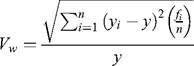
However, to deliver the objective of this study, we use export per capita and/or import per capita for calculating the Williamson Index:export or import distribution among countries in ASEAN is low. Therefore, if the index approaches to 1, the trade distribution in the region is high inequality.
3 EMPIRICAL EVIDENCES
In Indonesia, based on RCA calculation, in fact the number of competitive products is relatively fluctuating. The higher number had been reached in 68 product groups. However, the number of competitive products had declined in 2010 then increased again in 2015 as much as 61 products. The contrary trend can be seen for Malaysia. Its competitive products had been increased up to 61 products in 2015. In Thailand case, the pattern is quite same with Indonesia but its competitive products are higher than Indonesia and Malaysia. It had 78 competitive products in 2015. The details are in Table 1.
Based on: RCA > 1, STIC Rev 3 with 3 digits.
Competitive advantage becomes one of the many reasons why there is international trade imbalance or inequality in ASEAN. Countries with many competitive products tend have larger value in export compared to countries with few competitive products. Therefore, an increase of inequality on the number of competitive products among countries in ASEAN will increase the international trade inequality.
Meanwhile, based on Figure 1, the regional inequality on international trade trend is fluctuating also. From 1998-2002, there is a decreasing trend of
Table 1. Number of competitive products of selected ASEAN countries 1990-2015.
Number of Competitive Products
| Year/ Countries | Indonesia | Malaysia | Thailand |
| 1990 | 44 | 37 | 56 |
| 1995 | 47 | 38 | 58 |
| 2000 | 68 | 34 | 89 |
| 2005 | 57 | 40 | 77 |
| 2010 | 55 | 48 | 75 |
| 2015 | 61 | 61 | 78 |
(2)
Where Vw denotes Williamson index, yi represents per capita export from country i,y is the mean of per capita export for all countries in the region, fi represents population of country i, and n denotes total population in the region.
Williamson Index ranges from zero to one. If the index is close to 0, the inequality in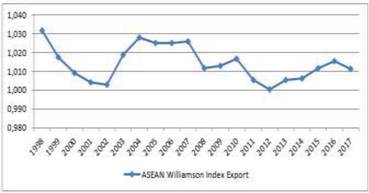
Figure 1. ASEAN regional inequality index of exports, 1998-2017.
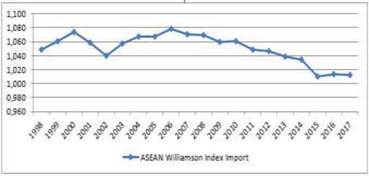
Figure 2. ASEAN regional inequality index of exports, 1998-2017.
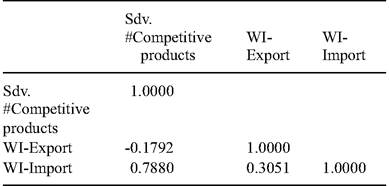
Table 2. Correlation on variation of competitive products and regional inequality on trade.
inequality, but last five years of the analysed data seems to be increased on inequality.
However, the regional inequality on imports is relatively different compared to exports. The trend of regional inequality on imports seems to be decreased since 2006 (Figure 2).
In Table 2, we correlate the variation of the number of competitive products of Indonesia, Malaysia, and Thailand to export and import Williamson indices. We find that the variation of the number of competitive products among those three countries has positive correlation on regional inequality of import in ASEAN. However, we also find a negative correlation of the number of competitive products among those countries to regional inequality index on export.
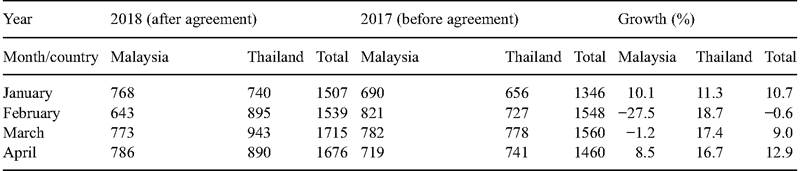
As we have mentioned earlier, central banks of Indonesia, Malaysia, and Thailand have established an agreement on local currency settlement in order to promote international trade among those countries. It has been implemented since January 2018. It seems that after the implementation of this agreement, Indonesian export growths to Malaysia and Thailand in total are positive compared to January-April 2017 (Table 3). The import growths from them are also relatively positive (Table 4).
Based on increasing trends of trades, both exports and imports among countries (Malaysia, Indonesia, and Thailand), it seems that local currency settlement framework has a promising impact on international trade among these countries.
However, it still need time to find a solid evidence that this framework reduces the trade imbalance or trade inequality on the region.Table 3. Indonesia’s exports after and before agreement for local currency settlement framework Indonesia, Malaysia, and Thailand (US $ Million).

Table 4. Indonesia’s imports after and before agreement for local currency settlement framework Indonesia, Malaysia, and Thailand (US $ Million).
2 CONCLUSION
REFERENCES
The results show that the variation of the number of product competitiveness might have an impact on regional trade inequality in ASEAN, especially for imports. Moreover, the implementation of local currency settlement framework among Indonesia, Malaysia, and Thailand seems to be positive for Indonesian export and import growth. These findings imply that local currency settlement could be expanded not only for those three countries but also for all countries in ASEAN.
ASEAN Secretary. 2017. Trade Statistics. Jakarta: ASEAN Secretary.
Balassa, B. 1965. Trade liberalization and revealed comparative advantage. The Manchester School 33(2): 99-123.
Dalum, B., Laursen, K. & Villumsen, G. 1998. Structural change in OECD export specialization patterns: despecialization and stickiness. International Review of Applied Economics 12(3): 447-467.
Krugman, P.A. 1991. Myths and realities of U.S. competitiveness. Science 254(5033): 811-815.
Laursen, K. 1998. Revealed comparative advantage and the alternatives as measures of international specialization. Eurasian Business Review 5(1): 99-115.