How Trump's steel and aluminium tariff shapes future world trade
K. Gupta
Australian National University, Canberra, Australia
B.P. Sutjiatmo & M.S. Kurniawan
Politeknik APP, Jakarta, Indonesia
ABSTRACT: In this information era where globalization and advancement of technology helps reduce trade cost, Trump just proposed his idea of having a tariff to help The United States' steel and aluminium industry.
Many pro-free trade economists still argue that the policy will hurt world trade. The cost can be so high; Australia, Japan, and European Union are trying to get exemption from the tariff. We show there is terms of trade gain for implementing import tax for a big player such as the United States of America (USA). This turns into a tit-for-tat game, which the best response for the rest of the world is to retaliate. In turn, WTO's role turns questionable and international trade gets harder to predict. Furthermore, we provide theoretical explanation why this will hurt the world as a whole.1 INTRODUCTION
International trade has been seeing increased trends since the last 15 years at the level where history has never seen before (World Trade Organization 2018). Economic openness has helped boosting developing countries' standard of living and has helped many people escape poverty. There is very little legitimate reason as to why a country wants to close your economy in the sense of growing your country's pie size (Obstfeld 2006).
There is, however, a problem in distributing the share of the pie. International Trade creates winner and loser. International trade can be seen also as zero sum game. Sector or agent, which enjoys protection from rigid movement of goods, will face fiercer competition. This was demonstrated well by Ricardo-Viner where a factor of production cannot move (Obstfeld 2006).
In fact, this is the main reason why the USA was creating World Trade Organization (WTO) in the first place.
Trade is, in a sense, similar to prisoner's dilemma where cheating is in the interest of the traders. The United States of America (USA) proposed the creation of WTO to keep the playing field even, and has been working well so far (Stiglitz 2018). The irony is, now the USA is threatening the very existence of WTO.Donald Trump was elected, and promised to bring inclusive growth to the US soil. He suggested a major change to US international economic policy, and Trump's wish persist in moving the USA toward a further protectionist side (Stiglitz 2018). Trump has just delivered his promise by imposing tariff to steel and aluminium import, which are 25% and 10%, respectively (Denton 2018).
With a country as influential as the USA, the whole world will surely be affected. In this piece, we discuss how Trump's logic actually has some sense. First, we debunk Trump's trade balance argument. Second, we use standard trade model proposed by Obstfeld (2006) to see how protection can benefit steel and aluminium processing sector. More importantly, we analyze how Indonesian government and private sector should react to this policy. Finally, we conclude.
2 THE LOGIC BEHIND TRUMP TARIFF
2.1 Tradebalanceargument
Trump has repeatedly proposed that trade balance is bad. He states that having a negative net export means the USA “lost” to its trading partner. To what extent is that story true?
According to Goerge (2018), it is important to describe between two things that are often discussed in the same sentence: the trade deficit and the US Government's budget deficit. These things interact, but they are very different. The trade deficit is simply the amount of money from the annual value of imports exceeding the annual value of exports.
When the USA runs a trade deficit, say with China, it implies that after Chinese consumers have purchased all the American goods and services they want in a given year, they still have some US dollars left over. Whenever the Chinese investors switched from the dollars to their own currency (Yuan), this would increase the value of the Yuan relative to the dollar.
This would imply that the prices for Chinese exports would be higher in the USA, which theChinese manufacturing industries for sure do not want. Rather, the Chinese purchase US treasury securities - bonds - that are essentially loans from the US government. Then, the trade surplus supplies the US government with a setup source by low-interest loans, which aid to finance its annual budget deficits (Goerge 2018).
We also have to remind the President how powerful US dollar is. Many countries hold US dollar as their reserve, including Indonesia. The US dollar is eligible currency in Ecuador, El Salvador, and East Timor, but it circulates on the side with many others (Goerge 2018). It is approximated that at least two- thirds of the US currency now in circulation is used outside the country (Goerge 2018). The fact that this money helps create the negative trade balance should imply how far the USA is leading this world instead of losing.
2.2 Winner and the terms of trade
The “standard” trade model is very powerful in showing that free trade is pare to optimal, with a very little exceptional cases where trade protectionism can do better (Obstfeld 2006). Free trade has its own problem, however. One of them is creating losers.
When a country opens to trade, it will import goods that it produces poorly, and export goods that it is comparatively better at producing. Price then adjusts: the goods exported get increased price, and the goods imported get the price reduced. Moreover, under free movement of factors among sectors, Factor Price Equalization (FPE) should hold (Obstfeld 2006).
However, free movement of factors can be a too heroic of an assumption. This means labor and capital of a sector can move freely to other sector. The import sector will be contracted due to import competition, then capital and labor move to export sector, which need more capital and labor due to expansion to meet foreign demand. Problem happens when factors cannot move.
Cheap steel from China means lower wage and capital rent in steel industry. Under free movement of factors, this labor can easily get another job, which has better salary. However, this might not be the case.It gets more dramatic when we observe Chinese side. From the viewpoint of the exporting country, Chinese steel workers should get increased wage, chasing US steel workers’ wage. This is indeed the case, as observed by Xing (2018). This essentially removed the US workers’ salary to their Chinese counterpart, which suggest that US’ steel labors are among the losers. This should also hold true for capital owner’s rental rate. This creates incentive for factor owners in US’ steel industry to lobby for protection.
Usually, this problem is sector-specific. Ifthe government’s interest is in the whole country, then accepting the lobby may be less efficient. The reduction of steel sector should be less big than the increase of export sector such as agriculture should. Moreover, export sectors, which use cheap steel from China, such as health equipment and automotive industries, should benefit even more. Trade should then be good for overall welfare of the country. However, this might not be true for big countries like the USA.
Tariff, most of the times, creates dead weight loss for the economy, making it less efficient (Obstfeld 2006). For big countries, however, this is not the case. Import tariff reduces demand, and for big country, it causes world price to drop. Under this advantage of terms of trade, the impact of the tariff to demand is reduced (amid lower world price), and the government can potentially reap big enough tariff revenue to cover dead weight loss.
The logic is easier explained with a graph. Consider Figure 1, in which the USA is the importing nation. Under autarky, the US’ steel price is in Pm, while China trades at Px. Under free trade and the condition Px < Pm, the USA becomes the importer with China as the exporter, with the market price down to Pw.
Suppose both countries are price taker, any trade restriction will lead to a deadweight loss for both of them. This is not true with a big country assumption.Consider the tariff by Trump, which leads the price in the USA to increase to Pw+t, with t being an ad-valorem tariff. The increased domestic price reduces the demand in the USA, which will not affect the world price if USA is small. But suppose the USA is a big country, big enough such that its reduced demand alone leads to lower world price, to Pw'. Like any tariff, there will be deadweight loss. However, the decreased world price leads the tariff gained by the government, which may cover the deadweight loss. Small country can only collect a tariff as big as (Quantity import ? (Pw+t-Pw)), but big country gets (Quantity import ? (Pw+t-Pw')). For the USA, it is rational as long as the shade ((Pw- Pw’) ? Quantity import) is bigger than the deadweight loss.
This gain, however, comes at the expense of the other country, which is China. Not only that its revenue reduced by not producing for the USA, but also for the decreased world price. In fact, the world as a whole will be hurt by the tariff. This is what happens
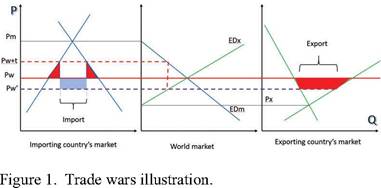
if China chooses to sit idly doing nothing. However, doing nothing is not the best response to the tariff. The best response is to retaliate.
By comparative advantage, the USA also has sectors, which they rely on Chinese market. They will use the same trick to the USA on this market and get the surplus enough to cover the loss in the steel and aluminium market. This is the best way China can do, sadly at the expense of the whole world.
3 HOW THE WORLD REACT?
The previous section argues the logic behind Trump’s background to tariff, which is mostly debunked. However, the policy has been done, and the world reacts to it. When main problem arises with having a (big) country impose tariff on foreign good, the best way for its trading partner to react is retaliation.
China will take counter-measures of the same proportion and scale if the USA imposes further tariffs on Chinese goods (The Guardian n.d.). China announced tariffs on imports of US food and other goods in response to US tariffs on imports of aluminium and steel. China tariff on US soybeans could cost Iowa farmers up to $624 billion. Soybeans are among hundreds of US products China has singled out for tariffs. The USA has an equally long list that includes taxing X-ray machines and other Chinese goods. US soybean prices have fallen about 12% since March 2018, when the US-China trade dispute began. China already has smacked farmers with an additional 25 percent tariff on pork, and Mexico plans a 20% tariff on ham and pork shoulders.
Those moves could cost the US pork producers $360 million over the year; Mexico is weighing tariffs on $4 billion of US corn and soybeans, while the European Union and Canada are considering tariffs on a range of US products. In addition, US farm competitors will take in to capture as much of the Chinese soybean market as possible. It will be South America - Brazil and Argentina - and parts of Western Europe - Russia and the Ukraine - that will replace US farmers to fill China market (Eller 2018).
Not just China, Trump declared the USA would change tariffs on imports of steel and aluminium also from Canada, Mexico, and the European Union in an effort to cut down trade unbalances with the three important allies. Trump also established an investigation that may result in similar limitations on imported automotive trade between the USA, Canada, and Mexico. Besides the tariffs, Trump’s strong line in the renegotiation of the North American Free Trade Agreement, or NAFTA, has left the future of that negotiation in uncertainty. Trump said all of the processes are planned to cut down the trade deficit between the USA and other countries (Brian 2018).
Reported by Bank of America Merrill Lynch, the portion of the total US trade deficit attributable to
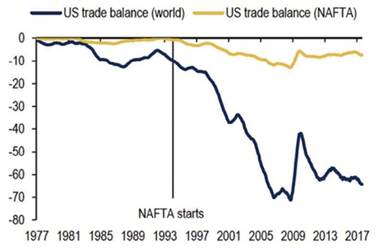
Figure 2. US Trade Balance (Brian 2018).
Canada and Mexico is under 10%. In fact, since NAFTA’s implementation in 1994, the trade deficit with America’s neighbors has only increased reasonably, although the global deficit ballooned (Brian 2018). The details are in Figure 2.
Should the situation escalate, the consequences could be terrible. Should the USA and EU ramp up various tariffs, including on cars, the impact could knock 0.4% from US growth and 0.3% from the EU (The Guardian, n.d.). The USA has a trade in goods deficit with the EU of about $38 billion, with about $78 billion exported to Europe from the USA, and $116 billion goes the other way. If the tariffs were raised by 10% above the proposed levels, global trade potentially drops by about 6% (The Guardian, n.d.). The EU has said it will retaliate by slapping tariffs on a range of high-profile American goods and will start a case against the USA at the WTO.
4 WHAT THIS MEANS FOR INDONESIA?
Trade wards this big (and potentially gets bigger), surely will affect Indonesia in several ways. One thing for sure, in this section, we are further predicting what the world is going to do, and how we should fit in.
First, we should be prepared to see a change in trade pattern. Indonesia’s steel export to the USA consists only 2.58% of its global steel export (World Integrated Trade Solution n.d.). Indonesian steel exporter should prepare to shift the market to some other place. However, due to predicted lower steel price, this should not be a big issue. In fact, Indonesia as the world’s top 10 importer of steel should benefit. China and other net steel exporter will need to find alternative market. This will help industries that use steel as intermediate input (such as automotive) to get cheaper inputs.
Second, in terms of other goods, we can actually benefit from the trade war. Steel and aluminium exporting countries will retaliate against US’ agricultural products. Meaning, their farmers will need to shift market. Indonesia, which enjoys US’ agricultural products (such as soybean), will get reduced price.
Third, whoever gain and lose in trade wars, global trade will surely decrease. We need to bear in mind two things. One thing is logistics activity. Less trade means less movement of goods across the oceans and the sky. Logistics player should prepare to halt its expansion, facing fiercer competition. The other thing is the flow of capital. Expect greater movement of capital due to increased trade cost. Harley-Davidson in fact has already moved some of its production to European Union territory due to retaliation tariff against US' automotive products (Lynch & Long 2018).
Finally, regardless of the plans in the hands of the USA, as long as the rest of world are looking to get more progressive trade deals, we can simply ignore the USA and move on. While Trump announced that the USA declined the Trans Pacific Partnership (TPP), other members are continuing the TPP (Reynolds & Tweed 2018). This should hold true to other Trade Agreements also. This scenario isolates the USA, while at the same time opens opportunity to our manufacturers to find other markets. How deep the USA is isolated, we may still see two great powers on trade: WTO and the isolated USA (along with whoever decides to befriend with them).
5 CONCLUSION
The escalation of trade wars only gets fiercer and faster. The USA just imposed tariff for its steel and aluminium import. However, flawed the logic behind the policy, the best its trading partners can do is to retaliate. This leads to huge disruption to the global trade, especially if the escalation gets even fiercer.
The trade wars can potentially place two poles of trade power: the USA and the world. We need to understand where to stand. We argue that trade wars can benefit Indonesia in the sense that everything that we import could get cheaper as our main trade partners need to switch market. What we sell to America is not yet protected, so we can at least breathe easy for now.
Whoever gains from the trade wars, however, the world's GDP is going to contract. Expect slower movement of goods especially for logistics firm. Overall consumption will further shrink and export- led growth strategy will be less powerful.
Need to keep in mind that Trumpism might only last as long as Trump is the president. We need to take a closer look at US' presidential election, more so than ever.
REFERENCES
Brian, B. 2018. One chart shows why trump’s trade fight with Canada and Mexico is misguided. [Online]. Retrieved from https://bit.ly/2tCxGcJ. Accessed on 2018-06-25.
Denton, J. 2018. Trump’s tariffs explained: What are they, how has the world reacted and what are the implications for Britain and global trade? [Online]. Retrieved from https://bit.ly/2lIjWbZ. Accessed on 2018-06-25.
Eller, D. 2018. China tariffs on US soybeans could cost Iowa farmers up to $624 million. [Online]. Retrieved from https://dmreg.co/2LZmxJU. Accessed on 2018-06-25,
Goerge, H. 2018. Protection or free trade. [Online]. Retrieved from http://www.truefreetrade.org/amap.htm. Accessed on 2018-06-25.
Lynch, D.J. & Long, H. 2018. Trump says he’s ‘surprised’ har-ley-davidson is moving work overseas after tariffs take effect. [Online]. Retrieved from https://wapo.st/ 2yZfzTq. Accessed on 2018-06-25.
Reynolds, I. & Tweed, D. 2018. Tpp is a big deal, with or with-out the US. [Online]. Retrieved from https://bloom. bg/2EHSpyA. Accessed on 2018-06-25.
Stiglitz, J.E. 2018. Rethinking Globalization in the Trump Era: US-China Relations. Frontiers of Economics in China 13(2): 133-146.
The Guardian. n.d. Us on brink of trade war with eu, canada and mexico as tit-for-tat tariffs begin. [Online].
Retrieved from https://bit.ly/2Jkdwgv. Accessed on 2018-06-26.
World Integrated Trade Solution. n.d. Indonesia metal export by country 2016. [Online]. Retrieved from https://bit.ly/2tHJqL3. Accessed on 2018-06-25.
World Trade Organization. 2018. World trade statistical review 2017. [Online]. Retrieved from https://bit.ly/ 2izQnbF. Accessed on 2018-06-25.
Xing, Y. 2018. Rising wages, yuan's appreciation and China is processing exports. China Economic Review 48: 118-122.