Can cryptocurrency help business to be more competitive?
D.S. Ratana
Politeknik APP Jakarta, Jakarta, Indonesia
K. Gupta
Australian National University, Canberra, Australia
ABSTRACT: Recently, cryptocurrency has been a huge debate among leaders in business and finance, especially in the way it can revolutionize finance and transaction.
Chicago Mercantile Exchange trades Bitcoin futures, and there are merchants who accept cryptocurrencies as payment. As the development of cryptocurrency will only get faster, we review literature and Indonesian government stance and law. We argue that business should be conservative in adapting to cryptocurrency amid its limited uses, volatility, and relatively small market cap.1 INTRODUCTION
Money has three functions: medium of exchange, unit of account, and store of value (Mankiw 2014). To be a medium of exchange, money had to be widely accepted, and so the first money was made of gold, silver, etc. Then, in 1800s, the gold standard was adopted so that people don’t have to bring their heavy gold to transact anymore and use paper money. This model was accepted because government would redeem the paper money for its value in gold. We no longer use the gold standard, but the money we have still have value because of trust in the government that issued it. Money includes currency, that is, the paper bills and coins issued by the government and the deposits in the banks. Even though these deposits can be transferred to any other account as a medium of exchange, supposedly the cost to transfer are too high, particularly to another country.
In short, our current system of payment still relies on two things. First, it relies on how well the government keep our trust to the money. Without any backup, Government can easily play around with this money, leaving us with second-guessing the value in a presence of a bubble (Shriver 2018). Nowadays, we try to deal with this first problem by hedging the value of money with something else, such as futures or foreign currencies.
Second, it relies on a middle man (or men) to bridge the transaction, which incurs additional cost.This is where cryptocurrency comes in. Technology has been a prominent driver for growth. It helps business in various ways. Gap of information is getting closer and closer with faster transportation and communication.
Businesses nowadays are able to manage risk using developed instruments such as insurance and futures. Transaction wise, we invent something today we call money. Cryptocurrency is a kind of money which can be “mined” by everyone and is a technological breakthrough. It has limited amount, just like precious metal (Shriver 2018) which means, regulating the value of cryptocurrency will be less trivial than printing money or switching interest rate. Moreover, cryptocurrency can be traded without any middle man, thanks to unique key which is impossible to impersonate (Simonite 2011). The question, then rises: should business utilize cryptocurrency?
We assign the paper in to three parts. First, we discuss about what is cryptocurrency and its features. Second, we identify how these features helpful for business. Finally, we conclude.
2 UNDERSTANDING CRYPTOCURRENCY
Cryptocurrency has been widely talked about, yet people struggle to clearly define it. The definition of cryptocurrency according to Merriam Webster is “any form of currency that only exists digitally, that usually has no central issuing or regulating authority but instead uses a decentralized system to record transactions and manage the issuance of new units, and that relies on cryptography to prevent counterfeiting and fraudulent transactions”. Note the key words here: currency, digitally, decentralized system, and cryptography. We will address all of this in the following section.
The first known cryptocurrency is Bitcoin, which was proposed in 2009 by a mysterious character being called Satoshi Nakamoto (Simonite 2011). However, it was in 2013 when Bitcoin started its first hype (Collins 2018).
In 2015, Bitcoin is getting more seriously taken when United States gave themTable 1. Cryptocurrencies with highest market caps, taken 28 June 2018.
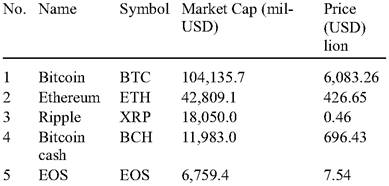
Source: coinmarketcap.com
status “commodity” (Collins 2018). Up to 2017, Bitcoin received 18? growth of value (Collins 2018).
Since Bitcoin enjoys a hike in market capitalization, other currencies start to emerge. Among the top gainers of market caps are Ethereum, Ripple, and EOS. Table 1 summarizes the top 5 market caps of currently traded cryptocurrency (CoinMarketCap 2018). Almost all of these currencies just change the parameters of the block chain from the Bitcoin platform and try to find markets of their own. Ethereum, for instance, provides ether as digital currency and a platform for those who want to sell and buy decentralized application. Essentially, it is a market place without a centralized server. This should make Ethereum a more valued platform because for anyone who wants a product developed, they can post a contract and wait for someone who would provide the service. Such service would utilize the Ethereum platform, with miners already in place. But this proves otherwise, the platform still produces other altcoins - yet another Cryptocurrency. An exception to this might be Ripple, where it is currently still somewhat controlled by its creator (Orcutt 2018).
Bitcoin is built with no central bank to which control of double spending and spending of non-existent money is difficult. Bitcoin tackles this issue using every nodes/miners as ledgers keepers which doubles as coin distribution mechanism (Tschorsch & Scheuermann 2016). For any transaction, the system made a sophisticated puzzle which requires quite a computational power. The first miner to solve the puzzle gets an incentive in the form of the currency itself. After the puzzle gets solved, it was then written in a block which will be carried over to the next transaction.
This system is called a block chain. This in itself provides anonymity, independence from central authority, and double spending attack protection. No other group of currencies, beside cryptocurrencies, has combination of these features (Lansky 2018). They further classified the approach of countries into 5 levels in both directions, negative and positive, with level 0 ignoring cryptocurrency and level 5 completely integrating or banning the currency. The level goes as follows (Lansky 2018):Level 0 - ignoring: the state authority does nothing with the existence of cryptocurrencies. Level 1 - monitoring: the state authority issued a statement that it is aware of the existence of cryptocurrencies but no recommendation was issued. Level 2 - recommendation: the state authority issued a statement that it is aware of the existence of cryptocurrencies and is issuing recommendation that most view crypto negatively.
Level 3 - guidance: the state authority has issued guidance to govern the method of using cryptocurrencies and usually accompanied by a warning against cryptocurrency risks.
Level 4 - regulation: provision of cryptocurrency-related services requires an explicit authorization from the relevant state authority.
Level 5 - ban or integration: the state authority has issued the refusal or the full adoption of the cryptocurrency concept.
As you will see, this will prove very interesting for Indonesia, because the stances of the authority are not only on a different level, but also at different polarity.
On February 6, 2014, Bank Indonesia states Bitcoin and other virtual currency are not a valid currency payment instrument in Indonesia. Such statement is only an affirmation to the public since it is already stated in the Government Law no. 7 2011. This was reaffirmed multiple times through Bank Indonesia Regulation no 17/3/PBI/2015 and public statement with an added warning clause (Das 2017). This essentially removes cryptocurrency as a legal currency, at least in Indonesia.
Anyone who accepts or uses any cryptocurrency will get penalized by the Central Bank, particularly financial institution. Implementing the law on anonymous transaction is obviously hard, and merchants are still using US dollar in business transactions, particularly in imported consumer goods. Cryptocurrency made that even easier, so if a product was imported with cryptocurrency, it will also exchange with cryptocurrency.Despite this, Indonesian cryptocurrency exchanges are still operational and thriving. In fact, on June 5th, BAPPEBTI said that they had legalized Bitcoin and other cryptocurrency as commodities and can be traded as futures (Bosnia 2018). The move was made by BAPPEBTI to lure foreign investors as there are a few countries that allow the trade. It is confusing to have governmental institutions of the same country yet with two different stances, but both institutions are adamant with their stand and said the other institution did not collaborate with them.
3 HOW USEFUL IS CRYPTOCURRENCY TO BUSINESS?
Anonymity and double spending attack protection are inherent in fiat currency so there is no added benefit from these characteristics. Independence from central authority, however, can lead to much smaller fee and faster transaction. Smaller fee can happen because more than one entity recording the transaction provides competition, and competition always benefit customers by pushing prices down. The down side is that it’s possible that no one wants to record it if the fee or incentive to process the transaction is too low. Although with centralization, it can get pricey, all transaction will always be completed even if there is no incentive for some transactions.
Transferring from one central authority to another can take a lot of time, but within a central authority scope, one can transfer fund instantaneously everywhere, even abroad. In contrast, in cryptocurrencies, this depends on the system they adopt. While Bitcoin can take as fast as 10 minutes, other cryptocurrency may do faster on the expense of less security.
Note that this 10 minutes’ confirmation time on Bitcoin is the fastest and is not very secure. One does not care about security when he/she only buys a cup of coffee, but 10 minutes’ waiting time is obviously too long. This can be hastened by giving an optional transaction fee for the successful miner (Barber et al. 2012), and again such fee can only feasible if the transaction value is big enough to justify the fee.The main arguments against cryptocurrency are its legal status and its high volatility value (Ivashchenko 2016). Legality might not be a huge issue since there is only small number of countries that openly ban cryptocurrency, with Indonesia being not among those countries. Moreover, executing the ban is a non-trivial task amid its decentralized nature (Lansky 2018). We then left with the volatility problem.
Volatility, then, is a huge problem. Stable price is one of the main requirements for transaction medium. Moore & Stephen (2016) find that Bitcoin can only be a safe hedge for a country’s reserve if it consists only 0.01% of total reserve. There are, however, potential solution to this problem.
First, we can now trade Bitcoin futures as well. Some people are skeptical about Bitcoin futures, but people were also skeptical when the first futures were sold (Collins 2018). Second, some fiat currencies of some countries are also volatile. Bitcoin is a much safer bet if we want to trade with Venezuelan or Zimbabwean (Lansky 2018). Finally, due to its decentralized nature, cryptocurrencies’ value is dictated by the market (Collins 2018). This leads to a possibility of predicting cryptocurrencies’ value using market sentiment such as forums (Kim et al. 2016).
But there are many other issues with using cryptocurrency. According to European Banking Authority (2014), one example is its low market cap in general. This is one source of its volatility. Bitcoin is already highly volatile, but other cryptocurrencies are performing even worse in terms of stability of value (Lansky 2018). Cryptocurrencies are still growing in a sense that we are seeing the emergence of more and more new Initial Coin Offering (ICO), but it is hard to imagine a new one would take over the safest, highest market cap Bitcoin.
The main feature of cryptocurrency for business is its fast, decentralized transaction. However, its volatility presents more risk than return. The relatively small market cap of cryptocurrency might also means adopting to it will only present with marginal benefit. Moreover, cryptocurrency and the technology behind it is still developing. Some method of delivering cryptocurrency is also varying, from completely decentralized like Bitcoin to somewhat controlled like Ripple. It is probably best for business to wait until a clearer pattern emerges from this technology.
3 CONCLUSION
Technology powers the emergence of a new decentralized digital currency called cryptocurrency. Unlike conventional currencies, cryptocurrency is fast and free from any central bank’s control. While adopting cryptocurrency will be certainly beneficial in the sense of reducing the cost of transaction and dropping the reliability to the government, existing cryptocurrencies are highly volatile and still have a relatively small market cap in contrast to conventional instrument. We believe that it is better to wait to adopt cryptocurrency for investment uses until we understand this relatively new technology.
REFERENCES
Bank Indonesia. 2014. Pernyataan bank Indonesia terkait bitcoin dan virtual currency lainnya. [Online]. Retrieved from https://bit.ly/2KfBc78. Accessed on 2018- 06-25.
Barber, S., Boyen, X., Shi, E. & Uzun, E. 2012. Bitter to better—how to make bitcoin a better currency. In International Conference on Financial Cryptography and Data Security (pp. 399-414). Berlin, Heidelberg: Springer.
Bosnia, T. 2018. Bappebti: Bitcoin cs masuk kategori komoditas bursa berjangka. [Online]. Retrieved from https://bit.ly/2yWVRaG. Accessed on 2018-06-25.
CoinMarketCap. 2018. Crypto-currency market capitalizations. [Online]. Retrieved from https://coinmarketcap. com/all/views/all/. Accessed on 2018-06-25.
Collins, D.P. 2018. The problem with cryptocurrencies.
Modern Trader, 61. Canberra: The Australian National University.
Das, S. 2017. Bitcoin banned as a payment method, adopters will be ‘dealt with': Indonesian central bank. [Online]. Retrieved from https://bit.ly/2KqTQF5. Accessed on 2018- 06-25.
European Banking Authority. (2014). Eba opinion on virtual currency. [Online]. Retrieved from https://eba. europa.eu/documents/10180/657547/EBA-Op-2014-08 +Opinion+on+Virtual+Currencies.pdf. Accessed on 2018- 06-28.
Ivashchenko, A.I. 2016. Using cryptocurrency in the activities of ukrainian small and medium enterprises in order to improve their investment attractiveness. Problemy Ekonomiky. 3, 267-273.
Kim, Y.B., Kim, J.G., Kim, W., Im, J.H., Kim, T.H., Kang, S.J. & Kim, C.H. 2016. Predicting fluctuations in cryptocurrency transactions based on user comments and replies. PloS one 11(8).
Lansky, J. 2018. Possible state approaches to cryptocurrencies. Journal of Systems Integration 9(1): 19-31.
Mankiw, N.G. 2014. Principles of macroeconomics. Cen- gage Learning.
Moore, W. & Stephen, J. 2016. Should cryptocurrencies be included in the portfolio of international reserves held by central banks?. Cogent Economics & Finance 4(1): 1147119.
Orcutt, M. 2018. No, ripple isn’t the next bitcoin. [Online]. Retrieved from https://bit.ly/2DnYIbl. Accessed on 2018-06-25.
Shriver, L. 2018. Why cryptocurrency is the answer. [Online]. Retrieved from https://bit.ly/2E55oKH. Accessed on 2018-06-28.
Simonite, T. 2011. What bitcoin is, and why it matters. Technology Review, May, 25, 10A1.
Tschorsch, F. & Scheuermann, B. 2016. Bitcoin and beyond: A technical survey on decentralized digital currencies. IEEE Communications Surveys and Tutorials 18(3): 2084-2123.