Developing company viability based on virtue and human potentials (Study on SME in West Java)
B. Gomulia
Faculty of Economy, Parahyangan Catholic University, Bandung, Indonesia
ABSTRACT: The company viability, particularly in relation to virtue and human potentials, has scarcely been discussed in today’s field of business and management.
However, in line with the more dynamic and complex company milieu, establishing the viability as its adaptive and flexible capacities is urgent. The purpose of this study is to explore and confirm this specific “intrinsic” company performance and its determinant factors. The study is conducted with 47 SME industries located in West Java. The data was collected by survey taken from 905 workers, and from interviews with the owners or managers. Factor analysis method was conducted to verify the validity of the variables and its model proposition as to come to a valid form of research model and hypothesis to analyze. The results of path analysis showed that the company viability is significantly influenced by the management commitment and intrapreneurial spirit; both variables can be explained at R2 0.93. Meanwhile, the intrapreneurial spirit is explained by the work spirit, innovative learning, and compliance significantly, at R2 0.94. The study also explained the role of mutual trust. The results of this study is expected to be the basis of a more thorough research on the psychosocial aspects contributing to enhance the intrapreneurial spirit for developing the company viability.1 INTRODUCTION
1.1 Company viability and workers' roles in West
Java
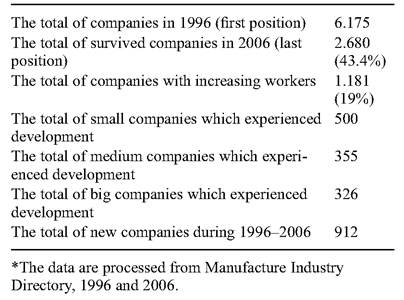
Economy crisis taken place in the 1997-1998, brought a big impact in West Java. Many companies were bankrupt; however, a few survived the crisis. The data of company mortality in West Java during 1996-2000 showed that 2.680 units or about 43.4% of all the companies in 1996 of companies were able to survive (as a first data position), and only 19% of companies could show the ability to progress better, provided the progress is viewed from the rising of total number of workers.
Moreover, it is also seen that the large-scale companies and middle-scale companies were able to survive and develop at once (see Table 1).Table 1. Company viability value in West Java in 1996-2006 (in unit).
17
Many factors and aspects determine the company’s ability to survive and develop. The worker factor is deemed as one of the factors which determine the success of business development. Statistic data in West Java in 2012-2014 show the increasing of workers and their productivity.
Table 2. The development of processing industry productivity in West Java.
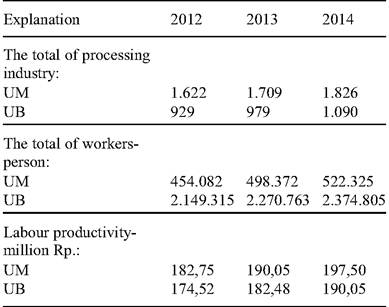
* The data are processed from BPS Indonesia and West Java BPS, UM=medium business, UB=large business.
The role and position of workers for the company are not equal to the machine, material, and asset on the production process. Different from the machine and any other resources, workers have reasoning and conscience to assess the appropriateness of the demands. Mele & Canton (2014) said the difference
between other creations and human is that human has free will.
“Free will - We are owners of our acts of choice, the desires accepted by our will, and thus we are responsible for them ”.
The attitude and behavior of the workers are determined by the harmony and the conformity between the norm and value applied in the society. The workers can choose to be the ethical person on working and business. This assumption becomes the reason why this study submitted the concept of company viability that is based on virtue and workers’ potentials (Moore & Spence 2006, Solomon 2004, Pirson & Lawrence 2010).
The purpose of the study is to find out the virtue and human potentials that contribute to the development of company viability. In specific, the questions are formulated as follows:
- How is the company viability constructed to face the environmental challenges?
- How the community member’s willingness to give the best for the company can contribute to the enhancement of the company viability?
- How the spirit of community member to change for the future challenges can contribute to the enhancement of the company viability?
2 PROPOSITION MODEL
2.1 Dynamic environment and company viability
Beer (1985) stated for the first time about a concept of organization viability that “system’s ability to maintain its independent existence within a specified environment”.
Viability is articulated as a system ability (organization) to keep its existence independently and autonomously in a way of developing the flexibility and adaptability. In general, the viability is defined as an ability of a company to survive, advance, and well grow up. A healthy company’s life is interpreted as company which is responsible consistently not only economically but also socially towards its member, and the community served.The company viability is considered as a form of successful business, which is multidimensional and also contingent and contextual. A company cannot survive to face the dynamic environment situation by relying on the system and management structure which tends to be mechanistic, instead of flexibility and high adaptability that are needed (Thompson 2017). The member of the company who has an opportunity and responsibility on facing the challenges can only provide this flexibility.
A well-survived company is a company which can operate, maintain, and update the working system in a short term or long term with the direction of the aspirations to be achieved in the future. A company which can maintain its viability is marked by the ability to maintain consistency and continuity of operation (Thompson 2003). The external or internal community support in order to maintain the stock and process directly and indirectly gives company the flexibility and adaptability to deal with the changes occurring (De Geus 1997, Freeman et al. 2007). This viability is developed on the basis of trust and good will on developing together between stakeholders and companies (Cameron et al. 2004a, Cameron et al. 2004b, Chun et al. 2011, Freeman 2004).
2.2 Intrinsic dimensions of the company performance
In this study, the company viability does not use a hard-dimensional measurement such as the long company life, company growth, maturity stage, and other measurement because these kind of dimensions only show how far the company is able to survive.
Meanwhile, the future company deals with the dynamic environment which is different from its previous condition, then the soft dimension is needed to be stated in this study which becomes the basis of the company’s ability to build on the internal capability. This capability can maintain the company’s long-term viability (Collins 2001, Drucker 2014).To express the company viability adequately, some dimensions which characterize the intrinsic capability will be identified. First, sensitivity to the market - it reflects the company’s ability to fulfill the consumer needs for the products and services which fluctuate quickly. So far, the consumer is consistently loyal to the company. Second, a balance and fairness transaction - a fair treatment for the stakeholders, which brings a win-win situation on working and business run by the company. This business relationship is the best guarantee to maintain business viability in a long term. Third, vision to build people’s capabilities - reflection from the company aspiration and desire to develop the future, which supports the positive and innovative member’s innovation. These three dimensions are expected to reveal the flexibility, adaptability, innovation, and company standards to run business and create a fair and responsible working environment.
2.3 Company viability based on the virtue and human potentials
On the company viability concept, human is placed in the central role and position in the company management; people benefit from various things cannot be seen as a ready resource, but it can be considered and treated as a human resource which has virtue and potential for the actualization (Hartanto 2009, Peterson & Seligman 2004). Hartanto (2009) also viewed human potentials as a strong character, which grow from the confidence, belief, and emotion about positive things in a working life and social life. If this human potential is loaded with a beauty, moral superiority, concern for other people, then those potentials are often called as a virtue.
From the assumptions that company viability can only be manifested through working and management effort, and by company members who will and are able to work synergistically (Hartanto 2009), the proposition is submitted that the company viability is influenced by Management Commitment and Intrapreneurial Spirit to the company. The meaning of the virtue and two potentials explicitly are described as follows:
- Management Commitment - Management commitment is one of the forms of work ethic which reflects management determination to build support from all of the community members to produce performances expected by the company continuously, and the capability to contribute consistently even though the working and business environment is less conducive (Chun et al. 2013, Cullen et al. 2000, Porter et al. 1974, Rhodes & Eisenberger 2002)
- Intrapreneurial Spirit - The entrepreneurship shows the company member’s readiness to study, change, adapt, and innovate consistently in accordance with the working demands development in the daily operation, in present and future (Kao 1995, Kuratko et al. 2011)
The intrapreneurial spirit itself seems to be influenced by the company members’ spirit and behavior. The spirit and behavior are defined as follows:
- Working Spirit - This spirit is needed to maintain the sustainable working in a full of challenging situation.
- Innovative Learning Spirit - This spirit is needed to bring out renewal and innovation in a constantly changing situation.
- Accountability - This spirit is needed to ensure that working is in a law and ethic corridor, in addition to maintaining decision-making done responsibly.
Human is a social being; therefore, the attitude and other people in the surroundings affect behavior. Likewise, the virtue and worker’s potentials can develop corresponding to the society situation and the situation of the company community at the same time (Solomon 2004). There are some working environment aspects which are estimated to influence the behavior and working life.
Ethical climate, social climate, and mutual trust are believed to affect the company viability. Complete research proposition model to be tested is presented in Figure 1.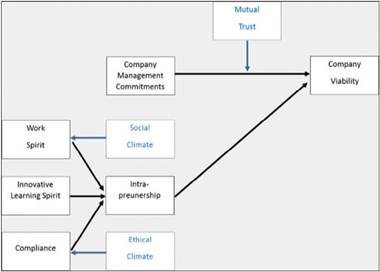
Figure 1. Proposition model.
3 RESEARCH METHOD
Research sample is from 47 medium- and small-scale manufactures that have been running for at least fifteen years in West Java. The total of the sample is sufficiently estimated, because this type of study usually requires at least 30 companies (rule of thumb). Bigger sample is required to ensure the validity of the result.
The variable is measured perceptually through the workers’ or management member perception for community or company behavior. The instruments used are general opinion questions on “psychosocial”. In this study, workers and management member as the observation units filling the survey is as many as 905 individuals.
The statistical analysis consists of factor analysis and path analysis which used SPSS version 21 (Statistical Package for the Social Sciences).
3.1 Factor analysis
In this study, the test was conducted in two stages; first stage is conducting a validity and reliability variable constructing test with the exploratory factor analysis as well as confirmatory factor analysis. Second stage is conducting a test towards reconstructed research model. The confirmation is is used as the research model and hypothesis from the relationships between research variables; finally, the Research Model is obtained and analyzed further.
4 RESULTS AND DISCUSSION
After conducting a factor analysis to the research variables, which are submitted on the proposition model, a redefinition variable is obtained. This variable is a representation from the psychosocial condition which is perceived in the company environment. The exploratory and confirmatory factor analysis success in identifying dimension and variable that contribute to the improvement model quality of company viability is shown in Figure 2.
4.1 Company performance - viability
The company viability turns out to be a concept, which has to be holistically seen from three dimensions including (1) Attention to Operational, (2) Market Adaptation, (3) Responsibility. All the dimensions consist of company capability to maintain the operational dynamics in order to answer the development of challenges and market chances.
The long-term company viability is not only driven by external stimuli, but also appear implicitly as a consciousness from company members to self-development in order to meet the challenges in the future. This can be seen from the manifestation contents of each company viability dimension, which consist of people development aspects.
Table 3. Management commitment (KMP) and intrapreneurial spirit (SKI) towards company viability.
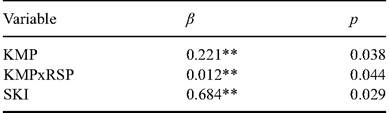
R2 = 0.929
The mutual trust, which is felt in these company environments, is as expected. This mutual trust has been proven to increase the positive influence of the management commitment towards the company viability. Thus, the companies have actually been proven to have assets yet unable to use them for productive work.
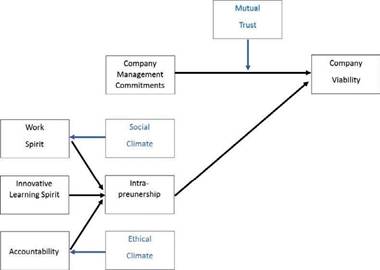
Figure 2. Research model.
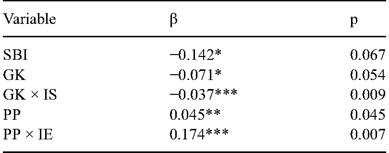
Table 4. Work Spirit (GK), Social Climate (IS), Innovative Learning (SBI), Compliance (PP), and Ethical Climate (IE) toward Intrapreneurial Spirit.
R2 =.94
4.2 Management commitment and intrapreneurial spirit in rising company viability
Table 3 shows the result of path analysis, from which research model submitted can be confirmed as significant, even though not all hypotheses submitted are accepted. With the explanation level of R2 0.93, most of the company viability can be explained by Management Commitment and Intrapreneurial Spirit. The company viability has been proven positively and significantly by Management Commitment and Intrapreneurial Spirit. From the results, it can be concluded that company viability can be increased if there is an effort and real concern from the management (and owner) to the workers, as well as the spirit of innovation in the internal company environment. The rising of intrapreneurial spirit, which is found in the company environment, will affect company viability positively and significantly. Thus, it can be seen that the spirit felt in the company environment contributes to the company capabilities to deal with the internal and external challenges.
Table 4 shows that the intrapreneurial spirit which is discussed in this study is adequate, because the value of R2 0.94; it means that intrapreneurial existence can be explained by Work Spirit, Innovative Learning, and Compliance. Nevertheless, as per psychosocial research, this research model still needs to be refined and enriched, so that the complete and comprehensive description can be obtained.
The increase of innovative learning spirit available among company members makes a decrease in intrapreneurial spirit. It is suspected due to one or more reasons as follows:
- Innovative learning spirit, which is marked a lot by dialog, discussion, and asking each other, is considered as disrupting daily production activities and the achievements of production target. This phenomenon isin line with the practice, in which the researched company orders workers to focus their attention on the achievement of production target and it needs no renewal because it is considered as management responsibility.
- Innovative company members who learned a lot yet get their opinions ignored or rejected by the management will increase their diasspointment. Consequently, this situation will decrease the company’s performance.
The increase of working spirit has negative effect towards intrapreneurial spirit. It is estimated among 47 researched companies that are still transactional and raised by external stimuli such as performance achievement, which is related to the reward. This situation is strengthened by working condition which tends to be mechanistic with clear and certain working conditions. All of the renewal and innovations which want to be implemented in the working environment tend to be considered inhibit working opportunities to achieve production target and big reward. The working spirit is usually associated with the effort to pursue more rewards which will automatically reduce the willingness to implement new ideas, and this is reflected in the working environments. When the renewal is still considered as a disruption for the production activities, then renewal spirit of the companies will tend to decrease.
The obedience to the rules and work plan turn out to increase the intrapreneurial spirit significantly. Even the impact is getting stronger and significant when the company members experience ethical atmosphere. If the members obey the rules and work ethically, manager can concentrate more to the renewal and innovation, because in the company environments, the supervision can be reduced. This matter can increase the company dynamic and viability.
5 CONCLUSION AND SUGGESTION
To conclude from all of the results and analysis stated before, the observed companies show a dynamic and good viability indeed; however, the viability still relies on the manager capability which is also the owner who is not in the virtue. The company members tend to be treated as a resource and production factor, not as a human being who has virtue and potential that can be invited to think about the company future and directly involved in contributing more to the increasing of company viability. It is estimated that if the member is given an opportunity to engage and contribute in production activities as well as the roles and responsibility, the company viability will be long guaranteed.
In line with the suggestions to the management, commitment should be enriched to be collective, which is supported by the results that company members’ mutual trust can be increased from management’s commitment towards company viability. Thus, it is suggested that mutual trust between members should be increased constantly through real efforts in the form of member involvement in the production activities and innovation. These efforts need to be implemented consistently by tolerant management, which is reflected through the following attitude and behavior:
• Have a willingness to learn from the honest mistake.
• Have a readiness to listen and consider new ideas of utilization coming from members.
• Respect to the useful members’ criticism.
The key to success of this management is determined by the management’ s willingness to keep the implementation consistently, because the goodwill of the management is usually tested by the members before the management’s attitude and behavior accepted as the new habits of the members.
The findings reveal that the work spirit developed in the company environment is still transactional, so that the intrapreneurial spirit need to be paid attention by the management, because in long term, this transactional-based work spirit will impede the company capabilities to develop and adapt with the external environment. Transactional atmosphere will make the company mechanistic increasingly. Management need to develop reward system which reduces members’ transactional, like the application of bonus system that gives appreciation to the innovation and renewal ideas, the involvement in social responsibility implementation, and the improvement of teamwork quality.
The management’s willingness for the utilization of the renewal ideas sincerely comes from this effort which will determine the usefulness of this suggestion. If it is actualized, the work spirit may develop into more transformational with positive impact on the intrapreneurial spirit. Obedience should be associated all this time as an actualized condition so that workers do not interfere the renewal and innovation spearheaded by the management. The meaning and understanding in the workers cycle become a readiness for the innovative working needs to be developed constantly in the regulation and applicable ethics. Here, it needs to be developed the definition of rules of obedience that does not go against the innovation and renewal.
REFERENCES
Beer, S. 1985. Diagnosing System for Organisations.
Chichester: Wiley.
Cameron, K.S., Bright, D. & Caza, A. 2004a. Exploring the relationships between organizational virtuousness and performance. American Behavioural Scientist 47(6): 766-790.
Cameron, K.S., Barker, B.A. & Caza, A. 2004b. Ethics and Ethos: Buffering and Amplifying Effect of Ethical Behaviour and Virtuousness. Journal of Business Ethics 52(2): 169-178.
Chun, J.S., Shin, Y., Choi, J. N. & Kim, M.S. 2013. How does corporate ethics contribute to firm financial performance? The mediating role of collective organizational commitment and organizational citizenship behaviour. Journal of Management 39(4): 853-877.
Collins, J. C. 2001. Good to Great. Colorado: Harper Collins Publisher.
Cullen, J.B., Johnson, J.L. & Sakano, T. 2000. Success through commitment and trust: The soft side of strategic alliance management. Journal of World Business 35(3): 223-240.
De Geus, A. 1997. The Living Company: Habits for Survival in a Turbulent Business Environment. Boston Massachusetts: Harvard Business School Press.
Drucker, P. 2014. Innovation and entrepreneurship. London: Routledge.
Freeman, R.E., Harrison, J.S. & Wicks, A.C. 2007. Managing for stakeholders: Survival, reputation, and success. Yale University Press.
Freeman, R.E., Wicks, A.C. & Parmar, B. 2004. Stakeholder theory and “the corporate objective revisited”. Organization science 15(3): 364-369.
Hartanto, F.M. 2009. Paradigma Baru Manajemen Indonesia: Menciptakan Nilai dengan Bertumpu pada Keba- jikan dan Potensi Insani. Bandung: PT. Mizan Media Utama.
Kao, R.W. 1995. Entrepreneurship: A wealth-creation and value-adding process. New Jersey: Prentice Hall.
Kuratko, D.F., Morris, M.H. & Covin, J.G. 2011. Corporate innovation and Entrepreneurship. Madison, USA: South Western Publishing.
Mele, D. & Canton, C.G. 2014. Human Foundation of Management: Understanding the Homo Humans. Spain: IESE-Business School, CUNEF-Universidad Complu- tense, Palgrave Macmillan.
Moore, G. & Spence, L. 2006. Responsibility and Small Business. Journal of Business Ethics 67:219-226.
Peterson, C. & Seligman, M.E.P. 2004. Character Strengths and Virtues: a Handbook and Classification, an American Psychological Association Publishing. New York: Oxford University Press.
Porter, L.W., Steers, R.M., Mowday, R.T. & Boulian, P.V. 1974. Organizational commitment, job satisfaction, and turnover among psychiatric technicians. Journal of applied psychology 59(5): 603.
Pirson, M.A. & Lawrence, P.R. 2010. Humanism in busi- ness-towards a paradigm shift? Journal of Business Ethics, 93(4): 553-565.
Rhoades, L., & Eisenberger, R. 2002. Perceived organizational support: a review of the literature. Journal of applied psychology 87(4): 698.
Solomon, R.C. 2004. Aristotle, ethics and business organizations. Organization Studies 25(6): 1021-1043.
Thompson, A. 2003. Business feasibility studies: Dimensions of business viability. Perth: Best Entrepreneur.
Thompson, J.D. 2017. Organizations in action: Social science bases of administrative theory. London: Routledge.