Examining the perceived career growth, organisational justice and intention to stay among traffic wardens in the City Traffic Police, Lahore
S.A. Mehmood, D. Nadarajah & M.S. Akhtar
University Putra Malaysia, Selangor, Malaysia
ABSTRACT: This study aimed to investigate intention to stay among officers in the City Traffic Police Lahore in relation to their perceptions of organisational justice and career growth.
224 traffic wardens working in Lahore participated in survey. Apart from procedural justice and professional ability development, all dimensions of organisational justice and perceived career growth were found to significantly influence traffic officers’ intention to stay. Moreover, promotional speed emerged as the strongest predictor of the intent to stay. The findings of this study may guide police authorities in dealing with issues on turnover by initiating policies which can strengthen employee retention intention. This paper enhances understanding of turnover issues by investigating retention intention of traffic police officers in an Eastern culture. Specifically, this research contributes to literature by examining the predictive role of organisational inducement factors (organisational justice and career growth) on attitude (intention to stay). Additionally, both the exogenous constructs of interest are used at the dimensional levels.1 INTRODUCTION
Employee retention in the police force has grown into a critical challenge (Howes & Goodman-Dela- hunty 2014). The turnover of 1145 out of 3000 officers from the City Traffic Police Lahore (CTPL) within 10 years (Bajwa, 2015) captivated our attention and necessitated the need for this research.
A range of factors rationalises why understanding the issue of employee turnover is essential for researchers and organisations. Among these factors include the recruitment and training of new staff, which entail some financial costs (Blumberg et al.
2015). That is, to become an accredited police officer, one is required to go through several specialised training programs; thus, recruiting well-trained sworn officers straight from the general public may be infeasible (Lynch & Tuckey 2008).
Moreover, police recruits are compensated during training and certification period, though they are not yet providing service to the public (Blumberg et al. 2015). Other consequences of turnover are the productivity and performance losses (Howes & Goodman-Dela- hunty 2014). In 2006, over 3300 young graduates were instated as traffic wardens in Lahore to transform the police culture into public-friendly policing. Initially, they performed up to expectations, but due to high workload, they eventually exhibited various counter-productive behaviors indicative of their waning performance (Mehmood et al. 2018). Another factor that may be associated with turnover is employee demoralization (Chew 2005). Apart from these, loss of job-specific and organizational knowledge has also been identified as a contributing factor for employee turnover (Reina et al. 2017).Career shifting is becoming increasingly common unlike in the past (Weng & McElroy 2012). High employee turnover particularly in police organisations is becoming a crucial issue (Hur 2013). As, policing is considered as one of the most taxing occupations in the world (Van Craen & Skogan
2016). Therefore, to help police officers cope with their stressful roles, it is important to consider the factors that may increase their intention to stay (Reu- kauf2018).
Intention to stay refers to employees’ conscious and deliberate willingness to stay with the organization (Tett & Meyer 2006). The focus of researchers and management professionals is shifting away from employee turnover, and has already made progress in discovering useful retention methods (Ghosh & Gurunathan 2015). However, the number of studies on intention to stay is rather limited compared to investigations on intention to leave (Kim 2015). Most researchers concerned with the retention of professionals and other workers tend to concentrate on aspects of the job or organization that make them decide to leave; whereas, surprisingly less focus seems to have been accorded to organizational and job components that make employees stay (Akhtar et al.
2018). Intention to stay has been measured amongst many occupational groups such as physician assistants, IT personnel, service sector employees in Turkey, engineers in Malaysia, and personal support workers(Mehmood et al. 2018). As such, this study will greatly enhance our knowledge on intention to stay among police officers.
Despite significant implications and the opportunity to prevent voluntary turnover, there has been limited research on the nature of turnover in police organizations (Yun et al. 2015). In particular, very few published works on policing have been found in the Pakistani context. Pakistan, regarding its cultural values is the very high level of uncertainty avoidance and power distance. It is known that employees in cultures with high uncertainty avoidance are sensitive to little changes. That is, they are driven by strict rules, values and procedures, and they react more quickly on justice perception (Shao et al. 2011). In addition, the vast majority of research on turnover have focused on intention to quit. Accordingly, contemporary investigations argue that the determinants of intention to quit may differ from those of intention to stay (Akhtar et al. 2018, Lee et al. 2017). Therefore, knowing about the determinants of staying intention may help practitioners realize how to transform reluctant stayers into enthusiastic stayers (Lee et al.
2017). In addition, there is a call for future research to empirically investigate the organisational justice and career growth as determinants of staying intention (Mehmood et al. 2018).
2 THEORETICAL FOUNDATION AND HYPOTHESIS DEVELOPMENT
2.1 Social exchange theory
The social exchange theory (SET) provides an explanation on the relationship of intention to stay with organisational justice and perceived career growth. In this theory, Blau (1964) defined social exchanges as 'voluntary actions' in response to an organisation's treatment of its employees, expecting that such treatment will be repaid in the long run.
The social exchange theory has been widely applied to explain the nature of employee-employer relationship (Cro- panzano et al. 2016). Social exchange relationships develop when an organisation shows concern for its employees. The concept of social exchange proposes that workers are more devoted to their organisational task when they perceive a well-balanced and reasonable system of exchange (Blau, 1964). If an employee perceives that the organisation has benefited from him but failed to reciprocate within the expected period of time, some unfavourable effects on the growth of their mutual relationship may ensue (Cropanzano et al. 2016, Liu & Liu 2016). Such situation may lead to trust deficit wherein an employee's loyalty would be compromised.2.2 OJandITS
Organisations hardly survive without the key employees. However, the well-being, perceptions and feelings of employees within an organisation will considerably determine their intentions to stay or leave (Owolabi 2012). To build trust in employees, organisation has to take a fair approach in all aspects connected to daily work. It has been revealed that employees' perceptions of justice are important in their decisions to leave or stay with an organisation (Nadiri & Tanova 2010). Moorman (1991) explained that organizational justice (OJ) is concerned with the ways in which employees determine if they have been treated fairly in their jobs and how they affect other work-related variables. OJ is composed of three dimensions: distributive, procedural and interactional justice. Distributive justice (DJ) refers to “employees' perceptions of the rewards they receive such as pay and promotions” (Moorman 1991). The concept was initially derived from (Adams et al. 1976), who used equity theory to evaluate fairness. While, procedural justice(PJ) is defined as “the fairness of the manner in which the decision-making process is conducted” (Folger & Konovsky 1989). The notion of PJ was first introduced by (Walker & Thibaut 1975) in third-party dispute proceedings such as arbitration and mediation.
Muzumdar (2012), a sociologist, defined interactional justice (IJ) as the level of dignity and respect received by individuals. In particular, it deals with the interpersonal treatment that people experience when procedures are carried out. IJ in the workplace is rooted in the social exchange theory and concern about the feelings and well-being of employees, and quality of treatment when procedures are enforced (Muzum- dar 2012). According to Greenberg (1988), the two dimensions of interactional justice are interpersonal justice and informational justice. Interpersonal justice pertains to personal treatment such as politeness, respect and dignity. On the other hand, informational justice is about actions taken by the management, including how information is disseminated to the employees (e.g., listening to the employees' concerns, providing adequate explanations for decision-making, and demonstrating care towards their well-being). Primarily, it explains how information is conveyed and presented to the people.From the social exchange perspective, employees expect to receive fair and respectful treatment from their organisation or its representatives (Bakri & Ali 2015). When they receive fair treatment, they will have greater satisfaction with their job (Ahmadi et al. 2012) and better work outcome (Sahni & Sinha 2018). Researchers suggest that justice perceptions directly relate to organisational outcomes such as turnover intentions and other withdrawal behaviours (Rhoades & Eisenberger 2002). The relationship of OJ and turnover intention had widely been studied in literature. For instance, (Rusbadrol 2018) conducted a systematic literature review of 46 studies and discovered that all dimensions of OJ negatively correlate with turnover intention. Consistent with previous findings, we propose following hypothesis:
H1 : OJ is significantly related to ITS.
H1(a) : DJ is significantly related to ITS.
H1(b) : PJ is significantly related to ITS.
H1(c) : IJ is significantly related to ITS.
2.3 PCGandITS
While ‘career’ is understood as a succession of lifetime work experiences of an individual (Arthur et al. 2008), ‘career growth’ is defined as “one’s perceptions of the chances of development and advancement within an organisation” (Jans 1989). According to (Weng & McElroy 2012), perceived career growth consists of four factors, namely, career goal progress (CGP), professional ability development (PAD), promotion speed (PS), and remuneration growth (RG). Career goal progress is the degree to which one’s current organisation creates an environment that allows the person to meet his career goals. Professional ability development is about acquiring new knowledge, skills and abilities. Promotion speed is the degree to which the organisation reinforces accomplishments through promotions. Compensation describes the degree to which one’s remuneration may increase. Career goal progress and professional ability development account for intrinsic career growth, whereas promotion speed and compensation contribute to extrinsic career growth (Spagnoli
2017).
Weng & McElroy (2012) studied career growth and its influence on turnover intentions. Perceived career growth has also been linked to work outcomes, such as job satisfaction (Spag- noli 2017), employee voice, organizational commitment (Weng et al. 2010), turnover intention (Chen et al. 2016), and performance (Spagnoli 2017). Inferring from the social exchange theory, a conceptual support of intention to stay and its relationships with perceived career growth is proposed by this study. Thus, the following seven hypotheses were postulated in this empirical investigation
H2 : PCG is significantly related to ITS.
H2(a) : CGP is significantly related to ITS. H2(b) : PAD is significantly related to ITS.
H2(c) : PS is significantly related to ITS. H2(d) : RG is significantly related to ITS.
As shown in Figure 1, the model includes both OJ and PCG as potential predictors of ITS.
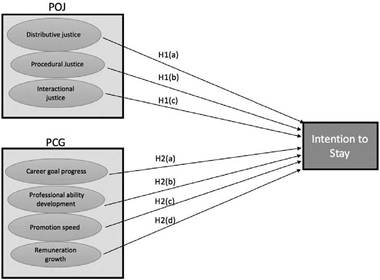
Figure 1. Conceptualframework.
3 METHOD
Chief traffic officer was formally requested to grant permissions for their staff to participate in the research survey. A total of 650 potential respondents were approached using stratified random sampling. The sample consisted of 224 traffic wardens working in 30 sectors in City Traffic Police Lahore was gathered. In order to avoid potential biases and problems which may stem from the hectic nature of a traffic officer’s job, data gathering was carried out during the morning briefing time, when employees were more mentally and physically fresh. Furthermore, social desirability bias was minimized by ensuring the confidentiality of the responses of respondents. Moreover, he length of questionnaire was minimised and phrased so as to retain logical flow of questions as well as the interest of the respondents.
4 MEASURES
Intention to stay, as opposed to turnover intention, is defined in this study as a conscious and deliberate wilfulness to leave the organisation (Bayazit & Mannix 2003). Consistent with this definition, intention to stay was measured using a three-item scale with a Cronbach’s alpha coefficient of 0.83, and was developed by (Stassen & Ursel 2011). A sample item is: “If I were completely free to choose, I would prefer to continue working in this organisation.”
Distributive justice refers to “the fairness associated with decision outcomes and distribution of resources” (Loi et al. 2006). In accordance to this, distributive justice was measured using a six-item scale developed by Price and Mueller (1986), that has a reported Cronbach’s alpha coefficient of 0.94. A sample item is: “I am rewarded fairly, considering the responsibility assigned to me.”
Procedural justice refers to “the fairness of the processes that lead to outcomes” (Loi et al. 2006). Accordingly, procedural justice was measured using a six-item scale developed by Moorman (1991), which has a reported Cronbach’s alpha coefficient of 0.94. One of the items is: “My organisation’s procedures provide for collecting accurate information for making decisions.”
To measure interactional justice, Moorman’s (1991) six-item scale that has a Cronbach’s alpha coefficient of 0.93 was employed. One of the items in the scale is: “My immediate supervisor treats me with kindness and consideration.”
Career progress practices indicate an employer’s commitment and concern for their employees’ future in the organisation. To assess career goal progress, a scale developed by (Weng et al. 2010) consisting of three items and a Cronbach’s alpha coefficient of 0.086 was utilized. A sample item is: “My present job sets the foundation for the realization of my career goals.”
Professional ability development is defined as “the development of the knowledge, skills and abilities that employees require to perform their tasks competently” (Nouri & Parker 2013). To measure professional ability development, a three-item scale developed by Weng et al. (2010) that has a Cron- bach’s alpha coefficient of 0.090 was used. One of the items in the scale is: “My present job encourages me to continuously gain new and job-related skills.”
Promotion speed was measured using Weng et al.’s (2010) scale, which consists of three items and a Cronbach’s alpha coefficient of 0.087. A sample item is: “My promotion speed in the present organisation is fast.” Remuneration encompasses fringe benefits, salary and yearly bonus. In this study, remuneration growth was evaluated using a three-item scale developed by Weng et al. (2010), that has a Cronbach’s alpha coefficient of 0.083. A sample item is: “My salary is growing quickly in my present organisation.”
All instruments used in this study were answered on a five-point rating scale, with response options ranging from 1 “strongly disagree” to 5 “strongly agree”.
5 RESULTS
5.1 Descriptive analyses
Table 1 presents the means, standard deviations, and correlation coefficients between the study variables. The possible range of scores for all variables was 1 to 5, where higher scores indicate greater levels of intention to stay, distributive justice, procedural justice, interactional justice, career goal progress, professional ability development, promotion speed and remuneration growth. Specifically, the range for each variable of interest is: 1.0 - 4.33 for intention to stay, 1.17 - 4.50 for distributive justice, 1.0 - 4.50 for procedural justice, 1.0 - 4.33 for interactional justice, 1.0 - 4.67 for career goal progress, 1.0 - 4.33 for professional ability development, 1.0 - 4.68 for promotion speed and 1.0 - 4.57 for remuneration growth.
5.2 Hypothesis testing
Multiple regression was employed to predict intention to stay (ITS) from distributive justice (DJ), procedural justice (PJ), interactional justice (IJ), career goal progress (CGP), professional ability development (PAD), promotion speed (PS) and remuneration growth (RG). Results from partial regression plots and a plot of studentized residuals against the predicted values showed linearity. The analysis also revealed independence of residuals as measured by a Durbin-Watson statistic of 2.21. Homoscedasticity was likewise established using a visual inspection of a plot of studentized residuals versus unstandardized predicted values. Despite high correlations among the independent variables, there was no evidence of multicollinearity, as evidenced by tolerance values greater than 0.1.
Overall, the multiple regression model significantly predicted intention to stay (F (7,216) = 26.37, p < 0.05, adjusted R2 = 0.443). Specifically, 44.3 percent of the variance in intention to stay can be explained by different dimensions of organisational
Table 1. Means, standard deviations and correlation coefficients.
| 1 | 2 | 3 | 4 | 5 | 6 | 7 | 8 | Mean | SD | ||
| 1 | ITS | - | 0.614 | 0.541 | 0.586 | 0.453 | 0.505 | 0.627 | 0.597 | 1.899 | 0.560 |
| 2 | DJ | - | 0.748 | 0.764 | 0.716 | 0.701 | 0.827 | 0.753 | 1.707 | 0.427 | |
| 3 | PJ | - | 0.750 | 0.711 | 0.664 | 0.737 | 0.722 | 1.825 | 0.484 | ||
| 4 | IJ | - | 0.772 | 0.704 | 0.797 | 0.733 | 1.672 | 0.448 | |||
| 5 | CGP | - | 0.662 | 0.759 | 0.674 | 1.670 | 0.543 | ||||
| 6 | PAD | - | 0.689 | 0.717 | 1.693 | 0.529 | |||||
| 7 | PS | - | 0.777 | 1.740 | 0.570 | ||||||
| 8 | RG | - | 1.783 | 0.568 |
Note: N=224
Note: Dependent Variable: Intention to stay, *pbgcolor=white>0.038