Consumer engagement captured in online endorsement (A case study in hijab endorsement)
F. Fatmasari, N. Muna, A.C. Nugroho & Y. Yudani
Polytechnic APP Jakarta, Jakarta, Indonesia
ABSTRACT: As technology changes rapidly, marketing area has a challenge to have sufficient changes as well as to meet the demands from consumers.
Online endorsement is becoming more familiar for being a strategy in digital marketing. This marketing way is often used to introduce a new product or to post a sale of a product. Online endorsements can use celebrities or non-celebrities as endorsees. Both of these can represent attachment to the consumer differently. The engagement could be seen from action people did right after seeing online endorsement. The research aimed to provide an insight on how online endorsees and consumers engaged to each other. A comparison between celebrity endorsees’ and non-celebrity endorsees’ engagement was also made. It used behavioral metrics implied from the online endorsement. It also used interpretative phenomenological analysis to analyze data. It would take a look at different capture of online endorsement.1 INTRODUCTION
1.1 Background
Millennial lifestyle changes where the Internet of things has triggered a change of promotion policy online. A product is no longer promoted through leaflets, bazaars, and banners, but has touched the consumer’s preference through endorsement. Endorsement is a promotion by using a figure, both public figure and non-public figure. This is very boisterously done through social media, such as Instagram, an application that allows members to post visual and audiovisual contents along with texts.
Selection of figures becomes important considering the “figure” is spearhead to increase turnover. The chosen figure usually has hundreds of thousands of followers who can be persuaded to buy after the character is seen using a product that is endorsed. Herein lays consumer engagement (consumer engagement) to the attention.
Marzocchi et al. (2013), stated that consumer engagement might be strong predictor of brand trust and affect.One type of endorsement is known as endorsement using customer-driven approaches. This type of engagement activities is of direct benefit to the customers and does not require much support from a firm or seller; alternatively, customers prefer not to involve the firm in the engagement activities. As suggested by Van Doorn et al. (2010), customer behavioral manifestations related to WOM, customer blogging, helping other customers, and writing online reviews are examples in which it is the customer driving the engagement.
Engagement in online endorsement had different view from usual offline endorsement. Some of the usual ways to know the attachment of the consumer is to observe the behavioral site metric. Although it is not always able to capture consumers, it is one of the things most believed by business owner in terms of such things as the number of followers, likes, and comments on the posting of the products. It is also believed that an internship of social media manager at a moslem clothing line prefers the selection of endorsement artists based on the number of followers and statistical data of social media follower increase owned by his moslem clothing line. Usually, the more followers one account has, the higher the cost they charge; however, it commonly comes with better impact on the product sales as well.
It is now an increasing phenomenon that more common people are being known as “rising star” in some social media. They are now in competition in attracting more people to follow their social media. As they get more followers, endorsement will be starting to come.
Considering the aforementioned facts, it begins to be a benchmark for sellers to make an endorsement for their products. Brand managers usually take a look at web metrics or statistical performance of celebrity endorsement; such as the number of followers, the acceleration of the number of followers, likes and unlikes, and also review.
It is also common for endorsement agents to provide statistical data to brand managers routinely. However, there have been a few number of research studies showing the ratio of engagement between consumers to celebrity and non-celebrity endorsees. Thus, the research captured different engagement between celebrity endorsees and non-celebrity endorsees. It comprised followers, likes, views, and comments.2 LITERATURE REVIEW
2.1 Consumer engagement
The concept of consumer engagement has been emerging since Brodie et al. (2011) provided logic that consumer engagement is a psychological state that occurs by virtue of interactive customer experiences with a focal agent/object such as a firm or brand. It is manifested into behavior which can strengthen or weaken the brand or firm (van Doorn et al. 2010, Jaakkola et al. 2014).
More related concept is mentioned about customer voluntary performance (Bettencourt 1997) and customer citizenship behaviors (Rosenbaum & Mas- siah 2007). They focus on customer contributions to the service quality of a firm through benevolent behaviors that are consistent with the role assigned to the customers by the provider. Thus, the stance of that will be helping the firm according to the plans of the firm. Moreover, Groeger (2016) was capturing value from non-paying customer engagement.
Some previous research provide two types of implications of engagement. First, by giving feedback, review, or information about the product (Kumar et al. 2010), or involving in designing product design or assembly (Hoyer et al. 2010, Kristens- son et al. 2004), then affirming new customer or influencing others (Kumar et al. 2010). An opinion against those perspectives leads to new types of consumer engagement (CE) proposed by Jaakkola et al. (2014). They are augmenting, co-developing, influencing, and mobilizing behavior.
An engaged customer will be able to post contents in social media or invent alternative products. They will then be very pleased to participate in test use of a new product.
Furthermore, an engaged customer can persuade or recommend a brand. Obviously, a really engaged customer can even ask others to boycott their competitor’s brands. In social media platform, engagement between customers and its owner(s) can be reflected through customer feedback and collaboration intention (Carlson, 2018).2.2 Endorsement
Endorsement through digital media is applied to both celebrity and non-celebrity social media users. Recent research has demonstrated that celebrity endorsement leads to a favorable attitude toward the endorsed brand (Till et al. 2008). Celebrity endorsement is considered an effective promotional tool by marketers worldwide. One-in-four advertisements use celebrity endorsement. Celebrity endorsement influences advertising effectiveness, brand recognition, brand recall, purchase intentions, and even purchase behavior (Spry et al. 2011). They can attractively invite new consumer to introduce new products to society. Capturing more consumer engagement in its dimensionalities is being observed by some researchers, for example, Noraini & Napi (2015). They reveal the effectiveness in celebrity and non-celebrity advertisement, especially in the area of physical attractiveness, trustworthiness, expertise, and brand-consumer congruency (Noraini & Napi 2015).
Endorsement can be applied through many media, either offline or online. In online endorsement, it is usually applied in some platforms, e.g., Instagram or YouTube, etc. Each platform admits each specialty. Instagram, as a favorite platform for millennials, brings out high engagement between its members through visual photography, caption, and its short videos shown in InstaStory or sometimes in their feeds. Similar to it, there is also Facebook. However, YouTube provides much longer audio-video visual to its subscribers. Those three platforms are now the three highest endorsement platforms having high members.
3 METHOD
This research was attained qualitatively by using interpretative phenomenology analysis.
It attempted to give an explanation on how participants are making sense of their personal life and social worlds which may reveal personal experiences (Smith & Osborn 2003). This research was also a kind of comparative study between celebrity and non-celebrity endorsement’s engagement.Sample brand endorsement observed is a brand in a Muslim fashion line. It was advertised through Instagram. It is observed for about a month after the product was posted. It would be observed in terms of the number of followers, the acceleration of the number of followers, impact to the brand, and comments. In this context, endorsees were persons, celebrity and non-celebrity, paid to promote a product.
4 RESULTS AND DISCUSSION
As shown in the research, many endorsees, especially in hijab, were millennials. The average age of endorsees was 30 years and below. This encouraged their fanbase who are predominantly teenagers to really follow them. However, the endorsees have a good image to get endorsed. In this study, the endorsees observed were Zaskia Sungkar and Laudya Chintya Bella celebrity endorsees, while Hamidah and Mega Iskanti were non-celebrity endorsees observed in this research. They were endorsing for the same brand in that era.
4.1 Preference criteria of endorsees
Choosing an endorser might become a really difficult work for brand managers. Many aspects would be observed through endorsees’ portfolio which is delivered soon after an endorsement inquiry is coming. Preference criteria to endorse might be prioritized into the following aspects: (1) image of endorser; (2) the increase in the number of followers in the social media; and (3) endorsement fee.
The image of the endorser often leads to consumers’ trust. Image of good moslem women with inner natural beauty and attitude would be highly preferred by brand managers. However, one product to another may have different criteria. In addition, reputation is also a major factor for brand managers to pick an endorsee.
Acceleration of the number of followers is the next important aspect of choosing the right endorsee(s). One motive of brand managers to make endorsement was to catch high engagement with new customers. When there is an increasing number of followers of the brand in its social media, one goal is considered achieved since it indicates that there are more viewers on the product post. This phenomenon often leads to better selling.
Since satisfaction also brings a role in endorser preference, endorsement fee is not a big problem for brand managers. Generally, the higher the engagement, the more money is made. The differences between celebrity and non-celebrity engagement and fees are shown in Table 1.
4.2 Consumer engagement capture in online endorsement
Activities of followers are inevitable for benchmarking how successful the endorsement is. People can see, re-post, and re-mention, or even give their footprints by giving like/unlike and feedback in the comment section.
As a post is free to share to public, anybody can visit and leave without an order. Once it is locked, only some people can leave their footprints, while checking a post, for instance a post by CEr2. In some latest post, there are only less than 10 comments. But when the lock was released, it can reach up to more than 400 comments.
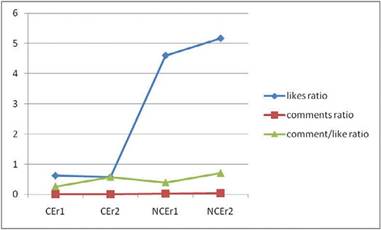
Figure 1. Ratio in consumer engagement.
As celebrity and non-celebrity endorsees reach some awesome number of followers, it will not be neglected that the ratio of footprints will be more challenging. Somehow, the increase in the number of followers should be also followed by the increase in likes or comments. In fact, having more followers does not always mean having more footprint ratio. However, it has been proven that the number of viewers of the post has climbed up significantly.
As seen in Figure 1, it is indicated that NCEr2 has the highest ratio in the number of likes. It could be conceived since the number of previous followers is still uprising.
The interaction between customers and endorsees usually take place in comments. When endorsees provide more feedback in comments, it can improve attractiveness and bring more followers to the account.
Taking a look at the capture, it was reasonable that brand managers would choose an NCEe to endorse the brand with the following reasons: (1) efficient in cost; (2) brought more followers because beginner NCEe are still in an effort of convincing public to trust the brand that he/she endorsed. Yet, CEe could be a good endorser since more followers can bring more viewers on to the brand, so that the awareness to the brand can be climbed up.
Table 1. An overview for celebrity and non-celebrity endorsement.
| Celebrity Endorsee (CEe) | Non-Celebrity Endorse (NCEe) | ||
| 1 | 2 | 1 | 2 |
| 22m | 13,5m | 657k followers | 554k |
| followers | followers | followers | |
| 2980 posts | 3411 posts | 1998 posts | 1445 posts |
| Up to 137k | Up to 77k | Up to 30,2k | Up to 28,6k |
| likes in a | likes in a | likes in a post | likes in a |
| post | post | post | |
| Got 359 | Get 441 | Get 118 | Got 202 |
| comments | comments | comments | comments |
| Starting from IDR 8m | Starting from IDR 3m | ||
*Taken per July13, 2018
5 DISCUSSION AND CONSLUSION
Grasping consumers to get engagement with endorsee was one important key to improving sales. This study has proven that the number of endorsees’ followers impact the the number of the brand’s account followers. Consequently, this leads to the percentage of the acceleration of followers of the account. In addition, the availability to chat with the endorsees in the comment section also triggers the acceleration of the number of the followers which usually leads to better selling.
This research jumped to the conclusion that preferences of CEe or NCEe would imply on each situation of the brand. More followers will come with more costs. This means that if we try to endorse a brand to a Cee, we have to be ready to prepare more money.
There is a similar research implying that product attitudes were predicted by inferences about the endorser’s liking for the product and by attitudes toward the endorser (Silvera 2004). In support of this practice, research indicates that celebrity endorsements can result in more favorable advertisement ratings and product evaluations (Dean & Biswas 2001).
For further studies, it is recommended that the ressearch go in a more in-depth investigation parti- culalry on the elaboration of the comment section. The analysis can be about the classification of the followers (whether they have real or fake accounts), their loyalty to the products or to the endorsees, and so on.
REFERENCES
Bettencourt, L.A. 1997. Customer Voluntary Performance
Customers as Partners in Service Delivery. Journal of Retailing 73: 383-406.
Silvera, D.H. & Austad, B. 2004. Factors predicting the effectiveness of celebrity endorsement advertisements. European Journal of marketing 38(11/12): 1509-1526.
Dean, D.H. & Biswas, A. 2001. Third-party organization endorsement of products: an advertising cue affecting consumer prepurchase evaluation of goods and services. Journal of Advertising 30(4): 41-57.
Hoyer, W.D., Chandy, R., Dorotic, M., Krafft, M. & Singh, S.S. 2010. Consumer Cocreation in New Product Development. JournalofServiceResearch 13(3): 283-296.
Jaakkola, E. & Alexander, M. 2014. The role of customer engagement behavior in value co-creation a service system perspective. Journal of Service Research 17: 247-261
Carlson, J., Rahman, M., Voola, R. & De Vries, N. 2018. Customer engagement behaviours in social media: capturing innovation opportunities. Journal of Services Marketing 32(1): 83-94.
Kristensson, P., Gustafsson, A. & Archer, T. 2004. Harnessing the creative potential among users. Journal of product innovation management 21(1): 4-14.
Kumar, V., Aksoy, L., Donkers, B., Venkatesan, R., Wiesel, T. & Tillmanns, S. 2010. Undervalued or overvalued customers: Capturing total customer engagement value. Journal of Service Research 13: 297-310.
Groeger, L., Moroko, L. & Hollebeek, L.D. 2016. Capturing value from non-paying consumers’ engagement behaviours: field evidence and development of a theoretical model. Journal of Strategic Marketing 24(3-4): 190-209.
Marzocchi, G., Morandin, G. & Bergami, M. 2013. Brand communities: loyal to the community or the brand? European Journal of Marketing 47(1/2): 93-114.
Noraini, W. & Napi, W. 2015. Celebrity and non-celebrity endorsement effectiveness on consumers ’ attitude towards advertisement. Kedah: Universiti Utara Malaysia.
Brodie, R.J., Hollebeek, L.D., Juric, B. & Ilic, A. 2011. Customer engagement: conceptual domain, fundamental propositions, and implications for research. Journal of service research 14(3): 252-271.
Rosenbaum, M.S. & Massiah, C.A. 2007. When Customers Receive Support from Other Customers: Exploring the Influence of Customer Social Support on Customer Voluntary Performance. Journal of Service Research 9: 257-270.
Smith, J.A. & Osborn, M. 2003. Interpretative phenomenological analysis. In Smith, J.A. (Ed.), Qualitative psychology: A practical guide to methods (pp. 53-80). California: Sage.
Spry, A., Pappu, R. & Bettina, C.T. 2011. Celebrity endorsement, brand credibility and brand equity. European Journal of Marketing 45(6): 882-909.
Till, B.D., Stanley, S.M. & Priluck, R. 2008. Classical conditioning and celebrity endorsers: An examination of belongingness and resistance to extinction. Psychology & Marketing 25(2): 179-196.
van Doorn, J., Lemon, K.N., Mittal, V., Nass, S., Pick, D., Pirner, P. & Verhoef, P.C. 2010. Customer engagement behavior: Theoretical foundations and research directions. Journal of Service Research 13: 253-266.