Israel
Before and after: a less secure nation?
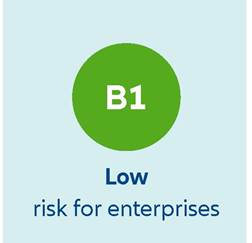
| GDP | USD522.0bn (World ranking 28) |
| Population | 9.6mn (World ranking 95) |
| Form of state | Parliamentary Democracy |
| Head of government | Benjamin Netanyahu (PM) |
| Next elections | 2026, Legislative |
Strengths & weaknesses
Economic overview
A resilient economy with high-tech strengths and growing pains
The conflict will have severe, short-term economic consequences.
We expect a surge in government consumption to continue into 2024, but this will not fully offset the growth impact of conflict-related restrictions, the dampening of private consumption, a disrupted labor supply (due to the massive call-up of military reserves) and weakening investment. Even if the military effort is limited, we predict the economy to return to pre-escalation levels only later in 2024, with economic growth hitting +1.5% this year on the back of public consumption growing by more than +10% if we include military imports. A multifront fight would significantly increase the war's economic weight. In 2025-27, real GDP growth is expected to exceed 3% annually. However, a prolonged conflict might damage the investment potential and Israel's long-term growth prospects.Israel is the third-largest economy in the Middle East after Saudi Arabia and Turkiye. It is an open, developed economy with critical capabilities in high-tech goods, business services and defense, as well as a diversified export base, a highly skilled labor force and stable fundamentals that have increased the economy's resilience to shocks despite continuous military confrontation.
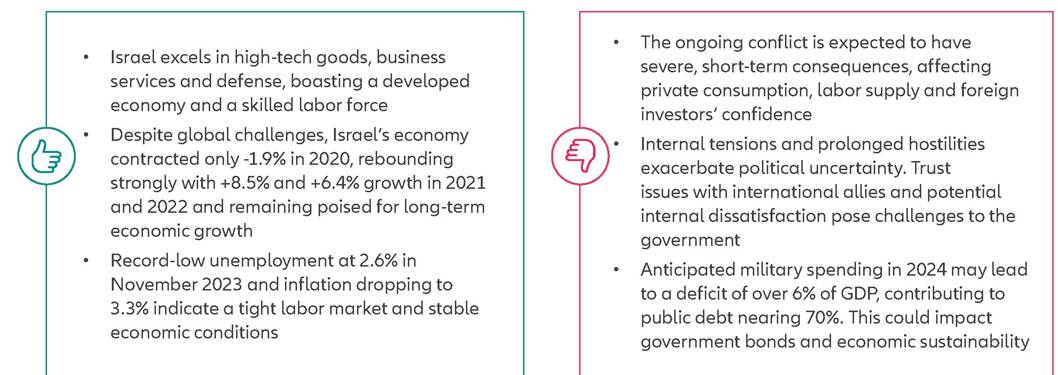
Annual per capita income exceeds USD40 000 and real GDP has grown at an annual rate of +4% on average over the last 15 years.Israel fared quite well during the global Covid-19 pandemic. Economic growth dropped by only -1.9% in 2020, far less than the regional and worldwide averages and a fast vaccination program laid the groundwork for a robust return to +8.5% and +6.4% growth in 2021 and 2022, respectively, fueled by expanding natural gas production and exports. In the first nine months of 2023, Israel was already converging towards low-paced growth due to external and internal factors, including the controversial justice reform and an almost-full occupation reached at the end of 2022. Israeli tech start-up investment had already fallen to a five-year low between January and June 2023 - a decrease of -31% compared to the second half of 2022 and a -68% decrease from H1 2022. At the same time, the construction sector and tourism-related industries (mainly transport and services) are being hit by the conflict and the reduced availability of personnel and resources.
The unemployment rate reached another record low of 2.6% in November 2023, indicating a labor shortage because of border closures and the country's decreased attractiveness since the beginning of retaliation following the October attacks. In June, inflation dropped from 5.4% in January to 3.3% in November 2023 - the lowest level since February 2022, but still above the central bank's 1.0-3.0% target. The policy rate is likely to remain above 4% for the rest of the year, but it could loosen faster amid lower-than-expected GDP growth to implicitly subsidize financing conditions given reduced international market appetite.
Balancing business confidence and political assertiveness
Substantial progress had been achieved on fiscal consolidation before the pandemic, while 2024 may see a deficit of more than 6% of GDP due to an anticipated increase in military expenditure and conflict-related measures.
Public debt was reduced to 58.5% of GDP in 2019 from 74% in 2009. However, a significant recovery package to mitigate the impact of the pandemic produced a fiscal deficit of -11% of GDP in 2020, pushing public debt back to 71% of GDP. Successive efforts, buoyant growth and the small fiscal surplus achieved in 2022 (+0.6%) for the first time since 2000 contributed to reducing the debt-to-GDP ratio to 61%, but this is likely to expand again, nearing 70% by the end of 2024. According to Bank of Israel research, every 1% increase in the public debt to GDP ratio raises the actual yield on long-term government bonds by 10 basis points. Transfers to schools and seminaries serving ultra-Orthodox Jewish communities and to married ultra-Orthodox Jewish men who choose to study religious texts rather than work reached USD1.7bn in the 2023 budget, around the size of all inflows to Israeli startups in one quarter of 2023. If tech firms were to move abroad, this would impact a significant share of government revenues and skilled labor, making such forms of economic assistance unsustainable.76 and divided: a nation's dangerous crossroads
Without a clearly written constitution, it is especially important for Israel to keep the judiciary separate from the executive and legislative branches. The internal tensions that emerged in the first nine months of 2023 and the prospect of a prolonged conflict around Israel's borders portend greater political uncertainty, political developments linked to the person of Prime Minister Benjamin Netanyahu and a general deterioration of political risk in the country.
The Netanyahu-led national unity government may bear responsibility for further escalation, while greater distrust from international allies and internal dissatisfaction with his policies would make a reelection difficult. Israel has had five general elections from April 2019 to November 2022 and polls have also been held in the past, even during particularly tense periods. We do not expect hostilities to cease before the end of the year, considering weaker diplomatic pressures from main security partners as a result of the run-up to the next US presidential election and related uncertainties.