Italy
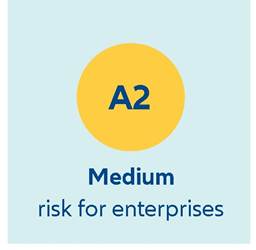
Post pandemic rebound has decelerated
| GDP | USD2010.4bn (World ranking 10) |
| Population | 58.9mn (World ranking 25) |
| Form of state | Republic |
| Head of government | Giorgia Meloni (PM) |
| Next elections | 2027, Legislative |
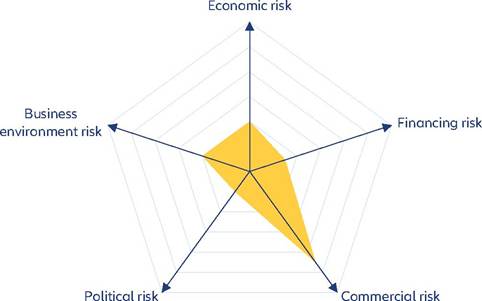
Strengths & weaknesses
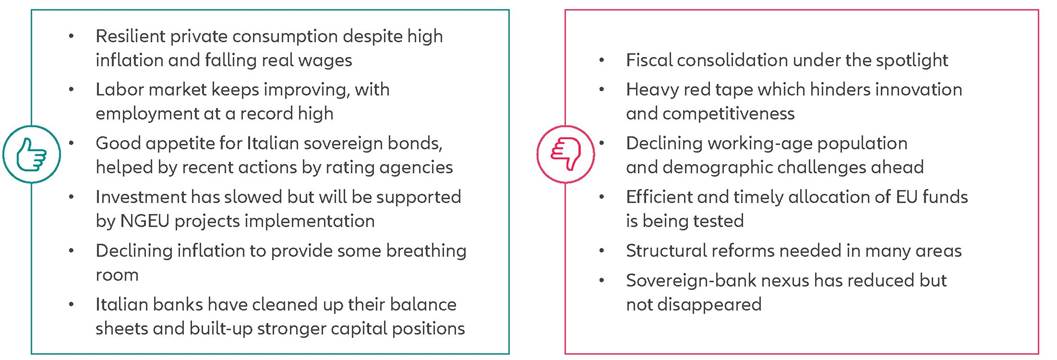
Economic overview
Higher interest rates and weak demand have clouded the outlook
Italy recovered solidly from the pandemic and turned out the best performer among the big four economies.
GDP is now expanding by 3.4% above pre-pandemic levels (vs. EZ GDP +3.1) despite having slowed down in recent quarters given the Eurozone has been challenged by cyclical headwinds. Private consumption growth resumed in Q3 2023 as confidence slowly recovers. The massive investment rebound experienced in 2021-2022 (+22% and 10% y/y respectively) has reverted in 2023 and will only pick up slightly given the high interest rates environment and some delays in the implementation of the NGEU projects.We see activity to grow only +0.5% in 2024, after +0.7% in 2023 and then to pick up to +1.5% in 2025. Indeed, Italy has been highly exposed to the energy crisis; gas represents 43% of the country's energy supply (and Russia was Italy's largest gas supplier, with 40% of all imports in 2020, reduced well below 10% in 2023). This has had a significant impact on households' purchasing power and saving rates and limited manufacturing production.
Therefore, a sustained decline in prices will provide some breathing room to the outlook.
Clearly, energy negative base effects remained the main driver of decreasing inflation (which touched 11.8% y/y in September 2022) and Italy's inflation is now one of the lowest in the Eurozone (below 2%). However, we expect some rebound in the short term, reflecting the phasing out of favorable administrative measures, pushing headline inflation slightly above the 2% threshold. Also, core inflation embarked on a solid downward trend; the contained hourly wage dynamic (at 2.7% in November 2023) is helping in the process.The labor market improved further in the course of 2023, but a slight deterioration is expected this year. The number of employed stayed at a record high and the number of inactive at historic low levels, while the number of unemployed has picked up slightly in recent months. The unemployment rate is low at 7.6% but is seen to deteriorate in 2024 due to the lagged effects of the current economic slowdown. Moreover, structural weaknesses remain; Italy has one of the lowest female labor force participation rates in the Eurozone and the lowest employment rate. This would require major policy interventions to (i.e., supply of childcare facilities) to reinforce women's presence in the labor force.
Business insolvencies resumed after 2020 but remained well below pre-pandemic levels. Monetary policy tightening and the rapid pass-through to corporate financing costs will push up the number of insolvencies in 2024-25. In particular, the manufacturing sector saw a very weak 2023 given the persistent falling demand across the entire sector and signaled no big hopes for 2024 despite a small improvement in future expectations.
Policy tightening impacts Italy's fiscal outlook
The government balance deficit has seen a narrowing in 2023-2024 from 9% and 8% in 2021 and 2022, respectively (given the new Eurostat accounting method for tax scheme which produced significant backward revision). However, we don't expect any substantial consolidation efforts.
Debt dynamics benefited from the favorable differential between nominal growth and debt-servicing costs in late 2022 and during 2023, which alleviated pressures on debt ratio, but we see debt-to-GDP stabilizing around current levels; no significant downward trend is expected in the medium term. Moreover, monetary policy tightening will translate into higher interest debt burdens (i.e., above 4% of GDP in Italy), but lengthened debt maturity profiles and good appetite of domestic retail investors should ease immediate rollover.The Italian sovereign bond market has stabilized after being hit by "old" concerns. Despite fears, the 2023 autumn round of rating actions by major agencies has concluded with no downgrades, alleviating some pressures in the Italian bond market. Indeed, spreads widened in October when the Draft Budgetary Plan was released, envisaging lower growth and a higher fiscal deficit (and any debt reduction). Moreover, the retail oriented H2 2023 sovereign issuances have found good appetite domestically, providing further relief from the ECB's quantitative tightening.
NGEU funds should help to improve the business environment
Italy is set to receive EUR194bn of NGEU funds (EUR122.6bn in loans and EUR71.8bn in grants) to boost growth. The efficient implementation of NGEU related reforms and timely allocation of funds, coupled with a strengthened administrative capacity, will be decisive and should kick-off a sustained path towards the country's green transition and digital transformation.
On 7 August 2023, Italy submitted its amended recovery and resilience plan, which includes a REPowerEU chapter. The modified plan has a strong focus on the green transition, devoting 39%, up from 37.5% in the original plan, of the available funds to measures that support climate objectives and reinforces Italy's digital preparedness and maintains its important social dimension. Italy already received four tranches of payments (around EUR100bn) linked to the fulfillment all the relevant milestones and targets and submitted the payment request for EUR10.6bn in December 2023. It covers transformative reforms in areas including public procurement, frameworks for spending review, industrial property system, competition law, waste management and education, as well as follow-up measures to keep up the implementation efforts concerning the already adopted reforms in the areas of justice.