A new strategy of SME governance in new Indonesia era: Better or worse?
R. Deti, A.V.S. Hubeis, I. Sailah & L.M. Baga
Institut Pertanian Bogor, Bogor, Indonesia
ABSTRACT: This paper explains the new transformation of Small and Medium Enterprises (SMEs) governance in Indonesia by discussing the development of related regulations.
As a developing country, Indonesia faces many challenges such as human development issues in SMEs governance. Data identify that SMEs governance needs some concrete actions besides regular regulations to support SMEs. There is a need of human development action to advance SMEs' performance. Special connection between human development and labor productivity also cannot be denied. The analysis is based on Labor Market Assessment of SMEs in West Java Province, Indonesia, as the most densely populated province in Indonesia. To address this gap, this study suggests a new strategy for building individual skills by developing Financial Life Skill Training.1 INTRODUCTION
Small and Medium Enterprises (SMEs) development is one of the popular topics to discuss in global economic development. Previous research discussing the development of Chinese SME revealed the importance of government and enterprises relations for creating conducive situation (Chen 2006). Topics of regulation and government role do not only occur in China but have emerged as significant issues in the United Kingdom (Bacon & Hoque 2005). In Poland, for instance, the discussion about SMEs comes up with the failure of government SMEs program. Development of SMEs needs structured supporting program from government (Klonowski 2010).
Experiences from many countries show that the transformation for SMEs governance needs government role. In this case, it will emphasize on historical regulations of SMEs in Indonesia. Furthermore, a research study in Cameroon argued that SMEs development is more complex because it requires the supportive business environment.
It needs some efforts to create good environment such as enhancement of human resource (St-Pierre et al. 2015). Hence, this research not only discusses the power of regulation to improve SMEs governance but also needs of developing human resource.From 1997 to 2013, the number of SMEs in Indonesia has increased from 39,765,110 to 57,895,721 (Badan Pusat Statistik Indonesia 2016). Growth number of SMEs drives to the complexity of SMEs governance. It comes to be more challenging because of internal and external factors (Bank Indonesia 2015). This article discusses human development as an internal factor and regulation as an external factor. It needs inline connection between internal and external factors. To this day, Indonesia has so many regulations to support SMEs development. However, it needs more active actions to accelerate the development, especially for human development issues.
2 INDONESIAN GOVERNMENT STRATEGIES FOR SMEs DEVELOPMENT
Government in developing countries tend to direct policies to achieve by focusing on creating occupations, short-term business development, poverty alleviation, and long-term economic growth (Azis & Rusland 2009). SMEs development is one of the government actions as transformation of economic development to help achieving the goals above. According to Indonesia’s Act 20/2008, SMEs aim to increase and expand the enterprises to develop Indonesia’s economic based on fair economic democracy in Indonesia.
Indonesian government has been concerned about development of SMEs since 1990s by regulating these matters as one of the actions to maintain stability of economic condition in Indonesia. This is also a continuation phase of financial crisis impact in 1998. Based on Badan Pusat Statistik report, SMEs did not have any disruption. It could survive from financial crisis in 1997 and provide workforce for unemployed people in Indonesia up to 107 million until 2012 (Bank Indonesia 2015).
Indonesia has been concerned about maintaining SMEs since the last period of New Order Era.
The empowerment and development of small enterprises regulated by Act 9/1995 and Government Regulation 32/1998 aims to expanded workforce and increased income distribution. These regulations continued by Presidential Instruction 10/1999 about empowerment of medium enterprises aimed to increase expansion by using technology in order to improve product quality, and other marketing methods.In Post-New Order Era, SMEs increased and survived to even become more stable in financial and helped in controlling numbers of unemployment in Indonesia. Hence, SMEs have been recognized in domestic economic activities as sources of livelihood for many households, employment regeneration, and poverty alleviation (Tambunan 2007, Padachi & Lukea Bhiwajee 2016, Agyei 2018), but it is still not good enough to help increasing Indonesia GDP growth until several years after Post-New Order Era. SMEs have helped in decreasing numbers of unemployment but still weak in terms of GDP contribution which needs more than financial stability, such as capital, human resource, technology, and market access (Tambunan 2007).
Table 1. SMEs Contribution to Indonesian GDP.
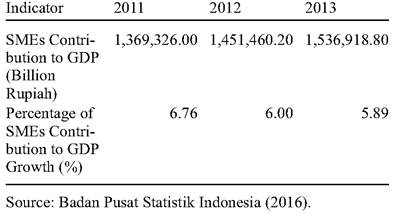
Furthermore, government regulated SMEs into Act 20/2008 supported by Government Regulation 17/2013, contained further development for micro, small, and medium enterprises. This action can be considered as improvement regulation to enhance SMEs strategies, because regulation and policy must be dynamic and adjusted to new situation. As a result, SMEs have been shown a good pace in order to maintain economic activities and have a big hand to Indonesia GDP growth.
From the data above, we can see SMEs contribution to GDP was increasing with increased percentage of more than 5% every year. This is one of the results of government concerns toward empowerment and development of SMEs. According to Ministry of Industry Website, SMEs contribution to the number of GDP has been improved up to 60% within 5 years (KOMPAS, 2016).
One of the key indicators in GDP is human resources. In order to develop quality and standard for SMEs workforce, government regulated Guidelines for Education and Training for Human Resources of Cooperatives, Micro, Small, and Medium Enterprises. This act aims to improve knowledge, skills, attitude, and behavior of SMEs workforce to increase productivity and business competitiveness.Since 2015, Indonesia has been concerned about the growth of ASEAN Economy Community (AEC), which are providing market access for enterprises and human resources to compete freely based on capability and skills. ASEAN countries also have been doing collaboration to reinforce competitiveness and sustainability of SMEs, strengthened by ASEAN Strategic Action Plan for Small Medium Enterprises Development (SAP SMED) 2012-2015 and the latest are for 2016-2025. This document offered strategic goals, explanation about opportunities, and access for SMEs in ASEAN to expand their business and network, supported by policies and regulations applied in each country.
These strategies are still unfamiliar for SMEs people in Indonesia, whereas they just need to utilize the opportunities to expand their business to another step. Indonesia government also has been encouraging SMEs people to expand their business through several strengthening strategies such as convenience financial facility, empowering human resources through vocational training center, and other activities based on government programs and regulations.
In reality, there are still SMEs people who are ignorant and resistant to regulation (Bacon & Hoque 2005), which impacted on SMEs performance. For these kinds of issues, improvement related to internal factors in SMEs is needed such as human resource development because through good policies, regulations, and programs, the SMEs governance just need more concrete actions to advance SMEs performance.
3 IMPROVING HUMAN DEVELOPMENT IN SMES
As we mentioned before, SMEs have been showing a good impact in several aspects on employment and financial stability but are still weak in terms of Indonesia GDP contributions.
It needs improvement in several aspects such as in human resources. Human development has an important and distinct impact on economic growth and performance, whereas GDP also has influence on Human Development Index (HDI) (Ulas & Keskin, 2017, Khodabakhshi 2011). Human Development Index is a summary measure of longterm progress for human development, consisting of three basic dimensions: a long and healthy life, access to knowledge, and a decent standard of living. Knowledge level is also measured by access to learning.Several studies stated that human capital attributes such as education, experience, and skill of employees and managers are important to determine SMEs outcomes (Huselid 1995, Pennings et al. 1998, Georgiadis & Pitelis 2012). Education and training are important to enhancing opportunities and quality in a job. These actions are also considered investment in human capital which can increase productivity, raise employment participation, and direct sources of innovation and competitiveness (Holzer et al. 1993, Barron et al. 1999, Conti 2004, Hunt et al. 2007). SMEs have external benefits on efficiency, innovation, and also increase productivity growth (Tambunan 2007). To advance SMEs growths, SMEs people, both employees and managers, have to improve their competitiveness to survive because there are great market opportunities and access available, but usually SMEs are weak on human capital development. To achieve this goal, SMEs must enhance human skills of SMEs people and thereby productivity growth (Opeyemi & Victor 2017).
Productivity growth is also related to how human resources can improve and develop their individual skills to give great impacts on business. However, SMEs people do not really have access to develop their skills because training in SMEs is considered as informal approach to enhance skills with little provision and systematic approach because SMEs do not really have luxury to train employees (Kotey & Slade 2005, Beaver & Hutchings 2005).
Literatures argue that human resources aspects in SMEs are in need of training and development to create a better organizational culture (Beaver & Hutchings 2005, Padachi & Lukea Bhiwajee 2016). In a changing environment where global competition becomes more intense, human development is one of the aspects required to support SMEs (ASEAN 2015). ASEAN Strategic Plan has several desired outcomes such as enhancing productivity and human capital development (ASEAN 2015). These outcomes can be effectively done with skill development. Improving skills is one of the strategies used to create a better SMEs performance, because coherent and dedicated strategies for employees can provide useful goals to work with their best efforts (Georgiadis & Pitelis 2012).
Besides requirement for hard skills, soft skills also have significant role in enhancing employees’ performance in SMEs. Soft skill development is important in order to survive in the industry and increase productivity of SMEs. In order to enhance individual performance, three factors should be improved: motivation, ability, and opportunity to participate (Armstrong 2009).
Nowadays, HRD has shifted its direction from training in general to being provided individuals to develop capability for the future of their own benefit and for the benefit of their organizations (Beaver & Hutchings 2005). Knowledge from training can be applied to overcome challenges that emerge in the market and give great influences to business, because results of education and training of the workforce in SMEs will tend to be positively related to the profitability of SMEs (Georgiadis & Pitelis 2012).
4 NEW STRATEGY: FINANCIAL LIFE SKILL TRAINING
Many strategies regulated by Indonesia government tend to improve SMEs performance. However, in Indonesian case, improving SMEs performance is beyond the role of regulations. In fact, it also requires skilled labors. Hence, for better transformation of SMEs governance, it needs a new strategy to improve their skills. A literature review also showed that fragile financial life skill of labor will affect the productivity. For getting known about what kind of labor might be needed by SMEs, we had done Labor Market Assessment (LMA) in West Java Province.
As we mentioned before, West Java had been chosen because of its high population number. The number of micro enterprises (MIEs) in West Java Province is around 24,669 (Dinas Koperasi dan Usaha Kecil Provinsi Jawa Barat, 2017). Specific areas selected for doing LMA are Bandung, Indra- mayu, Tasikmalaya, and Sukabumi. This research conducted quantitative survey and qualitative indepth interview. It involved 169 entrepreneurs from SMEs for quantitative survey. For Focus Group Discussion (FGD), it involved 16 government institutions and 146 entrepreneurs.
LMA result showed that there is a gap in labor soft skills so that SMEs might need upgrading labor soft skills such as technical knowledge, managing personal financial, accounting, computerizing, and communication. Figure 1 emphasizes 7 biggest gap soft skill assessments in West Java Province.
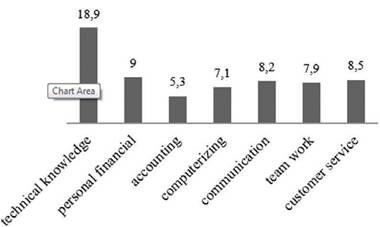
Figure 1. LMA for Gap in Soft Skill.
Furthermore, those data showed that we have to make some strategies to improve labors’ soft skills. Technical knowledge might need some training from each SME because it would be different for each. It depends on the type of SME industries. However, in general, all of SMEs labor needs personal financial soft skill. As we discussed before, personal financial problems might decrease labor productivity so that it
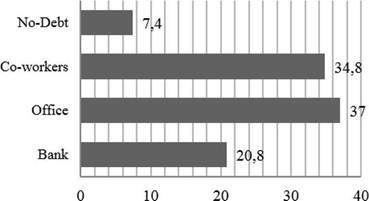
Figure 2. Labor debt.
is necessary to be more concerned about personal financial labor.
LMA showed that only 7.4% of SMEs labors are stable with personal financial state. Around 92.6% labors have credits in different sources. The highest number is labors with debt in office. As SMEs are nothing but small and medium enterprises, this also in one way means that the financial situation will also be in small or medium level. If many labors borrow money from office, it would drive to unstable financial condition for SMEs. Hence, we have to put more concerns to the personal financial labor issues.
This research aims to promote a new strategy for SMEs development in terms of personal financial life skill. SMEs need employees who could manage personal finance so that they would be productive employees in terms of enhancing SMEs performance. Indonesian government needs action to improve the performance because at some points, SMEs have been assumed as risky institution (Nunoo & Andoh 2012). Therefore, it needs some improvements to encourage trust for SMEs. One of the strategies that might be effective is financial life skill training for labors.
In this case, we also tried to do a survey on SMEs entrepreneurs about considering the need to implement financial life skill training. We want to make sure that whether it is needed for labors only or also for employers. The result of survey showed that 93.9% for SMEs entrepreneurs expect about having this kind of training for themselves. They consider joining it because they realize that it is an important training for their businesses to develop. In this survey, most of the SMEs entrepreneurs are managing company’s finance by their own.
Furthermore, 73.9% of them are having some credits from difference sources. It shows that financial literacy is one of popular discussions in the case of SMEs. This research has also found that 53.3% of SMEs entrepreneurs had been joining soft skill training; this shows that they seem interested for having this kind of training. Hence, they argue that SMEs entrepreneurs are supposed to have financial life skill training not only for labors but also for the entrepreneurs and employers.
From some surveys, we assume that Indonesia might need an action to improve SMEs performance. We need governance transformation of SMEs, which is supposed to be more concerned with financial life skill. Regulations are important, but we could not deny that human resource development is also a crucial issue in SMEs. As we already discussed, SMEs give a significant impact for economy development in Indonesia.
3 CONCLUSIONS
Indonesia has various strategies for improving SMEs governance, one of which is making regulation. Furthermore, it is getting better year by year. By regulating some public policies, it has been proven that Indonesia starts to be concerned with SMEs development. However, in this case, we could not ignore the importance of human resources. For improving SMEs performance, skilled labors or employees are required. Hence, personal training would be needed to get them. This research suggests a new strategy, which puts some attention of upgrading financial life skills of labors. By collecting some data from observation, interview, and survey, we have found that personal financial skill is one of the human development issues in terms of improving SMEs performance.
REFERENCES
Agyei, S.K. 2018. Culture, Financial Literacy, and SME Performance in Ghana. Cogent Economics & Finance 6
(I) : 1463813.
Armstrong, M. 2009. Armstrong’s Handbook of Human Resource Management Practice 11th Edition. London and Philadelphia: Kogan Page.
ASEAN. 2015. ASEAN Strategic Planfor SME Development 2016-2025. Jakarta: ASEAN Secretariat.
Azis, A. & Rusland, A.H. 2009. Peranan Bank Indonesia di dalam Mendukung Pengembangan Usaha Mikro, Kecil, dan Menengah. Dalam Seri Kebanksentralan 21.
Bacon, N. & Hoque, K. 2005. HRM in the SME Sector: Valuable Employees and Coercive Networks. The International Journal of Human Resource Management 16
(II) : 1976-1999.
Badan Pusat Statistik Indonesia. 2016. Ekonomi dan Perda- gangan: Badan Pusat Statistik Indonesia. [Online]. Retrieved from https://www.bps.go.id Accessed on 2018-01-05.
Bank Indonesia. 2015. Profil bisnis usaha mikro, kecil dan menengah (UMKM). Jakarta (ID): Lembaga Pengem- bangan Perbankan Indonesia.
Barron, J., Berger, M. & Black, D. 1999. Do Workers Pay for On-The-Job Training. The Journal of Human Resources 34(21): 236-252.
Beaver, G. & Hutchings, K. 2005. Training and Developing An Age Diverse Workforce in SMEs: The Need for A Strategic Approach. Education + Training 47(8/9): 592604.
Chen, J. 2006. Development of Chinese small and mediumsized enterprises. Journal of Small Business and Enterprise Development 13(2): 140-147.
Conti, G. 2004. Training Productivity and Wages. The Sixteenth Annual European Association of Labour Economists (EALE). Lisbon.
Dinas Koperasi dan Usaha Kecil Provinsi Jawa Barat. 2017. Profil Koperasi Provinsi Jawa Barat. Bandung: Pemerintah Provinsi Jawa Barat.
Georgiadis, A. & Pitelis, C.N. 2012. Human Resources and SME Performance in Services: Empirical Evidence from the UK. The International Journal of Human Resource Management 23(4): 808-825.
Holzer, H., Block, M. & Knott, J. 1993. Are Training Subsidies for Firms Effective? The Michigan Experience. Industrial and Labor Relations Review 46(4): 625-636.
Hunt, I., Hennessy, M., O’Brien, E. & Sherry, R. 2007. The Graduate and the SME. Education, Knowledge & Economy 1(2): 199-210.
Huselid, M. 1995. The Impact of Human Resource Management Practices on Turnover, Productivity, and Corporate Financial Performance. Academy of Managementjournal. 38(3): 419-443.
Khodabakhshi, A. 2011. Relationship between GDP and Human Development Indices in India. International Journal of Trade, Economics and Finance 2(3): 251253.
Klonowski, D. 2010. The effectiveness of government- sponsored programmes in supporting the SME sector in Poland. Post-Communist Economies 22(2): 229245.
KOMPAS. 2016. Berita Industri. [Online]. Retrieved from http://www.kemenperin.go.id/artikel/14200/Kontribusi- UMKM-Naik Accessed on 2018- 01-10.
Kotey, B. & Slade, P. 2005. Formal Human Resource Management Practices in Small Growing Firms. Journal of Small Business Management 43(1): 16-41
Nunoo, J., & Andoh, F. K. (2012). Sustaining small and medium enterprises through financial service utilization: Does financial literacy matter. In (Unpublished Paper) presented at the Agricultural & Applied Economics Association’s 2012 AAEA Annual Meeting, Seattle, Washington.
Opeyemi, A. O. & Victor, A.A. 2017. An Analysis of Human Capital Development and Productivity GrowthCase Study, Nigeria. Review of Innovation and Competitiveness 3(3): 61-84.
Padachi, K. & Lukea Bhiwajee, S. 2016. Barriers to employee training in small and medium sized enterprises: Insights and evidences from Mauritius. European Journal of Training and Development 40(4): 232-247.
Pennings, J. M., Lee, K. & Van Witteloostuijn, A. 1998. Human Capital, Social Capital and Firm Dissolution. Academy of Management Journal 41: 425-440.
St-Pierre, J., Foleu, L., Abdulnour, G., Nomo, S. & Fouda, M. 2015. SME development challenges in cameroon: an entrepreneurial ecosystem perspective. Transnational Corporations Review 7(4): 441-462.
Tambunan, T. 2007. Development of SME and Women Enterpreneurs in a Developing Country: The Indonesian Story. Small Enterprise Research 15(2): 31-51.
Ulas, E. & Keskin, B. 2017. Is There a Relation Between HDI and Economic Performance? 17th Annual Conference on Finance and Accounting (pp. 61-70). Switzerland: Springer.