Romania
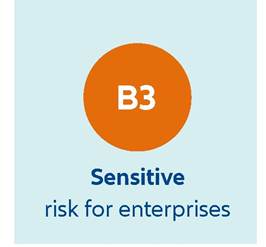
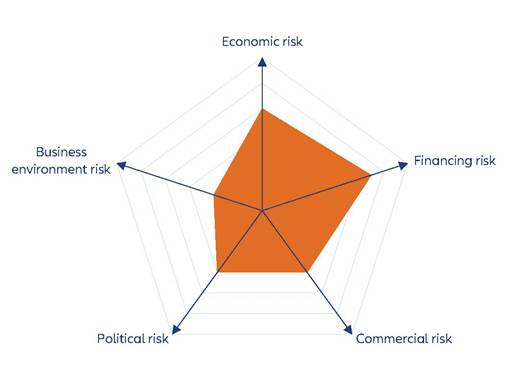
Macroeconomic imbalances remain a concern
| GDP | USD301.3bn (World ranking 45) |
| Population | 19.0mn (World ranking 65) |
| Form of state | Republic |
| Head of government | Marcel Ciolacu (PM) |
| Next elections | 2024, Presidential and legislative |
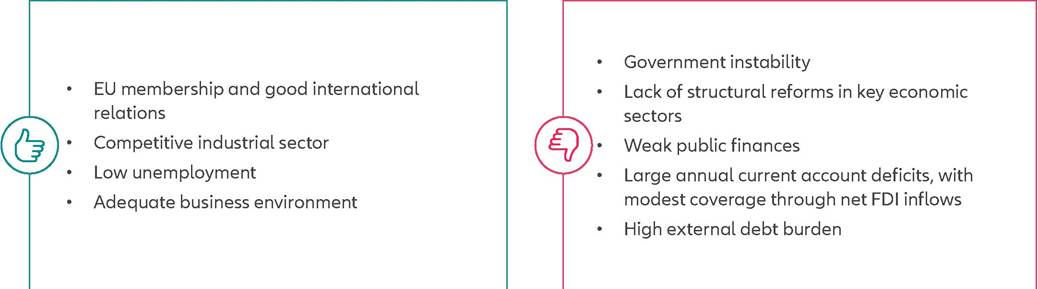
Strengths & weaknesses
Economic overview
Moderate growth and sticky inflation in 2024
Romania has been a strong performer among emerging economies, though periods of economic overheating have caused concern at times.
Average annual real GDP growth was +3.7% over the past 20 years, well above the respective average of the Central and Eastern European EU member states. The global Covid-19 crisis affected the Romanian economy markedly in 2020 (-3.7% contraction), but it rebounded strongly with a +5.7% output increase in 2021. However, Romania's economic prospects have significantly deteriorated since the war in Ukraine. This is due to the country's (pre-war) energy import-dependence on Russia and the impact of EU sanctions against Russia on the domestic economy (for example rising inflation and potential energy shortages). In 2022, economic activity in Romania still held up better than initially expected, thanks to robust consumer spending, investment and external demand. Statistical base effects also helped to achieve growth of +4.7% annually. However, the impact of surging inflation, rising interest rates, weakening external demand and deteriorating business confidence took full effect in 2023. As both domestic and external demand slowed down markedly, real GDP growth is estimated at just slightly over +2%. Going forward, growth is forecast to pick up to around +3% in 2024 and +3.5% in 2025, supported by resilient public spending and investment as well as strengthening consumer spending on the back of rising real disposable income, a fading impact of past interest rate hikes and some monetary easing.Monetary policy by the National Bank of Romania (NBR, the central bank) is officially based on inflation targeting (2.5% ± 1pp) but has been loose for a long time. The real interest rate was negative from end-2017 to October 2023, i.e., the key policy interest rate was below the inflation rate, even when the latter was above the target range for most of 2018-2019 amid rapid double-digit wage growth and again since mid-2021 amid rising energy prices. The latter drove consumer price inflation into double digits from early 2022 until mid-2023. The NBR hiked its policy rate moderately from 1.25% in September 2021 to 7.00% in January 2023. It has also frequently intervened in foreign exchange (FX) markets to prevent excessive currency volatility - not surprising as the official exchange rate regime is that of a managed float - thereby maintaining the exchange rate of the RON stable against the EUR. We expect it to continue to do so as long it has sufficient FX reserves. Meanwhile, inflation is forecast to remain sticky on the back of hikes in food prices and strong wage growth. We forecast headline inflation to average approximately 5.6% in 2024 and 4% in 2025.
Worrisome public and external finances
Romania's public finances will continue to deteriorate and have become a cause for concern. Strong pro-cyclical fiscal stimulus already widened the annual fiscal deficit to -4.3% of GDP in 2019. That ratio rose sharply to -9.3% in 2020 and -7.2% in 2021 because of Covid-19-related fiscal stimulus and loan guarantees and subsidies for SMEs, as well as lower nominal GDP.
Further large annual fiscal shortfalls of around -6% of GDP were posted in 2022-2023, this time due partly to lower fiscal revenues as well as higher spending needs in the wake of the crisis sparked by the war in Ukraine. Despite some planned fiscal consolidation, the annual deficits are forecast to remain high at about -5% in 2024-2025. Meanwhile, the public debt-to-GDP ratio increased from 35% of GDP in 2019 to 47% in 2022 and is forecast to reach about 50% in 2025. While this still appears modest compared to other EU countries, the trend dynamics are a reason to worry.Romania's external finances are another cause for concern. The current account deficit widened steadily from -0.3% of GDP in 2014 to -9.3% in 2022, before narrowing slightly to an estimated -6.5% in 2023. Crucially, only some 38% of the combined shortfall in 2022-2023 was financed through net foreign direct investment (FDI) inflows, well below the comfortable level of 75% and down from a recent high of 168% in 2016. Looking ahead, we expect exports and imports to grow at similar rates in 2024-2025 so that the annual current account deficits should remain large at above -6% of GDP in this period. The net FDI coverage of the deficits is likely to remain below 50% as capital flows to (weaker) emerging markets will remain muted amid ongoing global economic headwinds. Combined with the projected high fiscal deficits, this could raise external financing needs to critical levels. Moreover, the downtrend in the external-debt-to-GDP ratio from 77% of GDP in 2011 to 47% in 2019 has reversed; the ratio came in at 57% in 2020 and should remain above 50% in the next few years. Meanwhile, the NBR's FX reserves have increased again from temporary lows in 2022, although the aforementioned exchange-rate interventions cause some volatility in the level. At USD65bn at end-2023, reserves covered just about 4.8 months of imports, which is considered an adequate ratio. In other terms, however, they do not cover all external debt payments falling due in the next 12 months (well below the benchmark "comfort" level of 125%).
Above average business environment
The business environment is adequate though spots of weaknesses remain. The World Bank Institute's annual Worldwide Governance Indicators surveys suggest that the regulatory and legal frameworks are business-friendly while weaknesses remain regarding perceived corruption. The Heritage Foundation's Index of Economic Freedom survey 2023 assigns Romania rank 53 out more than 180 economies, reflecting strong scores regarding property rights, tax burden, trade freedom and investment freedom. However, weaknesses remain in the areas of judicial effectiveness, government integrity and financial freedom. In our proprietary Environmental Sustainability Index, Romania ranks 40th out of 210 economies, reflecting strong scores for energy use and CO2 emissions per GDP, water stress and general vulnerability to climate change. Yet, there are still weaknesses in renewable-electricity output and the recycling rate.