Sri Lanka
Rebuilding after the storm
| GDP | USD74.4bn (World ranking 76) |
| Population | 22.2mn (World ranking 59) |
| Form of state | Presidential republic |
| Head of government | Ranil Wickremesinghe (President) |
| Next elections | 2024, Presidential |
Strengths & weaknesses
Economic overview
A troubled economic recovery
Sri Lanka's economic growth path has been volatile, but the country has exhibited robust long-term averages in the past: +5% in the 2000s and +5.3% in the 2010s.
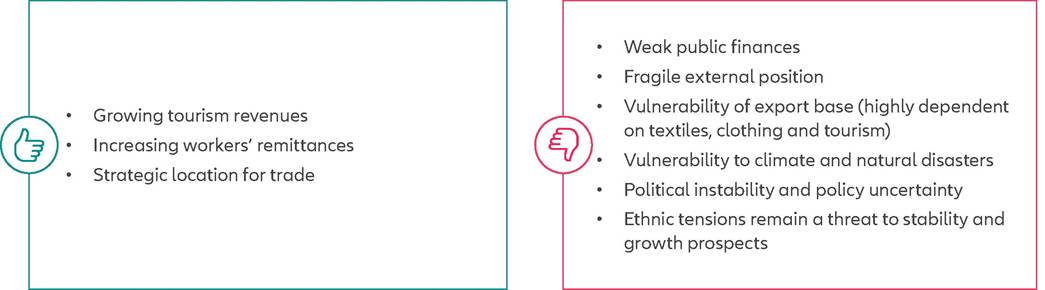
Since 2020, the country's economic health has been suffering from exogenous shocks and endogenous weaknesses. The Covid-19 pandemic caused a contraction of real GDP by -4.6% in 2020, followed by a moderate recovery of +3.5% in 2021. Then GDP plunged even more by around -8% in 2022 due to structural imbalances and financing risks that were not tackled in a timely manner. In 2023, the country continued to face economic challenges and contracted by around -4%. A modest recovery may take place in 2024.In May 2022, Sri Lanka defaulted on its sovereign debt for the first time in its history due to a series of adverse events: a loss in fiscal revenues in 2019 due to terrorist attacks impairing tourism and the global Covid-19 crisis in 2020-2021, as well as poor economic policies in 2021, notably a ban on imported chemical fertilizers - in an attempt to halt an ongoing decline in foreign exchange (FX) reserves - which led to a rise in agricultural producer prices (+35% in two months) and dramatically low harvests.
As FX reserves had fallen to less than USD2bn in early 2022 and without access to international financial markets since sovereign credit rating downgrades in 2020, the Sri Lankan government eventually had no other choice than to call for a restructuring of its debt in May 2022. In March 2023, the IMF approved a 48-monthUSD2.9bn Extended Fund Facility (EFF) to help the country get back on track, but Sri Lanka will remain in default until 2024 at least. The IMF's first review of the EFF in December 2023 was approved and the Sri Lankan government will continue fiscal consolidation measures to maintain IMF support.
Monetary policy was tightened with significant policy rate hikes in 2021-2022 (+1 100bps in total), in response to surging inflation (around 50% in 2022). Since then, inflation has eased (around 16% in 2023) and should decline further in 2024. The Central Bank of Sri Lanka (CBSL) thus began to ease the monetary policy in Q2 2023 and should continue to do so in 2024, allowing domestic debt restructuring to roll out more easily for the country.
Rebuilding financial stability
Looking ahead, Sri Lanka's financing risk will depend heavily on its ability to meet debt-restructuring goals. The government will remain in default in 2024 and we forecast the general government budget deficit to narrow only gradually from the double-digit percentage ratios in relation to GDP in 2020-2022. Gross public debt should remain elevated in the coming years, hovering around 120% of GDP (compared with c.80% in 2019). A domestic debt-restructuring plan was passed in July 2023 and an initial agreement was found in November 2023 with key official foreign creditors (including India and the Paris Club) to restructure around USD6bn of debt.
Sri Lanka's external finances will remain fragile, reflected in continued annual current account deficits in the coming years and a high level of external debt (estimated at around 70% of GDP). FX reserves as of October 2023 recovered to USD3.6bn but that covered less than three months of imports (well below the favorable ratio of four months).
In a longer perspective, in order to tackle these structural imbalances, an export diversification away from the high dependence on the textile & clothing and tourism sectors will be required, among other actions.Business environment and political developments
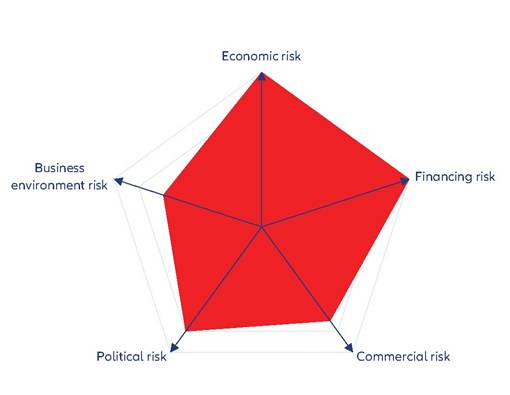
Sri Lanka's business environment is considered below average in our assessment of 185 economies. The Heritage Foundation's Index of Economic Freedom survey 2023 assigns Sri Lanka rank 136 out of 184 economies, reflecting weaknesses with regards to property rights, judicial effectiveness, government integrity, labor freedom, investment and financial freedom. Better scores are only achieved for tax freedom and trade freedom. Moreover, the World Bank Institute's annual Worldwide Governance Indicators surveys indicate weaknesses concerning the regulatory framework, the rule of law and measures to combat corruption. Our proprietary Environmental Sustainability Index puts Sri Lanka at rank 96 out of 210 economies, reflecting strengths in energy use and CO2 emissions per GDP, as well as water stress. However, there are still weaknesses in renewable electricity output, the recycling rate and the general vulnerability to climate change.
The political situation in Sri Lanka remains unstable. Poor handling of the economic crisis and the resulting mass protests led former president Gotabaya Rajapaksa to step down and flee the country in July 2022. Since then, the Sri Lanka Podujana Peramuna (SLPP) has supported Ranil Wickremesinghe - leader of the United National Party - to serve as interim president. President Wickremesinghe thus remains dependent on the SLPP's majority in Parliament for policymaking. With the next presidential and parliamentary elections planned for 2024, approval ratings of the incumbent president and his government are weak and significantly trailing the main opponent, Anura Kumara Dissanayake (leader of Janatha Vimukthi Peramuna). Considering that President Wickremesinghe's opponents have already expressed antipathy towards the IMF deal in place, a change in government could be a risk to the program and loan agreement in its current form.