Structuring Indonesia maritime logistics system through shipping industry, port service provider, and government perspective
Y. Sunitiyoso, S. Nuraeni, T. Inayati, F. Hadiansyah, I.F. Nurdayat & N.F. Pambudi
Institut Teknologi Bandung, Bandung, Indonesia
ABSTRACT: In 2012, as a political will to improve price of goods equality, Indonesian government initiated a program named as Motorways of the Sea Program (Tol Laut).
Ramification of the program is that large number of stakeholders in Indonesia maritime logistics should be accounted in the design and implementation processes. In order to empower multi perspective in development, stakeholders’ involvements shall be considered based on their interests, barriers, and expectations. This study aims to identify those interests, barriers, and expectations from stakeholders in developing and implementing Motorways of the Sea program. Those identification processes will be used as considerations to obtain support from important stakeholders especially government, shipping industry, and ports. Critical system heuristic is used to describe distinctive interests between stakeholders in maritime logistic system. Interviews are conducted with several stakeholders such as shipping companies, government, port infrastructure providers and port operators. Interview results have been triangulated using field observations in several Indonesia main ports. This study is producing a systemic map of each stakeholder’s interest, barriers, and expectations that will eventually enable policy makers to have holistic view of the situation, which is important to design policy that generate shared value in the Motorways of the Sea implementation.1 INTRODUCTION
Indonesia has an estimate of 17,500 islands located within its borders. Therefore, inter-island trade has been an important factor for Indonesia economic development. Indonesia’s trading relies heavily on sea transportation because of its capability to transport large volume of goods in relatively lower cost compared to other transportation modes (Siahaan et al.
2013). Furthermore, to keep the cost low, chain of distribution is often divided into more focused divisions such as port service, shipping, stevedoring, and trucking. On the other hand, coordinating and managing these stakeholders is a challenging task. Each stakeholder often has conflicting interest and strategy, presumably because each side wants to maximize their own gain and benefit. Output of this research aimed to develop holistic view of Indonesia maritime system in Indonesia. This holistic view could consider as policy evaluation and give further description gap between perceived and ideal situation in Indonesia maritime logistics.In some conditions, only sea transportation can send trade goods. On the other hand, although maritime logistics cost is relatively cheap, it is not adequately low to create equal price across the country. Indonesia’s production activity is mainly concentrated in several main islands such as Java and Sumatra (Ralahalu & Jinca 2013). This condition has created unfavorable position for regions that are located relatively far from the production centers. Based on World Bank’s report in 2016, Indonesia was ranked as the 63rd country based on its logistic performance index, which was still below in comparison with neighboring countries’ ranks. Indonesia was also considered as one of the countries with most expensive logistic cost where it still consumes 26% of its GDP. Major discrepancies in terms of development between regions or islands still exist. One of the most apparent phenomena to be observed as a sign of unequal development is the vast difference of basic commodities prices in different region in Indonesia. It is commonly known that the price of commodities such as gasoline in eastern part of Indonesia could reach 400% higher than the gasoline price in western part of Indonesia. The situation exists because of the high logistic cost to transport the commodities to the eastern part Indonesia. Hence, the government sees maritime logistic as one of the priority issues to be solved to reach its development goals.
Indonesian government sees that maritime logistics issue as an important factor for their success on realizing an equal development throughout the country’s broad region. In 2012, as a political will to improve price of goods equality, the Government initiated a program to tackle this issue named as Pendulum Nusantara, and in 2014 it was named as the Motorway of the Sea (Tol Laut) program. The main idea of the program is to decrease logistics cost by optimizing the utilization of sea transportation and the mobility of inter-island decentralized commodities production center. Ramification of the program is that large number of stakeholders in Indonesia maritime logistics should be accounted in the design and implementation processes. Democratic, decentralized, and pluralistic nature of Indonesia’s government, culture, and bureaucracy has put challenge on the implementation of the Tol Laut Program. In order to make the program successful, stakeholders’ involvements shall be considered based on their interests, barriers, and expectations (Direktorat Transportasi 2015).
BAPPENAS policy paper is to disseminate detailed government plan for Tol Laut implementation. Tol Laut strategy mainly focuses on development of 24 strategic ports. This port was chosen to build hub and spoke transportation system. Hub and spoke system aimed to boost shipping efficiency. Other policy is to non-commercial port that is not able to be self-sustained from operation activities (Direktorat Transportasi 2015). All of them will be under government control through Ministry of Transportation. Government also encourages shipping company to operate in certain routes. Government incentives were applied to attract shipping company. All this complex activity is run and monitored by Indonesia central government.
On the other hand, Indonesia’s maritime logistics system consists of many different stakeholders, which made the implementation of the government’s maritime logistics policy become more intricate.
Hence, it is essential to see how the stakeholders view and react to the policy employed by the central government. Therefore, this study aims to explore stakeholders’ perspective towards current Indonesia maritime logistics system; especially shipping industry, port service provider, and government.2 LITERATURE REVIEW
Maritime logistics problem in previous studies mainly focus on efficiency issue. Inefficient operation of route and ship is the main cause of inflated logistics cost, especially in Indonesia (Ralahalu & Jinca 2013, Fahmiasari & Parikesit 2017, Tu et al. 2017). A study about implementation of Tol Laut and Pendulum Nusantara could increase efficiency 10 times compared to previous network. To meet that condition, eastern hub ports, such as in Bitung and Sorong, need to be developed (Fahmiasari & Parikesit 2017). Furthermore, a unique strategy to formulate maritime logistics in Indonesia’s growing market is required (Tu et al. 2017). This view leads government to set and prepare prerequisite condition and calculate optimum parameter for each controlled element, such as number of ports, which ports should become a hub, and which route should be the most efficient in particular ship size.
Maritime logistics problem in previous studies mainly focus on efficiency issue. Inefficient operation of route, and ship is the main cause of inflated logistics cost, especially in Indonesia (Ralahalu & Jinca 2013, Fahmiasari & Parikesit 2017, Tu et al. 2017). A study about implementation of Tol Laut and Pendulum Nusantara could increase efficiency 10 times compared to previous network. In order to meet that condition, eastern hub ports, such as in Bitung and Sorong, need to be developed (Fahmiasari & Parikesit 2017). Furthermore, there is required unique strategy to formulate maritime logistics in Indonesia’s growing market (Tu et al. 2017). This view lead government to set and prepare prerequisite condition and calculate optimum parameter for each controlled element, such as number of ports, which ports should become a hub, and which route should be the most efficient in particular ship size.
Research of maritime transport from 2000 - 2014 in main maritime transport journal has shown growing portion of quantitative approach (Shi & Li 2017). The focus of these researches is mainly on shipping and port topics. This phenomenon indicates that maritime logistics is viewed as sectoral optimization (Mangan et al. 2008). On the other hand, maritime logistics include many parties that created multi perspectives and interests in the system. Thus, research to investigate who the stakeholder is and what their interest and aspiration toward maritime logistics are, especially in Indonesia, is needed to define Indonesia maritime logistics system (Wicaksana 2017).
Largely maritime logistics referred to as an integral process of planning, implementing, and managing the flow of goods and information where ocean carriage acts as the medium (Nam & Song 2011). Song & Panayides (2015) stated that maritime logistics perspective applies to maritime transport issues where logistics and supply chain theoretical context were employed. This indicates that maritime logistics relates to a vast network of actors/components. Moreover, there are three key players in maritime logistics which Nam & Song (2011) identified: shipping companies, port operators, and freight forwarders. Linked to the previous description of maritime logistics, this further showed the complexity involved in the study of maritime logistics, especially maritime logistics as a system.
When analysing environmental conflict issues, where stakeholders are basically the indispensable part of it, it is crucial to analyse and identify the worldview; this includes the interest and position, of the stakeholders involved in the said issues. Policy development is highly related to environmental conflict where its implementation will fundamentally decide the consequences, which relevant stakeholders will receive. It can be concluded that stakeholders view is needed when developing policy for a system.
Based on the study of Vitsounis & Pallis (2012), all members of relevant ports and community influence and contribute to the framing of port system. Furthermore, they conclude that pooled and reciprocal interdependencies that existed in ports are the ones which help promotes the emergence of value co-creation scheme. This indicates that, related to maritime logistics where the port system is one of its components, the understanding of relevant stakeholders’ views is needed to analyse maritime logistics system thoroughly.
3 METHODOLOGY
Critical System Heuristics (CSH) was a qualitative analysis method developed by Ulrich (1996), that is, a reference for system or a system of concern. It defines and structures the situation of an issue into a map of situation or design for changing. In practical, CSH can be used to assess an intervention or used for intervention (Reynolds & Holwell 2010). CSH uses boundary judgments as constraint to frame situation. The boundary method is used to make up a feature situation through mapping a phenomenon into two frames, namely descriptive frame and normative frame (Reynolds & Holwell 2010). Descriptive frame is that existing condition or known as “what is” condition. Normative frame is that ideal condition or known as “what should” condition.
In the first stage of Critical System Heuristics (CSH), identifying stakeholders carried out from secondary data. In this stage, the reference system is the SISLOGNAS, that being identified by the research and using the boundary questions to identify which stakeholders that have certain social roles. In the second stage of CSH, on constructing the descriptive frame, certain semi-structured interview was conducted to justify the identified stakeholders as well as their social roles and key problems.
This paper is utilising qualitative data to generate analysis. Data are collected through interviews with
3 representatives from different stakeholders. First respondent is a representative from one of the largest port service provider companies that is government owned and is authorised in managing government- owned sea ports concentrated in 10 provinces in Indonesia. Second respondent is a representative from a private-owned shipping company in Indonesia established since 1964. Last respondent is a representative from The Committee for Acceleration of Priority Infrastructure Delivery (KPPIP). All interviews were conducted from April 2018 until June 2018. These interviews were conducted using semi-structured interview where all interviewed were recorded upon the agreement of the respondents through interviewees’ consent. Interview guides were constructed using previous research, report, and critical system heuristics question guidelines (Ulrich, 2005).
4 RESULTS AND DISCUSSION
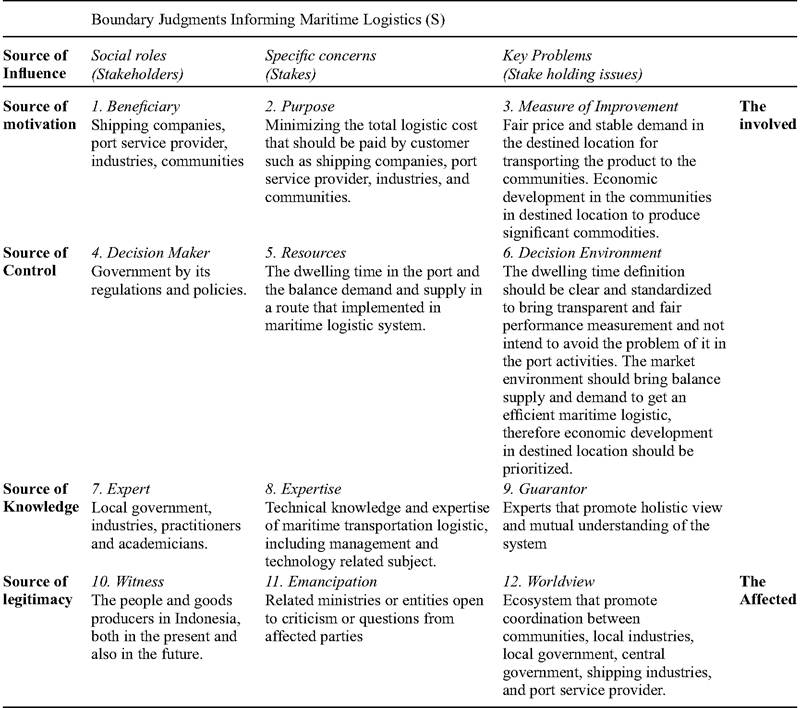
There will be two kinds of analyses: ‘ought to’ analysis and ‘is’ analysis. The “ought to” analysis will be conducted based on the boundary categories and questions of CSH adapted from Ulrich (1996). The analyses will perform ideal mapping of Indonesia maritime logistic system as the reference system based on its source of motivation, control, knowledge, and legitimacy from participating stakeholders. The analysis will define which part is the involved and which part is the affected from the implementation of maritime logistic system. The “ought to” analyses for maritime logistic system can be seen in Table 1.
Table 1. shows the ‘ought to’ analysis for maritime logistics. The ‘is’ analysis reflects the claims about current conditions by stakeholders. Government and state-owned enterprise are the intended beneficiary of the maritime logistic system. There is still less opportunity for domestic private-owned enterprises especially shipping industries to become one part that benefits from maritime logistic system. The involvement of domestic private sectors, especially in shipping industry, is considered important. However, Indonesian government chooses to have relationships with foreign private sectors. This condition forces domestic private sectors to diversify their products and services. Therefore, companies build non-shipping divisions or subsidiary companies. For instance, they build container, trucking, ports, warehousing, and distribution centre. Maritime logistic is less beneficial for domestic private-owned enterprise and its influence make less contribution for them to develop the system.
Whether government, shipping companies, and port service provider have the same goal in maritime logistic system, the main goal is minimizing total logistic cost. The improvement to achieve the goal in port service provider mainly focused to speed, reliability, transparency, and technology. The improvement is also affecting the logistic cost applies to shipping industries as customer in port service. Minimizing logistic cost also develop fair price of products in Indonesian area although it cannot be guaranteed that the effect will occurs directly. If cost of goods is still expensive but the logistics cost in shipping has decreased, then trading system in land has to be analysed. Traders may have increased their margin price. One way to cope with this problem is by establishing trading house managed by the Government.
Fair price and economic development is controlled by government to measure the improvement in order to seek the real impact of minimizing total logistic cost from shipping industries and port service provider. The rule of shipping should be that the vessel follows trade, but what happens currently is the other way around. Building ports need to be conducted where there are economic opportunities in that area. This causes the inefficiency of shipping logistics hence increased costs. However, the condition is the other way around. Government had spent major amount of money to pioneer harbour instead of commercial harbour, which is counter intuitive action according to commercial perspective.
Development of motorways of the sea in maritime logistic system, by providing several routes in Indonesian archipelago, should be supported by clear potential commodities in each destined location that
Table 1. Ought to analysis for maritime logistics system.
will bring efficient loading on shipping process of logistic. Economic development should be guaranteed by local government and communities’ activities that will be helped by the availability of product from shipping routes. There is a problem from local government who often gives additional demands to the infrastructure specification such as exit gate for toll road in their area. Decentralized government should be coordinated with the creation of shared values and goals between local government and central government to minimize intervention and sabotage during infrastructures delivery.
In other perspective, to support the economic development on the destined location may involve marketing aspect. The communities’ ability to produce as well as consume different commodities could be pointed out through the marketing channel. Therefore, the coordination of several participating industries should be implemented. The said participating industries are retail companies, warehousing, and trucking companies. The goal is to bring the economic development in the communities to produce leading commodities. Then, the commodities can be transported to another area that can support efficiency of the shipping route in maritime logistic system.
Still in the context to maintain economic development, acceleration of infrastructure delivery is also important. Factors that subjected to the development of maritime logistic infrastructure are policy, sabotage, and market factor. Policy factor discusses the urgency of action that can support the acceleration of infrastructure delivery. Sabotage factor will be focused on the uncertainty during infrastructure delivery should be minimized especially in social and political issues. Market factor will determine whether the targeted area where the infrastructure will be built is economically well developed and has the needed potential or not.
Government as a decision maker has prioritized which infrastructure are critical to be built with the hope to manage its limited financial capability. The demand of infrastructure is often higher than the capability of government to build them. Infrastructure development should be done in good coordination between central governments, local governments, and private industries. Such manner is needed to give opportunities to private companies take part in supporting government’s financial capability and develop a potential business from its infrastructure. However, the government only manages major ports that have high potential of profit. Smaller ports are offered to private-owned companies. These ports are considered to be less profitable compared to ports owned by government-owned companies. Government-owned companies are supposed to conduct public services for the citizens; instead, they are aiming for profit. Small ports should be managed by government-owned companies rather than handing them to private-owned companies. Other phenomena showed that the planning of ports development in Indonesia was considered being too hasty in its process, whilst the development should be carefully planned yet being sustainable. This can occur with cooperation with local government. However, local government’s budget for infrastructure allocation is small. One possible solution is to bring this matter to ministry level. In addition, public private partnership may also be incorporated to generate more funding.
Operational aspect, dwelling time and productivity in port are also becoming important measurements in developing maritime logistic system. However, the definition of dwelling time in the port should be standardized and adjusted to the condition of the port itself. The regulation must be supportive to the system in port to maintain the clean and clear statement of the arriving logistic. The problem should not be avoided by using the regulation, but the regulation must bring the deliberating of authorization to deal the administrative demand in port. There must be appointed personnel or system to replace longer bureaucracy process. Government is the main decision maker with its regulations and policies. On the other hand, integrated system/platform including custom and administrative process of the logistics involving 18 authorized ministry and department in Indonesia need to be developed. Thus, it may consider the deliberating authorization of respected personnel in the department or ministry. The approval process should be able to be done in the port area to minimize the waiting time of transporter in port and total logistic cost for customer. The system is also become transparent via the implementation of cashless and one gate bureaucracy system. The system will minimize human interaction and the payment can be done in the system directly anytime and anywhere the customer wishes to pay.
The productivity in the port itself is significant to be increased to reduce delays and dwelling time in the said port. Therefore, port management needs to be considered as essential booster of productivity. Changing the capacity of the ships may generate the decrease of occupancy almost to half of previous occupancy. Hence, with the decrease of pier usage rate, the delays of dwelling time on ports will also decrease. Efficiency of the logistics system does not depend solely on gears or machines, but also human resources. Sufficient trainings are needed for workers in every level in order to ensure the efficiency of time and productivity. The strategy will be delivered firstly by doing a re-layout of the port, continued with the solving of human resources and operational activities’ problem. Lastly, implementing related and relevant technologies can do the improvement in equipment and system.
The actual condition may still lack of coordination especially between government, state-owned enterprise, and domestic private companies. The priority of infrastructure development still has inadequate potential market to generate profit. Thus, private companies are reluctant to participate. This condition also exacerbates with less guarantee from government for developing infrastructure in maritime logistics. Yet, government relies more on their collaboration with state-owned enterprises and foreign private companies to get more funding in developing port infrastructure for its maritime logistic system. However, there is mutual interest from government, state-owned enterprises, and private companies in maritime logistic system to promote productivity and efficiency in port for minimizing the total logistic cost. Different stakeholders claim several practical solutions based on each experience for minimizing the total logistic cost.
5 CONCLUSION
As the largest archipelagic country in the world, Indonesia’s maritime logistics system is very fundamental and significant whose problems should be taken by initiatives as quickly as possible. When discussing about a system, stakeholders are having major roles in creating and implementing it; however, stakeholders must have different perspectives and interests at hand. Therefore, this paper’s purpose is to identify interests, barriers, and expectations from stakeholders who have important roles in this system by utilizing a methodology identified as Critical Systems Heuristics. Our findings after gathering data through interviews with several stakeholders show that there are discrepancies of how the system ideally should be and how it really is in terms of operations, supply chain, human resources, financing, even the policies and implementation by the Government. Building integrative system that can benefit all stakeholders, although difficult, is yet still doable. Further recommendation is to gather important stakeholders to coordinately create not only beneficial maritime logistics systems but also sustainable.
REFERENCES
Direktorat Transportasi. 2015. Implementasi Konsep Tol Laut 2015-2019. Jakarta: BAPPENAS.
Fahmiasari, H. & Parikesit, D. 2017. Container shipping network efficiency comparison in Indonesia: Nusantara Pendulum and Sea Tollway. The Asian Journal of Shipping and Logistics 33(2): 79-84.
Mangan, J., Lalwani, C. & Fynes, B. 2008. Port-centric logistics. The International Journal of Logistics Management. 19(1): 29-41.
Nam, H.S. & Song, D.W. 2011. Defining maritime logistics hub and its implication for container port. Maritime Policy & Management. 38(3): 269-292.
Ralahalu, K.A. & Jinca, M.Y. 2013. The Development of Indonesia Archipelago Transportation. International Refered Journal of Engineering and Science (IRJES). 2(9): 12-18.
Reynolds, M. & Holwell, S. 2010. Systems approaches to managing change: a practical guide. Berlin: Springer Science & Business Media.
Siahaan, D.L., Jinca, M.Y., Wunas, S. & Pallu, M.S. 2013. Container Sea Transportation Demand in Eastern Indonesia. International Refereed Journal of Engineering and. Shi, W. & Li, K.X. 2017. Themes and tools of maritime transport research during 2000-2014. Maritime Policy & Management. 44(2): 151-169.
Song, D.W. & Panayides, P. 2015. Maritime logistics: A guide to contemporary shipping and port management. London: Kogan Page Publishers.
Tu, N., Adiputranto, D., Fu, X. & Li, Z.C. 2018. Shipping network design in a growth market: The case of Indonesia. Transportation Research Part E: Logistics and Transportation Review 117: 108-125.
Ulrich, W. 1996. A Primer to Critical Systems Heuristics for Action Researchers. Hull, UK: University of Hull, Centre for Systems Studies.
Ulrich, W. 2005. A brief introduction to critical systems heuristics (CSH). Web site of the ECOSENSUS project, Open University, Milton Keynes, UK.
Vitsounis, T.K. & Pallis, A.A. 2012. Port value chains and the role of interdependencies. In Maritime Logistics: Contemporary Issues (pp. 155-174). Bingley: Emerald Group Publishing Limited.
Wicaksana, I.G.W. 2017. Indonesia’s maritime connectivity development: domestic and international challenges. Asian Journal of Political Science 25(2): 212-233.