After 1945, and especially after 1989, the United States wielded overwhelming power on a previously unimaginable global dimension.
The scale and reach of America's unprecedented power transcended the normal confines of the nation-state. By 2010, the United States had more than 300,000 ground troops and 90,000 naval personnel deployed abroad, stationed in 761 military “sites” (i.e., bases) in 39 foreign countries; these figures do not include forces engaged in the wars in Iraq and Afghanistan.1 In 2011, US military spending surpassed the defense budgets of the next 13 states combined.2 No other nation-state has come anywhere close to matching this projection of power.
US officials, often in conjunction with private corporations and non-governmental organizations, manage a vast international network of political alliances, legal obligations, diplomatic treaties, economic relationships, and military commitments, all for the purpose of maintaining a world system established by presidents Franklin D. Roosevelt and Harry S. Truman during the 1940s. It is this dominant position that has led observers to describe the United States in imperial terms. The historical sociologist Michael Mann has called the post-World War II United States “the only global empire there has ever been.”3 To the historian Niall Ferguson, America is simply the world's “colossus.”4
Mann and Ferguson may believe that the United States has been, and still is, an imperial power, but in the United States their view is not widely shared. Americans have instead overwhelmingly denied an association with imperialism. The United States, according to this view, has for the most part avoided or rejected formal systems of outright colonialism and imperial dominance.5 The result, Daniel Immerwahr points out, is that the history of American empire remains hidden from view, at least on a popular level.6
More representative of popular attitudes and political ideology is George W Bush, who emphatically denied that the United States was an empire even while he was wielding American power more imperially than most of his predecessors had ever
1 Bacevich 2010, 25.
2 Plumer 2013. America's massive military spending, especially in comparative context, has been continuous since the end of the Cold War and the collapse of the Soviet Union. See Kennedy 2002.
3 Mann 2012, 2. Mann has written elsewhere of the United States as an empire: see Mann 2003.
4 Ferguson 2004.
5 On American self-denial about empire, see Go 2011, 1-4.
6 Immerwahr 2019.
Andrew Preston, America’s Global Imperium In: The Oxford World History of Empire. Edited by: Peter Fibiger Bang, C.A. Bayly, Walter Scheidel, Oxford University Press (2021). © Oxford University Press. DOI: 10.1093/oso/9780197532768.003.0044. dared. After the 9/11 attacks, Bush told the graduating cadets at West Point in the summer of2002, building a “just peace is America's opportunity and America's duty.” The United States had legitimacy among other nations to do so because “America has no empire to extend or utopia to establish. We wish for others only what we wish for ourselves, safety from violence, the rewards of liberty, and the hope for a better life”[2781] The irony that Bush's anti-imperial declaration came in the speech in which he announced his doctrine of preemption, probably the most explicitly imperial doctrine in American foreign relations since the Roosevelt Corollary of 1904, epitomizes the irony of American imperialism.
Bush's view, based on a belief that by definition “empire” and “imperialism” mean the control of foreign territories and the forcible subjugation of foreign peoples, shrouded the existence of America's own global imperium. According to Bush, other people built empires; Americans did not. “The United States,” he proclaimed in his 2005 State of the Union address,
has no right, no desire, and no intention to impose our form of government on anyone else. That is one of the main differences between us and our enemies. They seek to impose and expand an empire of oppression in which a tiny group of brutal, self-appointed rulers control every aspect of every life.
Our aim is to build and preserve a community of free and independent nations, with governments that answer to their citizens and reflect their own cultures. And because democracies respect their own people and their neighbors, the advance of freedom will lead to peace.[2782]Bush's view that empires were colonial, and thus by definition territorial and illiberal, was hardly novel. And if empire was territorial, then Americans were not imperialists—at least, not after their relatively brief and unhappy fling with empire in the Philippines. According to Samuel Flagg Bemis, writing in 1936, US annexation of the Philippines was a “Great Aberration,” an unfortunate detour in the nation's history but understandable in the context of the 1890s and relinquished as soon as possible.[2783] A quarter of a century later, Ernest May argued similarly that this imperialist moment was inadvertent and unsought.[2784] Other than in the Philippines, Americans spent much of the century after 1898 dismantling territorial empires— by ousting the Spanish from the Western Hemisphere, encouraging the liquidation of British and French colonies in Asia after World War II, and defeating Nazi Germany, imperial Japan, and the Soviet Union—rather than building one of their own.
Yet build one they did—and not just any empire, but a globe-spanning leviathan that the historian Richard Immerman rightly describes as “the most powerful empire
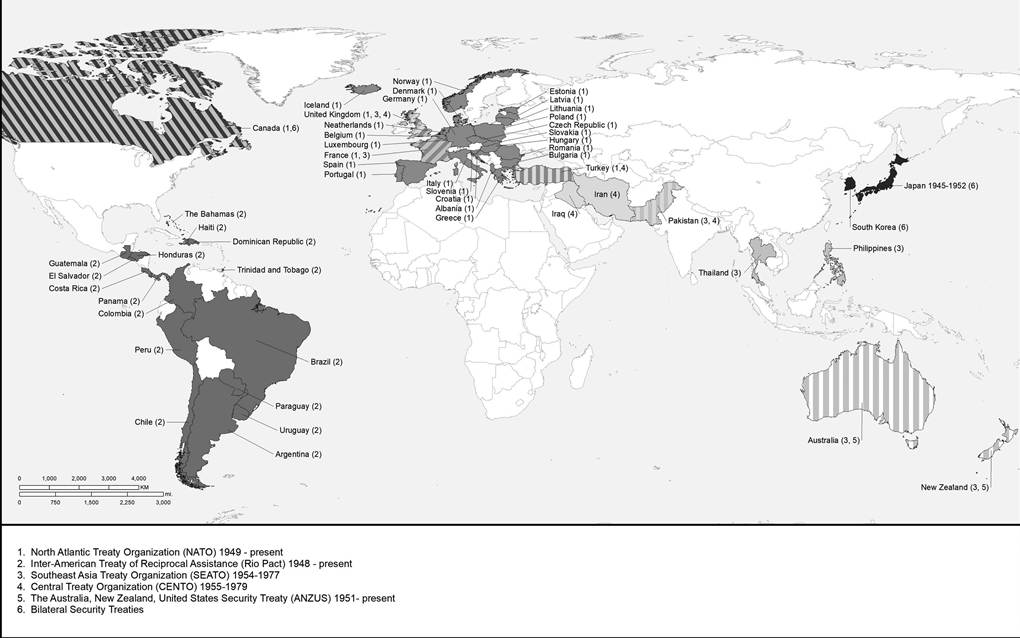
Map 44.1. US Security Treaties.
Copyright: Andrew Preston with Jonathan Weiland.
America’s global imperium 1219
1220 ANDREW PRESTON
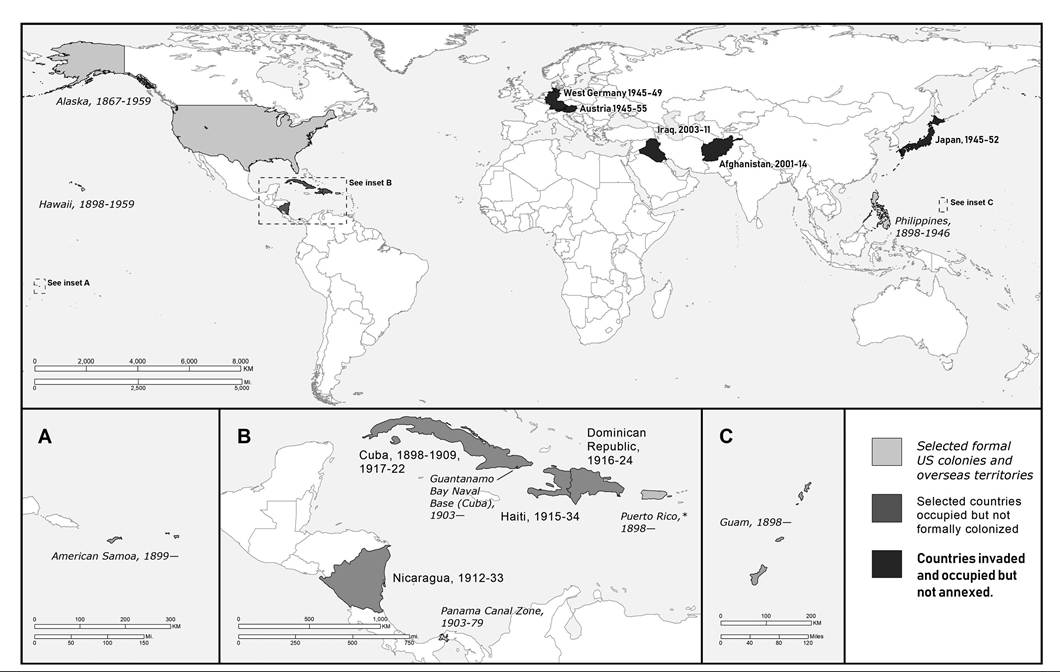
Map 44.2. US colonies, Territories, and Occupations.
Copyright: Andrew Preston with Jonathan Weiland.
in world history.”[2785] How does one solve this paradox between anti- imperialist ideology and imperial practice? The answer is in fact found in the question: after acquiring a relatively limited territorial empire between 1898 and World War II (including the indefinite military occupation of several Caribbean and Central American nations), America's liberal global imperium was founded on what had originally been antiimperialist ideology.[2786] This normative empire, akin to what Massachusetts senator Charles Sumner once called “the imperialism of the Declaration of Independence” deliberately avoided the mercantilist European model followed earlier in the Philippines.[2787] Instead, the new American imperium became synonymous with a liberal, capitalist world order conducive to US values and interests.
Other states would participate in this system or find an enemy in the United States. Ultimately, antiimperialism—that is, an ideology hostile to territorial colonialism and mercantilism— found its apogee in a global American empire that dwarfed all its predecessors.Thus while the seizure and domination of territories that began in the 1890s and waned in the 1930s was imperialistic, the disproportionate scale of power between the United States and the rest of the world that followed World War II was as well. As Michael Doyle has pointed out, an imbalance of power is not by itself symptomatic of empire; a hegemonic power, as opposed to an imperial one, influences the external behavior of other states but does not meddle in or affect other states’ internal policies or domestic politics as well.[2788] By this standard, by not only controlling its external environment but also shaping the domestic character of many other nations, the United States established a long-running empire. After 1945, American dominance was neither incidental nor inactive. To the contrary, American officials who oversaw victory in World War II and waged Cold War against the Soviet Union knew precisely what they were doing. As John A. Thompson has persuasively shown, American elites self-consciously sought global leadership; it was not thrust upon them.[2789] Their overall objective, however, was not simply power for the sake of power; rather, it was to create a world system in an American image, which in turn would ensure America’s security in an interdependent world. For a state that had grown in power and wanted to safeguard its interests, which were now global, but did not want to commit itself to building a territorial empire, controlling the external environment by setting up an integrated world system based on liberalism and openness was the perfect solution. Yet this liberal order was grounded in a paradox: in order to uphold the system, the United States had to use its political, cultural, and above all military and economic power coercively.
It was the creation of this integrated global system, which stitched together peripheral nations around the world from metropolitan centers like Washington and New York, that made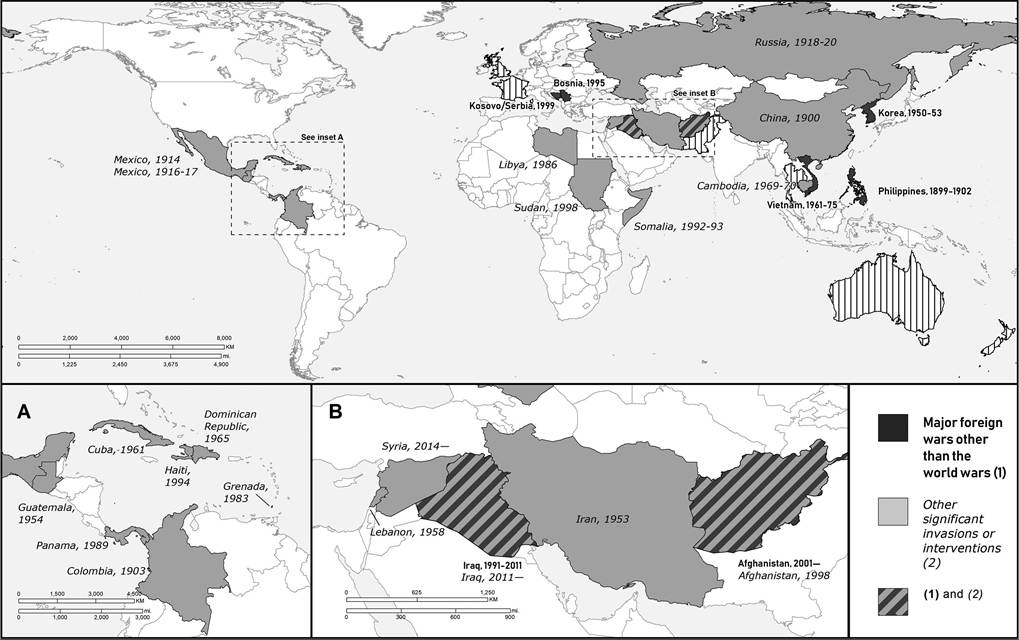
Map 44.3. US Interventions.
Copyright: Andrew Preston with Jonathan Weiland.
1222 ANDREW PRESTON
American power active, purposive, determining, and often coercive—in other words, imperial.
For much of the twentieth century, the terms “empire” and “imperialism” were too politically loaded to provide much analytical insight. Yet since the end of the Cold War, the notion of an American empire has become more accepted by historians as both a legitimate scholarly subject and a (mostly) neutral category of analysis.[2790] This more accepting attitude reflects a dramatic historiographical shift away from notions of empire as formally colonial and territorial, such as the annexation of the Philippines. Historians now often perceive an American empire as informal, predominantly economic and/or cultural, and not necessarily territorial. In this vein, Kristin Hoganson identifies a “consumer’s imperium” that arose from the American middle classes during the industrial boom on the late nineteenth and early twentieth centuries and conditioned the nation’s engagement with the wider world.[2791] The links between culture and empire did not dissipate as America’s hard power grew exponentially in later decades; on the contrary, culture remained an integral component of American globalism. In his history of Cold War Austria, for example, Reinhold Wagnleitner refers to the spread of American culture as a process of “coca-colonization.”[2792] Victoria de Grazia applies a similar concept, “irresistible empire,” to describe the spread of American culture in twentieth-century Europe.[2793] This extends to the invasive nature of other aspects of American culture, often termed “soft power,” but which Ian Tyrrell has called a “moral empire” and Eric Hobsbawm more bluntly refers to as the “imperialism of human rights.”[2794] As Immerwahr has shown, this American empire also extends to the ability to standardize international norms and codes for everything from consumer goods to financial conduct.[2795]
Historians also consider economic clout, derived not from the control of territory but from the control of wealth and the means by which wealth is generated, an important aspect of America’s imperial power.
When the United States transformed itself in the 1970s from a Fordist “empire of production” to a post-industrial “empire of consumption,” argues Charles Maier, the economic and political shockwaves were felt around the world.[2796] Yet according to Noel Maurer, economic interests could also lead to the creation of an unintentional, even reluctant, empire: so great was US wealth, and so extensive was its international reach, that its presence created an “empire trap” that lured a sometimes reluctant US government deeper into world politics because it needed to safeguard private American capital and trade.[2797]Even when historians have explored the more formal and territorial aspects of American power, they have still ascribed to them an imperialistic character. Geir Lundestad has memorably portrayed the expansion of US power into post-World War II Western Europe as an “empire by invitation.”[2798] John Lewis Gaddis builds upon this idea by contrasting America's empire of consent in Western Europe with the Soviet Union's brutal and bloody domination of Eastern Europe.[2799] The historian Odd Arne Westad perceives the Cold War as a fundamental clash between an American “empire of liberty” and a Soviet “empire of justice.”[2800] Not coincidentally, perhaps, historians of other empires, particularly but not exclusively the British Empire in the nineteenth century, situate the twentieth-century United States squarely within the comparative history of empire and imperialism.[2801]
Invitation, consent, and liberty all signal the liberal nature of the American empire. For this reason, “imperium” is perhaps a more appropriate term, for it connotes an imperial system that is deliberately constructed and integrated by a metropole but is not strictly territorial. To be sure, to some extent an imperium must, by definition, be grounded in the rule over territory;[2802] but it can also extend to sovereign rule beyond the control of territory. As Anthony Pagden has observed, imperium was an ancient Roman concept that translates as both “sovereignty” and “rule,” and it encompasses political and economic power as well as military might.[2803] It reflects, as Julian Go has put it, the establishment of “imperial formations” based on “imperial modalities,” rather than strict colonial empires based on the holding of territory.[2804]
Whether America's imperium was irresistible or invited, it has done much to shape the modern world. Since its advent in the 1890s, it has been simultaneously liberal and militaristic, cooperative and coercive, hard and soft. It began, with the annexation of the Philippines and the Open Door Notes over China, as a bid to be recognized as a great power. Woodrow Wilson then altered its terms when he brought the United States into the Great War. It culminated in victory over Germany and Japan in World War II and reached full maturation during the Cold War with the Soviet Union. After 1989, with no rival socioeconomic system to check its advance, it grew dramatically in scale, scope, and reach to become one of the main stimulants to globalization. By the turn of the century, the stability of the American imperium had become so established that it was able to endure bloody setbacks in the Middle East and Central Asia. To be sure, the United States never became all-powerful or invincible; nor was it always in control of the liberalizing and globalizing trends it drove forward.[2805] Yet it is difficult to dispute former Secretary of State Madeleine Albright’s characterization of the United States as “the indispensable nation,” for there is little in the international system since World War II that has not escaped its influence—for better or for worse.[2806]