Anthropology in practice: views from the field
View 1: M.V. Portman advises on photography
Two frontier situations illustrate the perspectives anthropological fieldworkers adapted from such manuals. In 1896, the London-based Journal of the Anthropological Institute published ‘Photography for Anthropologists’.
The author was M.V. Portman, a colonial official who held the position of Officer in Charge of the Andamanese, inhabitants of an archipelago in the Bay of Bengal. Colonial occupation of the islands, which dates from 1789, was an extension of the British presence in Bengal, where an offshore penal settlement had been deemed a necessity, although it was abandoned after only a few years. In 1857 the British reoccupied the islands, this time for the detention of political prisoners implicated in the Indian Rebellion. The incursion of convicts and gaolers brought disease and conflict that saw the near decimation of the indigenous population by the 1870s. The survivors were induced to take up residence in supervised camps in forest clearings, collectively known as Andaman Homes, where they lived under the administration of officials that included the Officer in Charge.16 Portman, appointed to this post in 1879, held it for more than twenty years.Born in 1860, the grandson of an English peer, at the age of 16 he left Britain, having signed up to the Royal Indian Marine. He remained in South Asia until his mid-forties when he returned to England to live in relative obscurity until his death in 1935. Biographical details are sketchy, although a florid obituary in The Times recollects Portman’s presence among the Andamanese and says much more about how an Englishman’s encounter with savagery was viewed in the metropole:
In many parts of the islands the natives were still either ferocious enemies or at best half-tamed; and his work consisted in making contact with them and very gradually bringing them to recognise the value of British rule.
Above all men he had the ‘native touch,’ that rare, mysterious gift that attracts and makes friends at once with natives; and slowly, through a long period of years, he made his gift prevail—work of extraordinary difficulty, for most of them were as shy as wild animals, and often of extreme danger—he would frequently have to land on their beaches, standing up in an open boat, amid a shower of poisoned arrows. But in course of time he won them by sheer personal magnetism. He doctored them; they were very rapidly dying out from venereal disease. He judged them and, when necessary, he hanged them... Not only did he carry out a colossal amount of daily administrative work, but he found time to write an exhaustive history of them and their islands, as well as a grammar of their language... the value of which was repeatedly recognized by the British Museum and other authorities.17While The Times painted Portman’s residence among the Andamanese as a civilising mission, Satadru Sen argues that his position was more complex, if no less pernicious. Colonial records suggest that Portman ‘rejected much of the colonial discourse of civilizing primitives and chose, instead, an interventionism that he and his colleagues called “taming”, by which they meant maintaining aborigines in a state of semipristine savagery under “expert” authority and supervision’.18 Posted to an archipelago with few checks on his autonomy, Portman pursued a double-pronged agenda of preserving and controlling what he perceived as a prime remnant of savagery. He researched on his living specimens, producing several publications and several hundred photographs.19
Portman claimed in ‘Photography for Anthropologists’ that he was writing for the benefit of men like himself, ‘would-be explorers, or recorders of ethnographic facts’. He had read Notes and Queries on Anthropology and his substantial research into the South Andaman languages was conducted in accord with its recommendations.20 His article on photography does not only quote from but also suggests modifications to its advice to photographers.
Although Portman gathered a fairly wide array of ethnographic data, he argued that visual representation occupied a pre-eminent place in the advancement of anthropology. Photographs constituted ‘facts about which there can be no question’, whereas ‘the timid answers of natives... are more apt to produce confusion than to be of benefit to comparative anthropology’.21Portman championed a form of image-making in which the native would be represented as a pure essence, untainted by environmental or historical circumstance (such as the environs of the Andaman Homes). Severed from the regimen of discipline and surveillance from which it originated, the anthropological photograph could function in much the same way as a biological specimen. To this end, Portman, in collaboration with a physician named W. Molesworth, compiled eleven volumes containing frontal and profile views of Andamanese, all photographed against the uniform backdrop of a chequered screen.22 When taking such images, he recommended that the subjects ‘should be stark naked, a full face and a profile view should be taken of each’ and all ‘abnormalities, or deformations, whether natural or intentional, should be photographed’.23 While much of the article consists of technical advice, Portman issued stern counsel on the disposition required of any researcher emboldened to attempt such work:
It is absolutely necessary to have patience with the sitters, and to be in no hurry. If a subject is a bad sitter. send him away and get another, but never lose your temper, and never show a savage that you think he is stupid, or, on the other hand, allow him to think that, by playing the fool, he can annoy you, put off your work, or that to stop him you will be willing to bribe him into silence.24
In its channelling of imperial authority, Portman’s article reaches back to the metropole as much as it extends laterally in its engagement with other colonials in purportedly uncivilised lands.
Most conspicuously and violently, its power is projected downwards at the mercurial savages under his authority fixed with his photographic gaze. Portman amplifies the didacticism of Notes and Queries by tempering the original instructions with the authenticating grit of his field experience. The power relations between coloniser and colonised, always implicit in Notes and Queries, are made explicit. The discipline that Portman brought to his superintendence of the Andamanese was reproduced in his selfdiscipline as a scientist who must unflinchingly maintain his composure, immune to the eruptions of childlike savagery that threaten to capsize it.In spite of Portman’s imputation that the human form could be separated from its social and political context, power relations constitutive of empire are dramatically displayed in his anthropometrical photographs. Portman’s images are deeply voyeuristic and like much ethnographic photography should be recognised as erotica legitimised by an ostensibly scientific import. While no evidence has been found concerning Portman’s sexual relationships (if ever he had any), Sen argues that his primary imaginary was homoerotic. Naked, and usually younger, men were his preferred subjects and, in direct contradiction of his own recommendations, he staged bizarre tableaux in which he depicted himself posing majestically, surrounded by naked Andamanese men. Male genitalia were often displayed in his photographs and intimately described in his notebooks. The intrusiveness of his photographic method correlates with the corporeal proprietorship he assumed over his charges. He sniffed and handled them, and blithely reported on such intimate details as the size of penises and testicles. As Sen writes, Portman practised ‘an exercise in erotics and governance: a laying of hands and eyes on the bodies of subjects rendered docile by the exercise’.25 When the ‘savage’ is not simply childlike, but an actual child—as seen in Portman’s view of an Andamanese girl—his project acquires further connotations (Figure 17.1).
No longer do the callipers simply measure the subject. Rather, they pinion her into a stationary position as the camera takes its long exposure. Such an image makes visible the contradictions at work in the theatre of empire anthropology. In isolating the colonial subject to the extent that she becomes a specimen, her relationship with her imperial master is dazzlingly, albeit inadvertently, illuminated.View 2: Donald Thomson reports on Arnhem Land
In 1939 the Australian government published a report by Donald Thomson describing two anthropological expeditions in the mid-1930s. His travels, lasting twenty-six months, were through Arnhem Land, a 95,000 square-kilometre Aboriginal reserve in the north-east of Australia’s Northern Territory. Anthropology’s ‘amateur period’ was not yet dead, but already in serious decline. Portman had voluntarily conducted anthropological fieldwork; Thomson, forty years later, was an academically qualified professional. Anthropology, botany and zoology were all great passions for Thomson, who spent the greater part of his working life as a research fellow at the University of Melbourne. His career is representative of the changes at work in both anthropology and empire. He studied anthropology under A.R. Radcliffe-Brown, a titan of the discipline, who came to Australia in 1926 to take up a professorship at Sydney, where Australia’s first university department of anthropology was being established. Thomson’s biographer records that the ‘desire to join a scientific expedition to a remote region’ consumed him as a young man and directed his educational trajectory.26 He worked for a time as a journalist, honing his writing skills, and learnt photographic techniques. He also trained extensively in the natural sciences and graduated as a Doctor of Science in 1934.
Thomson is now recognised as a master photographer. In addition to his detailed notetaking and collection of material culture, he used a camera to create extensive visual
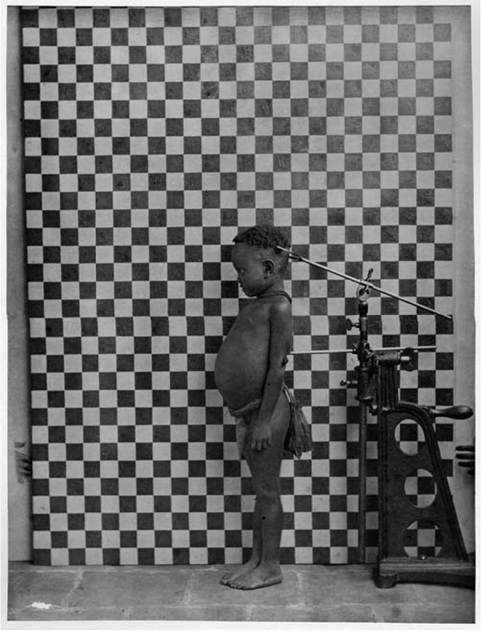
Figure 17.1 M.V.
Portman (photographer). Profile view of an Andamanese girl. Courtesy of the British Library.narratives of his expeditions. Thomson’s photograph of two Aboriginal men, Raywala and Djaari (Figure 17.2), is part of a series taken in 1937 in an area known as the Arafura Swamp. On a fire kindled on a bed of clay, the men are cooking goose eggs. They are seated on a sleeping platform, built in a tree beyond the reach of crocodiles. Thomson, in taking the photo, must have been seated on a similar platform, or was perched on a branch, for the gaze of the men is roughly level with his own. While Thomson was generally scrupulous in recording the names of people in his photographs, he had special reason to do so with Raywala, who had become a friend, tutor and guide in his Arnhem Land adventures. It was Raywala who told him about the annual pilgrimage to the Arafura Swamp that occurred each wet season, the nesting time for magpie geese, the eggs of which are a great delicacy. The egg hunter would build a light canoe, and pole his way through the reedy swampland in search of eggs. In 1937 Thomson combed the swamp with a party of egg hunters, documenting the procedure in minute detail. The unique ecosystem, the abundance of bird and aquatic life, and the endurance of this ancient foodgathering ritual, were stimuli for his interests: ethnographic, zoological and botanical.27
A box containing Thomson’s own equipment is visible in his portrait of Raywala and Djaari. He made no effort to edit his presence from the photo-narrative. The inclusion of
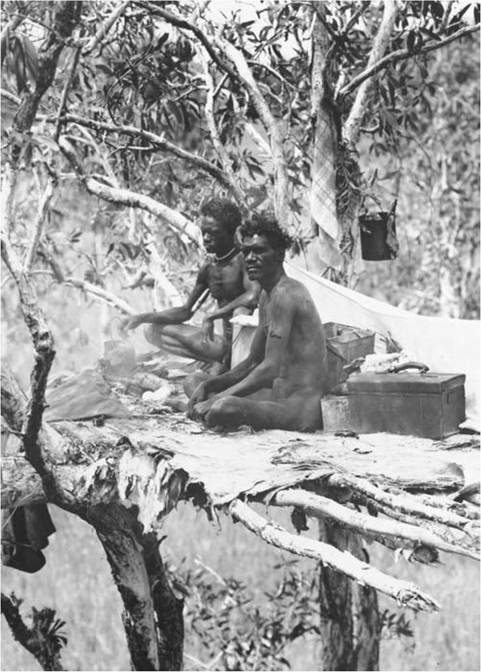
Figure 17.2 Donald Thomson (photographer). Raywala and Djaari sitting on a tree platform, 1937. Courtesy of the Thomson family and Museum Victoria.
his possessions in the image, combined with the sense of familiarity between photographer and subjects, suggests that for Thomson the distinction between the observer and the observed had become blurry. He had, after all, been living closely with Raywala and his clan, and depended on them for survival in the hazard-riddled terrain of the swamp.
Like the photographs he took, Thomson’s report on Arnhem Land reveals a very different face to the anthropological project from that of Portman. Of his purpose in embarking on these expeditions, he writes that they were ‘undertaken so that in addition to making contact with all the important groups of natives inhabiting eastern Arnhem Land, their numerical strength and the localities that they inhabited could be ascertained’.28 Unlike Portman, he wrote with humanitarian interest in the people, and although hints of condescension can be found occasionally, his report is an impassioned argument for the integrity and autonomy of the Arnhem Landers. Whereas Portman’s anthropometric photography stripped his subjects down to some pure essence of savagery, Thomson, who wrote a study of economic exchange in Arnhem Land, took interest in kinship, trade and other connections between Arnhem Landers and the wider world.29
In this spirit, he took considerable interest in their relations with Europeans, as he did also in the history of visitation from Asia. Vessels from South Sulawesi in the Indonesian archipelago had been exploiting maritime resources along the coast prior to British settlement.30 Then in the 1930s, the influx of large numbers of Japanese fishermen along the Arnhem Land coast resulted in sometimes violent clashes. Thomson wrote critically about the latter interventions and their effect on the local culture. His close living with the people whom he studied, and his attention to their lives, are constantly reflected in his observations. This interest in Aboriginal material culture also inspired him to amass a vast collection of art and artefacts, now housed in Museum Victoria in Melbourne.
By the mid-1930s, Australia was no longer a subsidiary of the British Empire, at least in the formal sense. With the exception of Western Australia, the Australian colonies had been self-governing since the mid-nineteenth century. Upon federation in 1901, the new Commonwealth of Australia became a largely independent nation-state. While aspects of defence, foreign policy and the judicial system were still regulated from London, the ultimate severance of these remaining ties had been signalled in 1931 with the Statute of Westminster, which recognised the dominions as ‘autonomous communities within the British Empire, equal in status’ and ‘in no way subordinate’.31
Empire and the values it inculcated, however, did not melt at the stroke of a pen. The history of Australia’s Northern Territory is a notable example of the logic of the imperial ‘out-thrust’ and its pervasiveness not only among the ‘old world’ centres of power. The colonies themselves were captivated by a desire for expansion. Six times the size of Britain, the Northern Territory for much of the nineteenth century had no formal colony and very few settlers, although it did host a sizeable Aboriginal population. It was the land left over when the boundaries of the six Australian colonies were formalised in the mid-1900s. South Australia was already a self-governing colony when it was given permission to annex the Northern Territory in 1863, thus becoming a minor (or aspiring) colonial power in its own right. South Australia’s ambition to settle and thereby incorporate into itself the great tract of ‘wasteland’ to its north would make it become a ‘Great Australian State’ connecting the northern and southern coasts of the continent. Direct trade with Asia would provide the basis for its future prosperity.32 Reality, however, was less bountiful than the ‘Great State’ schemers anticipated; the Northern Territory proved a constant drain on the South Australian purse, and in 1911 the Commonwealth government assumed responsibility for it, along with the significant challenge of addressing the volatile frontier relations in Australia’s north.
When Thomson went to Arnhem Land, some of its inhabitants had already adopted a sedentary existence on Christian missions, established with government blessing as part of a ‘civilising’ process.33 He regarded this as one of several threats to the nomadic groups still living a largely hunter-gatherer lifestyle. The subtext for Thomson’s decision to offer his anthropological services to government was concern at the way the Northern Territory’s administrators were endeavouring to bring tribal people, with their own notion of customary law and justice, under official governance. This included subjecting them to the strictures of criminal law and the court process, of which they had no understanding.34 Unregulated contact with Japanese and other mariners, resulting in prostitution, drunkenness and violence, was among the other threats facing the more traditional people. While in the Northern Territory, Thomson developed friendships with three Aboriginal men of the Djapu clan who had served time in prison for the killing of five Japanese men during an altercation in 1932.35
The most politically contentious aspect of Thomson’s report was his argument against the ‘justice’ meted out to the Djapu. Of the particular unfairness of putting Aboriginal defendants before the white man’s court, he observed
that a native when brought into a court, unless he is influenced by fear, real or imaginary, of punishment, disfavour, or other consideration, will act according to traditional behaviour. It must be remembered that he is not normally expected to tell the truth as we understand it but he is expected to fulfil his social obligations, which are outside his control, and which take the form of set attitudes to all who are near... against others to whom he has less definite obligations or possibly even traditional hostility... For this reason many natives have been tried and punished for ‘murder’ in a white man’s court, when they have been merely instruments carrying out social functions imposed upon them by a social group, to avoid which would mean that they would be regarded as anti-social, and treated by their own society accordingly.36
For Thomson, ethnographic fieldwork provided a window onto customary law and informed his critique of the imposition of a foreign legal system upon people who had neither the linguistic nor educational background to understand it. Although the stridency of his criticisms won him enemies within the profession, Thomson’s outspokenness is indicative of how anthropology had consolidated as a discipline and responded to the distinct temper of the interwar years. In her history of British anthropology, Kuklick describes the impact of the First World War on an intelligentsia that ‘had lost its faith in the inevitability of progress, having lost its belief that improvements in material standards of living brought... improvements in moral standards’. Empire as a project had become increasingly suspect, with anthropologists among social critics who sought to ‘represent all cultures as valuable in their own terms’.37