14 EUROPEAN STATE, GLOBAL NATION 1833–1974
Not only was Greece a new state on the map of Europe; it was a new kind of state, the first of many to be created in the name and in the image of a nation. The model was already being tried out in the New World, in both North and South America.
In Europe, it had been pioneered, abortively, in France during the Revolution. The idea of what we now call national self-determination had been around since the Enlightenment. Europeans everywhere were aware of its possibilities; its day would dawn later in the century, in the national ‘unifications’ of Italy and Germany. But Greece, formally recognised as independent in 1830, was the first experiment in making it work in the Old World.Ten years would pass before the new kingdom would be granted a parliament or a constitution. But even during the ten years of ‘Bavarocracy’, when Otto and his German advisers were accountable to no one, unless it was to Otto’s father back in Munich, most of the portfolios in the government and most administrative positions were filled by Greeks. These were the people who now began to build the foundations of a state that would be truly modern, European, and above all national.1
To be national meant: to be ‘Hellenic’. As a starting point they took the ‘Greek Revival’, whose example had done so much to bring the state into existence in the first place. Within months of the arrival of Otto and the formation of his first government, the decision was taken to move the capital from Nafplio to Athens. The ruined citadel of the Acropolis, crowned by the Parthenon, still dominated the plain of Attica, as it had done ever since the time of Pericles. The modern town at its foot was home at the time to no more than twelve thousand people. But in the eyes of any classically educated foreigner, the ruins and the ancient reputation of Athens encapsulated the very idea of Greece.
Athens must become a city once again, and a fitting capital for a modern state.
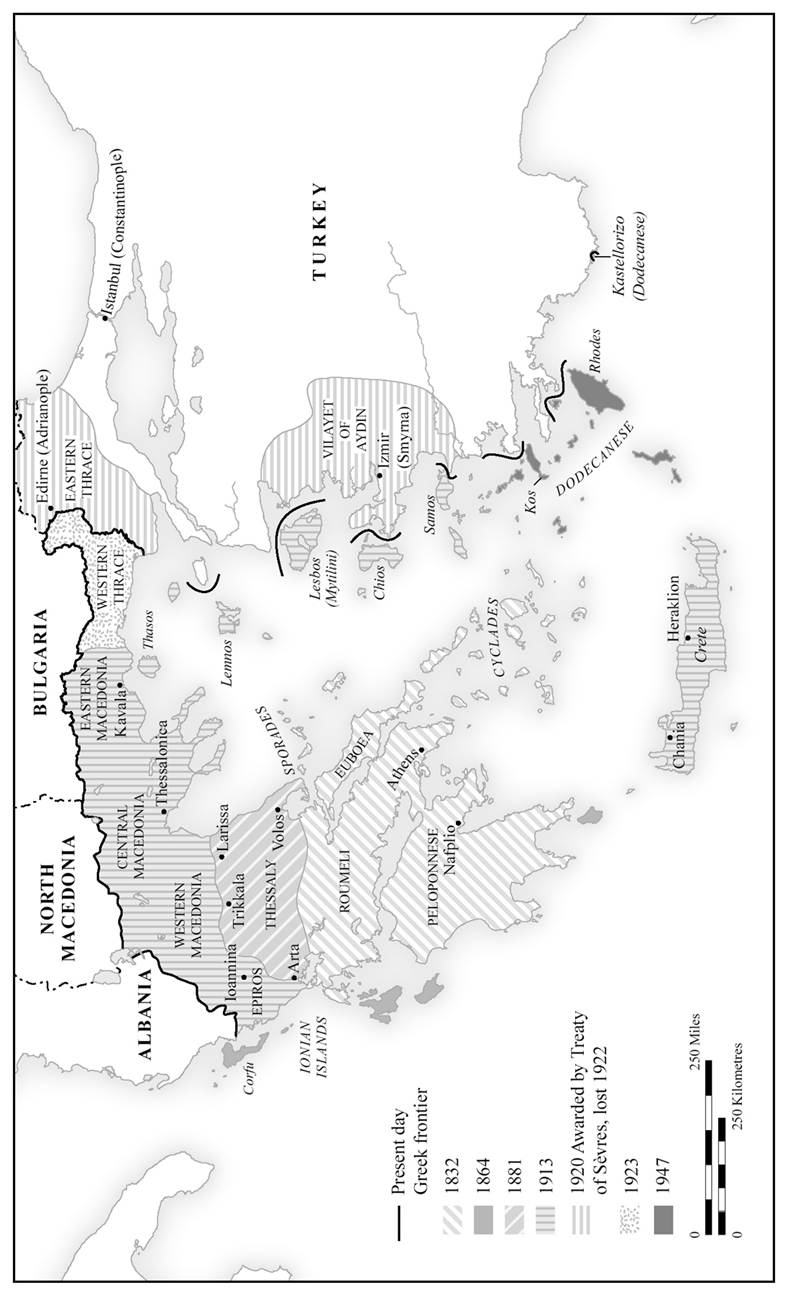
14. The expansion of the Greek state (1832–1947)
A whole new street plan was laid out during the 1830s. Its straight lines and geometric patterns followed Enlightenment principles, which in turn went back to Hellenistic models and ultimately to Hippodamus of Miletus. Over the decades to come, the wide straight boulevards of central Athens, that today are choked with traffic, were driven through derelict houses and open country. The focal point was to be the Acropolis high above, the new city laid out in homage to the old. And just about every sign of human activity during the centuries that separated the decline of the ancient world from the establishment of the new state was systematically obliterated—including all the medieval and later buildings on the Acropolis. Almost every new building, in Athens and many other parts of Greece, too, was built in the neoclassical style, reviving and perpetuating architectural details from the time of the ancient city-states. The new Greece was to be seamlessly welded onto the ruins of its ancient predecessor.2
But there was nothing ancient about the institutions that made all this possible, and enabled the state to function, even if some of them were given ancient names. With great vigour, during the 1830s, state institutions were created that were quite unlike anything that had ever existed before in this corner of the world. A national army was created. At the top of the national judicial system was a supreme court, named the Areopagus, after a rather different institution in ancient Athens. A national currency was introduced and called the drachma, after an ancient coin, but the monetary system was organised along entirely modern lines. A blueprint was drawn up for a national education system.
The University of Athens opened its doors in 1837, named at first after the monarch and then, from 1862, as the National University. The Hill of the Nymphs, overlooking the site of the ancient Agora, was crowned in 1842 by the National Observatory on its summit—the claims of modern science were made early. There was even a national version of the Orthodox Church. The Autocephalous Church of Greece for a number of years cut all its ties with the patriarchate in Constantinople, which of course was obliged to remain an Ottoman, as well as a Christian, institution.The obstacles to making all this work were formidable. The new state had only about six hundred thousand inhabitants, no natural resources, and an agricultural economy that had been ruined by more than ten years of conflict. It was already heavily in debt to the guarantor powers. Back in 1827, the provisional government had defaulted on two loans that had been raised from private speculators on the London stock market to keep the provisional government afloat in 1824 and 1825. None of the centres of Greek education that had flourished during the previous century lay within its borders; few of its citizens, beyond the elite, could read or write. Hardly a building, in most towns and villages, had escaped damage during the revolution; many lay derelict.
Given these challenges, it is all the more remarkable how much was achieved during the three decades of Otto’s reign. Endemic problems remained. Many ‘national’ institutions still had the appearance of a European veneer laid over traditional ways of behaviour that would take decades, yet, to change. Brigandage was rife in the countryside. Outside the centre of Athens, far more people still dressed in the traditional Ottoman style than a la franka (meaning, in the European way). A telling detail is that the national currency, the drachma, did not fully oust the Ottoman piastre until the 1870s. The constitution belatedly granted in 1844 was way ahead of its time, at least in theory, in the breadth of the franchise it offered to citizens.3 But much of this would remain a dead letter until its successor came into force twenty years later—and women would have to wait until 1952 to vote in parliamentary elections in Greece.
New foreign debts incurred at the time of independence, as well as the sometimes blatant interference of the ‘protector’ powers, would severely curtail the sovereignty that had been promised by the founding treaties until well into the twentieth century.Otto loved his adopted country, but his subjects only occasionally warmed to him. They deposed him in a second coup d’etat in 1862. King Otto I (and last) of Greece departed, as he had arrived, aboard a ship of the British Royal Navy, to live out his days back in Bavaria. But despite the frustrations of Otto’s reign, the Greek state had proved itself a ‘new model kingdom in the east’, in the words of its second monarch, the Danish prince who would be crowned as King George I of the Hellenes in the following year.4
A form of vindication came a generation later. In the 1890s, the Olympic Games were revived as a modern international athletic contest. The initiative came not from Greece but from a French sports enthusiast and educational reformer by the name of Baron Pierre de Coubertin. But with strong support from the Greek royal family (who of course were not ethnically Greek either) and leading Greek intellectuals, the city chosen to host the first modern Olympics was Athens. In April 1896, contestants and spectators from all over the world were won over by the splendid neoclassical buildings and wide-open spaces. The Panathenaic Stadium, originally built in the time of Lycurgus in the fourth century BCE, was restored in gleaming new marble, cut from the same quarries that had been used for the original construction. An additional boost to Greek morale came in the final event, the marathon race, which had been devised specially for the occasion, to re-create the twenty-six-mile forced march of the Athenian army after the battle in 490 BCE and was won by a Greek former soldier called Spyridon Louis.5
But Greeks knew very well, as the nineteenth century drew towards a close, that the kingdom in which many of them took such pride was only one part of a far wider Greek-speaking world.
At the time of independence, at least three times as many people who could be reckoned as Greeks had been living outside Greece as lived within it. Since then, the state had modestly expanded. The Ionian Islands had been ceded by Great Britain in 1864; Thessaly and part of Epiros, by the Ottomans in 1881. The population had quadrupled in the same period, to just under two and a half million in 1896. But the number of those living in the Ottoman Empire, in southern Russia, and in emigrant communities on four continents, although no precise means existed to count them, was probably between three and four million.6Even though the state now had a national capital of its own, many both inside and outside Greece throughout the nineteenth century continued to look on Constantinople, not Athens, as the true capital of their nation. One way of resolving the dilemma would be a much more ambitious expansion of the state. And so was born what came to be known as the ‘Grand Idea’.
Often said to be the brainchild of Ioannis Kolettis, a veteran politician who had played a leading part in the Revolution, in a speech delivered in 1844, this ‘Idea’ was in fact as old as the Greek state itself, and indeed inseparable from its very existence. Exactly what it might mean in practice and by what means it might be achieved were the subject of endless debate; many competing versions existed. In its fullest form, the Grand Idea envisioned a restoration of the Byzantine Empire, with its capital at Constantinople. But at its heart lay the aspiration to expand the borders of the Greek state so as to bring as much as possible of the nation within them. In one form or another, this aspiration became the basis for almost all the foreign and much of the domestic policy of every Greek government from the late 1830s to the beginning of the 1920s. And it was not confined to the elite; the Idea seems to have been very widely shared by Greeks in all walks of life, at least among those living in Greece.7
Beyond the borders of the state, attitudes varied.
In Crete, and some other islands that had a majority Greek population, union with the Greek kingdom across the sea was a goal worth dying for. Revolts in Crete broke out in every decade of the century, from 1821 onwards, under the banner of ‘Union or Death’. But elsewhere, Greek communities seem to have been more ambivalent. In Macedonia and Epiros, which bordered the kingdom to the north, and farther east in Thrace, Greek speakers lived cheek by jowl with speakers of Serbian, Bulgarian, Romanian, and Albanian, as well as Muslim Turks. Disentangling these mixed populations would prove a long and sometimes bloody business; in the nineteenth century, what we now call ‘national consciousness’ was only just beginning. Farther afield, if you lived in Trebizond or Caesarea (modern Kayseri) in Cappadocia, you would learn in a Greek school that you and your family were ‘Hellenes’ and belonged to an ancient nation whose fortunes were now reviving. But the simple facts of geography must make it very improbable that your homeland would ever become part of a political state governed from Athens.We have all too little information on the opinions of rank-and-file Greeks living in the Ottoman Empire during this time. But we do know that throughout the nineteenth century, individual Greeks and family networks, based far outside the kingdom, were making their mark on the world, quite independently of the Greek state. Greek shipping and trading networks, whose origins can be traced all the way back to the explosion of activity in Constantinople, Smyrna, Venice, and Crete during the sixteenth century, had expanded hugely during the eighteenth and now began to reach out even farther. It has been argued that their methods, and their business model, would play a formative part in shaping the international trading systems that today we call ‘global’.8
Typical of a new breed of entrepreneurs were the three Vagliano brothers, born on the Ionian island of Cephalonia. With one based in Taganrog on the Sea of Azov, another in London, and the third in the French Mediterranean port of Marseille, they oversaw a commercial network that exported goods from Russia and central Asia by way of the Russian ports on the Sea of Azov and the Black Sea right across the Mediterranean and as far as Paris, Rotterdam, London, and Manchester, bringing back manufactured goods on their return. By the time the last of the brothers died (Panagi Vagliano, in London, in 1902), the combined value of their estate was equal to almost half of the total gross national product of Greece.9
Other family-run firms reached even farther. The five Ralli brothers, born into a family originally from Chios, had set up operations in London during the Greek Revolution in 1823. Pandia Ralli, described as the ‘brain’ of the firm, remained in London; in later life he would become Sir Pandia, known with affectionate awe as ‘Zeus’. With offices on four continents during the middle years of the century, the Ralli family became the most prominent among some sixty well-to-do Greek families established in London, all of them originating from Chios. Their island had been devastated in 1822 during the Revolution; most had set out on their business careers with almost nothing. Throughout the latter part of the nineteenth century and beyond, these families formed a close-knit community, many of them living within a few hundred yards of each other in London’s Finsbury Park, frequently intermarrying, but also integrating to an unusual degree for an immigrant community into British high society. Their graves in West Norwood Cemetery in South London, many of them in grand mausolea designed in the neoclassical style, are a permanent and moving testimony to the public successes and private griefs of a world that has otherwise vanished.10
Fortunes were being made elsewhere, too. In Constantinople, during the second half of the century, out of a city population of just over one million, approximately a quarter were Greeks. Only a generation after the liquidation of the Phanariots in 1821, sweeping reforms in the Ottoman Empire had brought new opportunities for non-Muslims to take part in public life, to organise the education of their own communities, and, for the Greeks in particular, to build even further on the commercial successes of earlier generations. By the 1870s, Constantinopolitan Greeks had largely created the Ottoman banking system; even the sultan banked with Greek firms. Greek financiers based in Constantinople were the main source of inward investment in the Greek state during the latter part of the century. One of their number, Andreas Syngros, would later be remembered as a benefactor and philanthropist in Greece after he moved to Athens in 1870s. But Syngros was the exception; the majority preferred to stay where they were—which was where the opportunities lay.11
Another success story at this time was Egypt. Since the beginning of the century, Greek entrepreneurs had begun moving there in large numbers to exploit the possibilities of the cotton trade that was then opening up. When the American Civil War in the 1860s closed the Atlantic trade in cotton, these Greek businesses, based in Alexandria and Cairo, began to make money on a scale unimaginable in the constrained conditions of independent Greece. One of the most famous Greek businessmen in Egypt was Emmanuel Benakis, who presided over the community in Alexandria at the beginning of the twentieth century. Like Syngros, Benakis is better remembered today than most of his peers because he elected to move with his family to Athens, where he became the city’s mayor in 1914. Benakis’s son, the art collector Antonis, would give his name and his collection to today’s Benaki Museum in Athens.12
It wasn’t only in business and finance that Greeks outside the kingdom were achieving things that few of its citizens would even have dreamt of doing at home. At the turn of the twentieth century, and for some decades afterwards, some of the most influential literary periodicals that circulated in the Greek-speaking world were published in Alexandria. It was there, between the 1890s and his death in 1933, that Constantine Cavafy honed the unique poetic voice that would establish him as by far the best-known and the most frequently translated of all the poets of ‘modern Greece’.
Cavafy was born in Alexandria, into a Greek family from Constantinople, whose fortune had been made, but subsequently lost, in the cotton trade. He rarely visited Greece and didn’t greatly like what he saw when he did. Indeed, part of his youth had been spent in Liverpool and in London, close to the heart of the community dominated by Sir Pandia Ralli. Cavafy’s achievement was to imagine a Greek world centred upon his native city, that had been founded by Macedonians on Egyptian soil more than two thousand years before. More than half of his published poems evoke moments snatched from that history, during periods when the Greek language and Greek culture had been diffused right across the eastern Mediterranean and the Middle East. Cavafy’s take on this whole sweep of history is quintessentially at odds with a national narrative that, ever since the 1820s, has given priority to the Greek state. Imaginatively, in his verse, he celebrates and with self-deprecating irony participates in a narrative of Greek cultural superiority that goes all the way back to Thucydides and Isocrates.
The often-quoted pen portrait of Cavafy, drawn by the English novelist E. M. Forster, who met him in Alexandria in 1917, goes to the heart of an identity that must have been shared by very many educated Greeks of the time. Their mental horizons had been shaped far from Greece, but they would still take a deep, indeed a patriotic, pride in belonging to a much more broadly based Hellenic nation:
He was a loyal Greek, but Greece for him was not territorial.… Racial purity bored him, so did political idealism. And he could be caustic about the tight-lipped little peninsula overseas.… The civilisation he respected was a bastardy in which the Greek strain prevailed, and into which, age after age, outsiders would push, to modify and be modified.13
In the spring of 1897, Greece went to war against the Ottoman Empire. For a heady few weeks, enthusiastic crowds in Athens cheered the accomplishment of the Grand Idea. The Greeks would take back Constantinople; the emperor ‘turned to marble’, Constantine XI, who had died fighting on the ramparts of his capital, would return to life and lead his people to victory; the Turks would be despatched back to central Asia where they had come from. What happened was very nearly the opposite. Within a month, the Greek army was in full retreat, pursued by Ottoman forces that could well have reached Athens if the guarantor powers had not stepped in to enforce the terms of Greek independence. The humiliation of this defeat was felt throughout the kingdom. Even the well-respected King George and the royal family came in for unprecedented abuse. But then, as one apologist for the campaign insisted shortly after it was over, ‘It was the state that had been defeated and not the nation.’14
The Grand Idea now had to be rethought. Which mattered more: to preserve the integrity of the state, or to liberate the nation? The issue had become more complicated now that all the other inhabitants of the Balkan Peninsula had begun to emulate the Greek example and create new nation-states of their own. Romania, Serbia, and Montenegro had gained formal recognition in 1878; a Bulgarian principality was on the way to statehood, fully achieved in 1908; Albania would soon follow. All these new states had their own versions of the Grand Idea, because communities speaking their respective languages lived deeply interspersed throughout the southern Balkans. Meanwhile, the contested regions, known by their ancient names of Epiros, Macedonia, and Thrace, were all still part of the Ottoman Empire. So the stage was set for a three-, four-, or even five-way tussle.
The First Balkan War broke out in October 1912. Greece had a new prime minister, a lawyer who had cut his teeth in his native Crete, where the long-prized goal of union with Greece had still not been achieved. His name was Eleftherios Venizelos, and he would prove to be one of the most successful and also divisive leaders in modern Greek history. An admirer who met him shortly before this time would later record his first impressions:
He seemed to shine, he was transparent, like alabaster, with the complexion of a young girl from northern climes, strangely framed by a beard with the first sparse white hairs. The spectacles added to the brightness, but still more the two blue-green phosphorescent eyes, which seemed to come out from behind the glasses and look directly at you.15
Venizelos was perhaps the only Greek politician of modern times to gain respect abroad as a statesman of world stature. At home, for his supporters he was nothing short of a Messiah. To his enemies (and they were many) he was a ‘false prophet’, inspired by the devil himself. Many, at the time and ever since, have held Venizelos personally responsible for the greatest disaster ever to befall the Greek state.16
After he became prime minister for the first time in 1910, Venizelos applied himself to making the Grand Idea a reality, despite the setbacks of the decade before. Under his stewardship, the economy recovered strongly and investments could be made in the armed forces, as well as in infrastructure and public services. New diplomatic overtures among the competing nation-states of the Balkans at the same time brought about an unexpected alliance against the Ottoman Empire. The first blow was struck by tiny Montenegro, on the Adriatic coast, on 8 October 1912. Within days, Greece, Bulgaria, and Serbia had joined in. A Greek army led by Crown Prince Constantine entered Thessalonica on 8 November, only hours ahead of a Bulgarian force that had been racing to reach the same goal. The Ottomans were driven back to within a few miles of their capital.
Less than a year later, the fragile alliance fragmented. A Second Balkan War, fought in July 1913, rearranged the pieces on the board: Greece and the Ottoman Empire both made gains at the expense of Bulgaria, which had come out as the biggest winner in the first round. By the end of 1913, the frontiers of Greece had been extended to the north, east, and south (to include Crete), almost to where they lie today. The land area of the kingdom had increased by more than half; its population had almost doubled to 4.8 million. Was the next stop to be Constantinople?17
But then, in 1914, came yet another war. This one, too, began in the Balkans, with the assassination of the heir to the Austrian throne while on a visit to the Bosnian capital, Sarajevo, on 28 June. In early August, wider hostilities were declared. This latest Balkan conflict was about to become the Great War, or the ‘war to end all wars’, later to be known as the First World War. On one side was the Triple Entente, consisting of the empires of Great Britain, France, and Russia; on the other, the Central Powers, namely, the German Reich, the empire of Austria-Hungary, and from October the Ottoman Empire, too.
What was the Greek government to do? If Greece were to enter the war on the side of the Entente, an estimated two million Greeks, living in Ottoman territory as Ottoman subjects, would be effectively held hostage. On the other hand, if the Entente were to win, and if Greece had contributed to the defeat of its arch enemy, these Ottoman Greeks could be liberated and their homelands incorporated into a greater Greece. Venizelos, the prime minister, was for joining the war on the side of the Entente; the former crown prince, who was now Constantine I and married to the sister of Kaiser Wilhelm of Germany, was for staying neutral.
In 1915, Great Britain and France began to force the issue by landing troops in Thessalonica so as to defend their Balkan ally, Serbia. Further violations of Greek sovereignty followed. Greeks in all walks of life were more bitterly divided than they had ever been since the days of the internal conflicts during the Revolution. These divisions were so bitter because the argument was fundamentally not about international alliances or the world war at all, but between the interests of the nation and the interests of the state. The old fault line from the 1820s had emerged in a new guise to pit one version of Greek patriotism against another.
In September 1916, Venizelos defied the king and set up an alternative government in Thessalonica. He justified his actions with the declaration:
The Nation is called, in the absence of the State, to answer a national emergency.… Whereas the State has betrayed its obligations, it remains to the Nation to act in order to achieve the task assigned to the State.18
For the next eight months, the country had two rival governments, one led by the king in Athens, the other by Venizelos in Thessalonica. Under this pressure, open civil war broke out on the streets of Athens in December 1916. Six months later, with the support of French troops, Venizelos finally prevailed. King Constantine was forced into exile, Venizelos returned to Athens to head a government of reunified Greece, and Greek troops contributed to the final battles on the Macedonian front that helped to bring the war to an end in 1918.
Once the war was over, and the Entente had indeed won, Venizelos exercised all his considerable talents as a statesman at the ensuing Peace Conference in Paris. The result was to be two huge gains for Greece. The first was the right to land troops in Smyrna and to occupy the surrounding administrative district in May 1919. Then the Treaty of Sèvres, signed in the French town of that name in August 1920, awarded to Greece large swathes of Ottoman territory in eastern Thrace and western Anatolia. With the longer-term future of Constantinople still to be resolved, it was even possible that one day the capital city founded by Constantine, which had never ceased to be the symbolic capital of the Greek-speaking world, might again be ruled by Greeks.
It was a tragic miscalculation. Venizelos and his policy suffered a double defeat: at home, in a parliamentary election held in November 1920, but more critically in Anatolia at the hands of the newly created Turkish Nationalist movement led by Mustafa Kemal, later known as Atatürk, the founder of the modern Republic of Turkey. The election result in Greece brought the exiled King Constantine back to his throne. Because of the king’s stance during the world war, Britain and France withdrew all the diplomatic and financial support they had been giving while Venizelos remained in charge. The new government would have to go it alone. In 1921, Greek forces in Anatolia pushed eastwards in a preemptive strike against Kemal’s provisional capital, Ankara. When that failed, the stalemate that followed lasted for a year. Then in September 1922, the Turks broke through the Greek lines, the Greek army withdrew to the coast and was evacuated to Greece. The Greek population of Anatolia was now left to its fate. The city of Smyrna, where Greeks had made up the largest part of the population for several decades, was devastated by fire within days of the arrival of Kemal’s army.
The defeat of the Greek army in Anatolia, after a three-year campaign, has ever since been remembered by Greeks as the ‘Asia Minor Catastrophe’ (after the ancient name of the subcontinent, still current in Greek), or simply the ‘Catastrophe’. The Greek state had expanded its borders, but to an extent far less than had been envisaged by enthusiasts for the Grand Idea. The price had been the permanent uprooting of the Greek nation from eastern Thrace, from all round the Sea of Marmara, from the Black Sea coast of Trebizond and its hinterland, from the Aegean coast as far south as Smyrna, and from Cappadocia in central Anatolia. These ‘lost homelands’, as they are still remembered by Greeks today, had been home to Greek speakers for centuries, if not for millennia, and had once made up the heartland of the Byzantine Empire.19
Over the next few months, uncounted thousands of Greeks were either killed or taken prisoner. In the aftermath, between 1.3 and 1.4 million Orthodox Christians, almost all of them Greek-speaking, permanently lost their homes. Those who had not already fled during the last months of 1922 were evacuated to Greece as part of a compulsory exchange of populations that was negotiated under the auspices of the League of Nations at the Convention of Lausanne in January 1923. The task of housing and assimilating so many refugees, with assistance from international bodies such as the League and the Red Cross, has often and justly been reckoned as one of the outstanding successes of the Greek state in its two-hundred-year history. But it was also, inevitably, a story of human loss, tragedy, and bitterness. If the immediate crisis was largely over by 1930—when, even more surprisingly, a government once again led by Venizelos was able to normalise relations with Kemal’s new Turkey—it would take another five decades, at least, for the incomers to be fully assimilated.20
In the aftermath, artists and intellectuals agonised over the nature and meaning of what they called ‘Greekness’, or ‘Hellenicity’. A generation of poets, novelists, painters, philosophers, and historians grappled with the challenge: How was it possible, in this new world, to be at once Greek and modern? ‘Greece is travelling, always travelling’, wrote the poet George Seferis in 1936:
and we do not realise, do not realise we’re all of us sailors turfed ashore
do not realise how bitter is the port when all the ships put out to sea;
we laugh at those who do.
Seferis, who was himself an exile from his native Smyrna, took exception to the very term ‘Hellenicity’, which he saw as a form of stereotyping. In an essay published in 1938, he urged future generations ‘to seek the truth… not by asking how to be Greek, but with the conviction that since they are Greek, the work that they will truly produce cannot be anything other than Greek’.21
The novel by Nikos Kazantzakis, written in the early 1940s and known in translation as Zorba the Greek, addresses the same question (though it is about a great deal else as well). ‘Lots of people are patriots for what they can get out of it,’ says the title character. ‘I’m not a patriot, and too bad if I get nothing out of it.… If I hear the Greeks have taken Constantinople, it’s the same to me as if the Turks have taken Athens’.22 The fictional Zorba is anything but a typical ‘modern Greek’, as generations of readers of the novel in translation have supposed. Kazantzakis in his fiction, like Seferis in his essay, was casting about to discover a new Greek identity, and in the process helping to create one.
Successive governments during the 1920s and 1930s were much less successful in what was, essentially, the same quest. With the exception of the four-year administration of Venizelos, from 1928 to 1932, governments came and went, as often installed by one or other faction of a divided military as by the ballot box. Politically, the divisions of the previous decade obstinately refused to heal. Even the normally statesmanlike Venizelos was not above stoking them as his grip on power weakened in the early 1930s. The monarchy had been replaced by a republic in 1924, but was then reinstated eleven years later. In 1936, a political impasse enabled a former general, Ioannis Metaxas, to establish a dictatorship. During the next five years, the cult of the state became a fetish. The rhetoric of the Metaxas regime often echoed that of Hitler’s Third Reich and Fascist Italy under Mussolini. A ‘Third Greek Civilisation’ was proclaimed, and young Greeks were told to emulate the attitudes and achievements not of democratic, arts-loving Athens but of the tightly controlled militarist state of ancient Sparta. As Europe stumbled towards a second world war, some speculated that Metaxas might even join the German-Italian Axis.23
Even after the Catastrophe of 1922, and despite the rhetoric of some in government at home, the story of the Greek state could never be the whole story of the Greek nation. For all the brutal simplicity of the compulsory exchange of populations, there remained untidy edges, and therefore unfinished business, in parts of the Balkans and the eastern Mediterranean which for centuries had been part of the Greek-speaking world. Exceptions had been allowed for the Greeks of Istanbul, who at the time numbered approximately one hundred thousand, and the small communities on the islands of Imbros and Tenedos (Gokçeada and Bozcaada) which strategically guard the strait of the Dardanelles and had been demanded by Turkey as part of the settlement. In return, a Muslim and mostly Turkish-speaking community had been allowed to remain in the Greek province of western Thrace—and to this day is the only officially recognised ethnic minority in Greece.
Elsewhere, in regions that had passed out of Ottoman control before the exchange, Greeks still remained the majority population and of course were not affected by it. This was the case with the Northern Epirots who lived (as do some of their descendants to this day) in the southern part of Albania. The islands of the Dodecanese had been annexed by Italy in 1912 and would have to wait until after the Second World War to become part of the Greek state. Largest, and in the event the most politically significant, was Cyprus. Administered by Great Britain since 1878, the island became formally a Crown Colony in 1925. The 80 per cent of its population who were Greek Orthodox and spoke the Cypriot dialect of Greek had long cherished the notion that Cyprus would one day become part of Greece. But maintaining good relations with Britain counted for more with successive Greek governments, and the issue would remain sidelined in Greece until the Cypriots themselves took the initiative in the 1950s.
In the meantime, Greeks who had been branching out to establish communities in other parts of the world were consolidating their position. In Egypt, effectively under British rule from 1882 until after the Second World War, the Greek community reached its peak in the 1930s, when it numbered about a hundred thousand. Not only from their prominent role in the cotton trade but also as pilots for ships using the Suez Canal, the ‘Egyptiots’, as Greek Egyptians are known in Greek, have been credited with contributing significantly to modernizing their host country. Their status there was somewhere in the middle between the British rulers and the native Arab-speaking Egyptians, and to some extent they were in a position to act as mediators between them.24
Beyond Europe and the Mediterranean, Greeks had been setting out to create new homes and new lives for themselves in the United States since the last decade of the nineteenth century. By the time that US legislation put a stop to large-scale immigration in the early 1920s, just over half a million Greeks had crossed the Atlantic. The great majority of those were young single men; many hoped to make a quick fortune and return home to marry and settle down, back in Greece. But soon Greek brides-to-be were taking ship to join husbands they had never seen in marriages that had been arranged by relatives through letters and photographs. While many did return, sometimes after a whole working life spent in the United States, many more stayed and made their homes in their new country. Almost all of these immigrants had started out in manual trades, often as miners or railroad workers. But within a generation they were proving themselves remarkably upwardly mobile and would soon be found mostly in cities or larger towns, running their own businesses and making the most of the educational opportunities offered by their new homeland.25
America was also the latest continent on which multinational Greek-owned businesses flourished during the first half of the twentieth century and beyond, despite the upheavals back home. The First World War and the revolution in Russia in 1917 had changed the focus of their operations, away from the Black Sea and the Mediterranean into the Atlantic. By the end of the 1930s, Greek-owned cargo shipping was working its way up the world league table and had reached ninth place, ahead of such great shipping nations as Japan and Norway.26
By that time, a new figure had entered the closed and competitive circles of Greek shipowners: the legendary Aristotle Onassis. Displaced to Greece from his native Smyrna in 1922, the young Onassis moved on quickly to the other side of the world. The foundations for his business empire were laid in Argentina, where a Greek immigrant community had been growing for more than a century. Later, he would move the base of his operations to the United States, then to Monaco—but not to Greece. His was to prove the most spectacular rags-to-riches story of them all. And, like so many other Greek success stories in the world of business and particularly of shipping, it had very little to do with the Greek state. In the twentieth century, no less than in the nineteenth, Greek fortunes were being made elsewhere.
Greece entered the Second World War on 28 October 1940. The Italian dictator, Benito Mussolini, had annexed Albania the year before. Now, allied with Hitler’s Germany, which had just overrun most of mainland Europe, Mussolini sent a telegram to Metaxas demanding unhindered access to Greece for his troops. When it came to it, Metaxas was more patriot than fascist (though he was both). In the early hours of that morning, he said ‘no’: ochi in Greek, an event still commemorated in the national holiday known as Ochi Day. After that, for six heady months, the deep divisions within the Greek state were set aside. Fighting in terrible conditions in the snow and freezing temperatures of the Albanian mountains in winter, the Greek army and air force pushed the Italians back. By March 1941, they had won the first victory over the Axis in the whole course of the Second World War. But in April, Hitler came to the help of his struggling Axis partner. Unable to stand against the German Third Reich, the Greek army surrendered. Greece was parcelled out among the occupying forces of Germany, Italy, and Hitler’s Balkan ally, Bulgaria.
Metaxas, in his seventies and in failing health, had died three months earlier. What was left of the Greek government, headed by King George II, escaped into exile, first in London and later in Cairo. The Occupation authorities appointed an army general to head a puppet government in Athens; but it was powerless to prevent the Nazis from looting the country while almost the entire apparatus of the state collapsed. The whole house of cards, as it had been built up, painstakingly, since the disaster of 1922, came crashing down. Markets, the currency, and mechanisms for distribution and supply collapsed. During the first winter of the Occupation, as many as forty thousand civilians may have died from starvation in Athens and Piraeus alone. Between 1941 and 1943 the victims of famine are estimated to have reached a quarter of a million, close to 5 per cent of the total population.27
With the breakdown of civil society came a return to extreme violence, of a kind that had not been seen in Greece since the days of the Revolution in the 1820s. Organised resistance began in the mountains of the mainland in 1942. But almost from the beginning, it was not just a matter of fighting against the invaders. The Hellenic Popular Liberation Army, known by its Greek initials ELAS, by 1944 had as many as fifty thousand men under its command. The political leadership behind the movement belonged to the Communist Party, which had been outlawed by Metaxas. But not everyone who determined to take up arms and fight for freedom was prepared to sign up to this agenda. Just as had happened in the 1820s, incompatible ideas of liberty brought rival passions into conflict. Competing guerrilla groups took to the mountains, too.
Terror tactics were used by all parties, against the occupiers and against each other, while summary executions and the destruction of whole villages on the orders of Italian and German commanders intensified the cycle of violence still further. In a bizarre twist towards the end of 1943, thousands of Greeks took up arms against the resistance organised by ELAS and ended up taking orders from the Nazis. They then attacked fellow Greeks on the grounds that they were communists. Denounced at the time as ‘fascists’ and ‘collaborators’, these people can surely have been no more ideologically attracted to the doctrines of Hitler and Mussolini than most of the rank-and-file ELAS knew or cared about communism. All sides were simply fighting to survive in a failed state and to preserve what they could of what they valued, when even the forces of occupation could barely keep order outside the major cities, and only by terrorizing the citizens with arbitrary arrests and mass executions.28
The last German troops left mainland Greece in October 1944. The government in exile returned, but even with British military support proved incapable of governing a divided country. Civil war erupted on the streets of Athens in December. For half a century after that, the old fault line running through Greek society became aligned with the new geopolitical division of the postwar world, into a capitalist West and a communist East. The Greek communists were forced to lay down their arms in January 1945, but the ‘battle for Athens’ had been closely fought, with horrific atrocities on both sides. Not even the end of World War II later that year was enough to stave off a full-scale civil war in Greece. On one side was a communist-led Democratic Army that was the successor to ELAS; on the other, government forces backed by Britain and then, from 1947 onwards, by the USA.29
It ended in October 1949, when the last strongholds of the Democratic Army were overrun in the mountain ranges bordering Greece’s newly communist neighbours Albania and Yugoslavia. The government in Athens had won largely thanks to American firepower and economic support. The consequence was that instead of following the rest of eastern Europe into the Communist bloc dominated by Soviet Russia, and somewhat in defiance of geography, Greece became part of the ‘West’ for the duration of the Cold War, joining the NATO alliance (along with Turkey) in 1951.
During the ‘traumatic decade’ of the 1940s, it has been reckoned that some two hundred thousand Greeks may have lost their lives or been forced into exile—a number that does not include the eighty thousand Jewish victims of the Holocaust, citizens of the Greek state deported and murdered by the Nazis in 1943 and 1944.30 In the final stages of the civil war, thousands of Greeks, many of them children, either fled or were forcibly taken across the country’s northern border. Branded as communists back home, they and their children would have to make new homes behind the Iron Curtain in eastern Europe. Many who ended up in Russia would be resettled by the Soviet authorities in Tashkent, in Uzbekistan. Some of their descendants remain in all these countries to this day.
Once it was over, many more left Greece voluntarily to seek new opportunities and security as far from home as it was possible to go—in the Southern Hemisphere. Some joined an already thriving community in South Africa. The largest number, about a quarter of a million, set out for Australia. Most of those settled in the states of New South Wales and Victoria. It is as a consequence of the Greek Civil War that, since the 1950s, the third largest Greek city in the world has been Melbourne.31
As the 1940s drew to a close, the Greek state lay in ruins. Everything would now have to be rebuilt, from the ground up. And, remarkably, it was. Much of the credit for this, initially, must go to the programme for economic recovery in Europe approved by the US Congress in April 1948 and known as the Marshall Plan. During the next four years, more than one billion dollars were disbursed in aid to Greece. Seen as a bulwark in eastern Europe against the Communist bloc in the Cold War, the country benefited enormously from military and economic aid from America until the 1970s. During the 1950s and 1960s, new industries were established, while old ones, including the staple, agriculture, were modernised. Gross domestic product increased by an average of 6.5 per cent per year. The initial impetus might have been American, but this was very much a success story built by Greeks themselves.32
It was during those decades that Onassis and a new generation of shipowners came into their own. The Second World War had completely decimated the worldwide Greek shipping fleet. Vessels had been requisitioned, or sunk, or both. By 1946, when Greece was on its knees and about to embark on the final, bloodiest round of its civil war, the Greek shipowning firms were in scarcely better shape. What saved them was the offer of loans from a US government keen to offload a fleet of cargo ships that had been cheaply mass-produced during the war. The result was an investment that would pay off many times over. But Onassis was aiming higher still. In the 1950s, he launched a fleet of some of the largest tankers in the world.33
Within a few years, not only had Onassis become the ‘King of Tankers’ and one of the world’s richest men, but in 1968 he married the widow of US president John Kennedy, and she became Jacqueline Kennedy Onassis. Now based in Monaco, but with a string of homes around the world, Onassis owned a private islet in the Ionian group of islands, Skorpios, where he would be buried when he died in 1975. Together with another new entrant to the Greek shipowning fold, his brother-in-law and most bitter rival, Stavros Niarchos, Onassis built upon business practices that had been developed by Greek dynasties over several centuries to create a trading empire that was at once global and, in its own distinctive way, Greek.34
Ships would more usually fly other flags than the Greek blue-and-white cross and stripes. This was a legacy that went back to the days before there was such a thing as a Greek national flag—not just to the immediate origins of these shipping dynasties in the eighteenth century but all the way back to the time, back in the sixteenth, when Greek merchants and captains had begun to negotiate their way between the two opposed worlds of the Ottoman Empire and Christian Europe. Onassis was by no means alone among Greek shipowners after the Second World War in flagging his vessels in low-tax states around the world, particularly Panama and Liberia.
On the other hand, just like the poet Cavafy in Alexandria, early in the century, these were ‘patriotic Greeks’, proud of their Hellenic heritage. Businesses with a global reach and a huge annual turnover were run on strictly family lines. Positions of trust were limited to close family members, and outsiders carefully integrated through arranged marriages. Management and ships’ crews would include a high proportion of Greeks, often recruited from the island where the family had originated. The loyalty of employees to the Onassis firm was as enduring a part of the legend as the flags of convenience and the giant tankers. Once upon a time the Vaglianos, who rarely set foot there, had provided for an entire, unofficial system of social security in their native Cephalonia in the days when the state could offer nothing like it. On neighbouring Ithaca, several generations owed their employment and their prosperity to Onassis. This was the result of a visceral and deeply traditional sense of belonging to a community. But the community was a very different thing from the state. Greek shipping fortunes have always been securely banked offshore, well beyond the reach of the Greek state.35
Culturally, Greece was booming, too, during the 1960s. A new homegrown film industry, based on small-scale private enterprise, produced low-budget, mass-market films, shot mostly in black and white. The number of films produced rivalled the output of Hollywood at the same time when measured in proportion to the size of the population. Summer outdoor cinemas became so popular that the rate of cinemagoing in Greece was the highest in Europe. Many of these films are still treasured as classics by Greek TV viewers and buyers of DVDs today. Two that were made partly in English have kept their place in the international repertoire: Never on a Sunday, directed by American-born Jules Dassin with Melina Mercouri in the lead role, and Zorba the Greek, based on Kazantzakis’s novel and directed by Michael Cacoyannis, who had been born in Cyprus and educated in England. The 1960s also saw the heyday of Greek popular music, with the bouzouki, an instrument traditionally beloved of the urban underclass, elevated by composers Manos Hadjidakis and Mikis Theodorakis into the vehicle for a musical style that would soon become a Greek trademark around the world. And in 1963, Greece received its first Nobel Prize—for literature, awarded to the poet George Seferis.36
But once again, just as had happened during the 1930s, economic and artistic innovation went hand in hand with political deadlock. By the middle of the decade, street demonstrations and politically motivated strikes were paralysing city life. An election due to be held in April 1967 was widely expected to result in victory for the Centre Left. On 21 April, nine days before polling day, a group of middle-ranking army officers seized power in a coup d’etat. They relied on a plan that had been drawn up by the Americans to secure the country in the event of war with the Soviets. It worked with scarcely a hitch. Tanks replaced traffic in the streets. Parliament was dissolved and civil rights suspended. Dissidents were subjected to arbitrary arrest, torture, and long prison sentences. The music of Theodorakis, a known supporter of the banned Communist Party, was prohibited; another Communist, Yannis Ritsos, the most prolific and probably also the most popular Greek poet of the century, spent several years in internal exile on Aegean islands and under house arrest. According to the clumsy metaphor beloved of the military rulers, Greece had become a hospital patient strapped in a plaster cast as a necessary step to recovery. After six and a half years of this, the Yom Kippur War in the autumn of 1973 brought turmoil to the entire Western economy. Boom time for Greece was finally over.37
That November, a sit-in by students at the Athens Polytechnic drew thousands to the city centre to protest against the regime. In the early hours of Saturday, 17 November, a bloody crackdown began. Tanks, armed police, and soldiers were deployed against students and sympathisers whose only weapon was a short-wave radio station, that broadcast appeals for the regime to be overthrown and finally, desperately, for supplies of blood and bandages. Twenty-four demonstrators were killed that night; perhaps as many more by army sharpshooters in the streets during the days that followed. Hundreds were wounded. Thousands were either arrested or went into hiding. A week later, another coup d’etat brought to power an even more hard-line faction within the military.38
The new rulers finally overreached themselves when they tried to extend their influence across the eastern Mediterranean to Cyprus. Back in the early 1950s, when Great Britain had started to withdraw from its imperial role overseas, the Greeks of Cyprus had petitioned for their island to become part of Greece. When that was rebuffed by a British Conservative government, the Greek Cypriots had taken matters into their own hands. A messy and sometimes brutal three-way conflict, involving Greece, Britain, and Turkey, had ended with an outcome that nobody had wanted, least of all the Greek Cypriots, when a newly created Republic of Cyprus became an independent member of the British Commonwealth in August 1960. Its first president was Archbishop Makarios, the charismatic head of the Orthodox Church on the island who had led the political wing of the struggle against the British for union with Greece.39
In July 1974, the military rulers of Greece staged a coup against the elected government of Cyprus. For several hours it appeared that Makarios had been killed. These actions were in flagrant violation of the treaty of independence, which was supposed to be guaranteed by Britain, Greece, and Turkey. After a daring escape from the ruins of the presidential palace in Nicosia, Makarios was flown to London by his old enemies, the British. But then the British government, led by Harold Wilson, declined to become involved.40 Instead of a diplomatic initiative to restore the legitimate government of Cyprus, Turkey launched a massive air and sea assault on the island’s north coast during the night of 19–20 July 1974. Faced with a war that they themselves had provoked, and could not possibly win, the military rulers in Athens panicked and stood down. Democracy was restored four days later. The first parliamentary elections in almost a decade were held in November. Shortly afterwards, for the second time in the country’s history, a plebiscite abolished the monarchy, and the Kingdom of Greece became the Hellenic Republic, as it has remained ever since.
For the second time, too, since the ill-fated push into Anatolia in 1921, a military adventure by the Greek state had caused irreparable destruction to a portion of the wider Greek nation. More than a hundred thousand Greek Cypriots were either killed or forced from their homes in July and August 1974; the fate of many would never be known. This time there was no organised exchange of populations; tens of thousands of Greek Cypriots fled for their lives to the south of the island, and Turkish Cypriots to the north. No internationally agreed peace treaty has ever brought the war of that summer to an end. The line of control that still runs from west to east across the island of Cyprus is a ceasefire line, not a frontier. This was the price paid for the final healing of the wounds of divided Greece, that went all the way back to the second decade of the century.