15 NEW LEDGERS, NEW LEGENDS 1974–2021
An unintended and unforeseen consequence of the events of 1974 was that from that time onwards there has been not one but two Greek nation-states: the Hellenic Republic, with Athens as its capital, and the Republic of Cyprus, with its capital in Nicosia.
Although the Cypriot constitution of 1960 is still legally in force and applies to the entire island, the reality since 1974 has been that the internationally recognised Republic of Cyprus, which controls the south of the island, is a Greek-speaking state, while the self-proclaimed Turkish Republic of Northern Cyprus, in the north, is recognised only by Turkey. For thirty years, it was forbidden for Cypriots on either side to cross the ceasefire line; since the opening of official crossing points in 2004, there has been little mingling between ever more separate Greek and Turkish Cypriot communities.1Both republics (Greece and Cyprus) share the same national day and national anthem. In the Republic of Cyprus, it is as common to see the national flag of Greece flying on public buildings, and even on churches, as the official flag that had been devised for the island’s independence. Subtle differences of emphasis, as well as the system of government and a distinctive Cypriot accent, mark the two nation-states off from one another. But in terms of policy, since 1974 (and in strong contrast to the decade before that), the two governments have tended to move in lockstep.
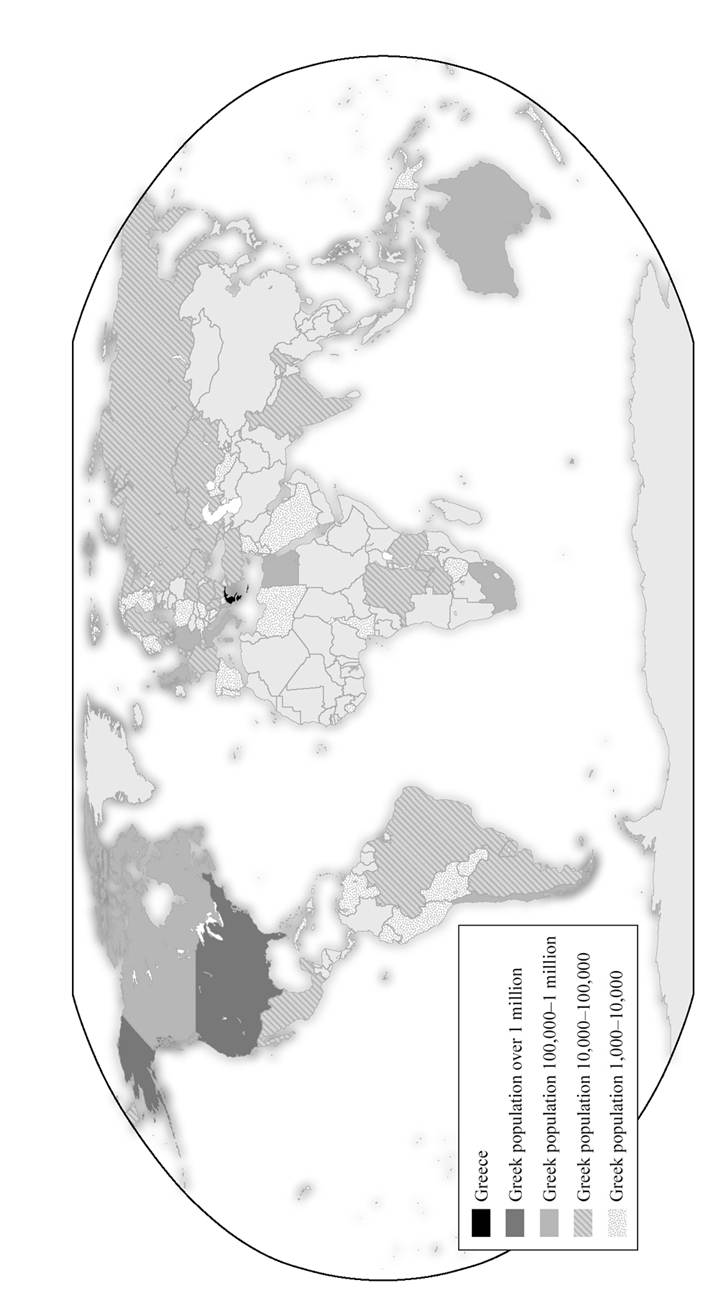
15. Countries of the world with the largest Greek populations today
In the immediate aftermath of the events of that year, Athens and Nicosia both made great strides in developing and embedding their democratic institutions. Since that time, power has regularly changed hands after elections that have been fairly contested (as had all too rarely been the case in Greece before that), with a broad spectrum of political parties taking part.
In Athens, a stable two-party system emerged. From the late 1970s until 2012, governments almost always alternated between the centre-right New Democracy, founded by Konstantinos Karamanlis, who became prime minister in 1974, and the Panhellenic Socialist Movement (known by the Greek acronym PASOK), led by Andreas Papandreou. From being a strongly left-wing populist movement in its early years, PASOK soon morphed into a centre-left party, close to the European mainstream, and was almost technocratic during the premiership of its second leader, Kostas Simitis, from 1996 to 2004. In Greece, the head of state is elected by parliament and the role is largely ceremonial. In Cyprus, on the other hand, the president has considerable executive powers and is directly elected. Since the time of Makarios, who died in 1977, presidents have been elected from political backgrounds ranging from the communist left to the nationalist right, and not necessarily aligned with the majority party in the House of Representatives.Both Greece and Cyprus recovered quickly from the economic downturn of the mid-1970s and, in the case of Cyprus, from the far greater devastation caused by the Turkish invasion. Governments in Athens oversaw impressive growth from the 1980s until the first decade of the new century. But in hindsight, much of this would turn out to have been state-led. Patronage and tax breaks handed out by three PASOK governments in the 1980s and 1990s are often blamed for the financial crisis that would follow in 2010. But for several decades, Greeks in Greece had the experience of prospering, and the annual rate of growth was impressive. Standards of living had never been higher.2
All this went hand in hand with a geopolitical shift that affected both countries. The leadership of the United States in the Cold War meant that Greece since the late 1940s and Cyprus since independence in 1960 had looked first to America in international relations. But rightly or wrongly, since 1974, Greek public opinion has tended to blame US policy for the seven-year dictatorship in Greece and for what is often called the ‘dismemberment’ of Cyprus.
As a result, both countries in the mid-1970s turned away from the United States and towards what was then the European Economic Community, the forerunner of today’s European Union. Greece joined the EEC in 1981 as its tenth member, and the Eurozone, which shares the single currency, the euro, in 2001. Cyprus was one of a slew of smaller European states to join the EU in 2004, and it adopted the euro four years later.This alignment has meant a great deal more than the technicalities of working with a supranational administration in Brussels and Strasbourg or the management and obligations of the single currency. Lifestyles in Greece became rapidly transformed during the 1980s. People stayed at home and watched television, newly opened up by the arrival of commercial channels which had been prohibited before. The traditional men-only kapheneion, where elderly denizens played backgammon, drank coffee, and disputed the contents of the daily newspapers, began to be displaced by smart bars where young people of both sexes would congregate. Not everybody was in sympathy with these changes, of course, and indeed the old ways have by no means disappeared. But in a more than superficial sense, since that time, Greece has become visibly more ‘European’.
The physical landscape has been changing, too. Projects born in the late 1980s and funded by European programmes would go on to be completed during the next decade and a half. A long-awaited new Metro system for Athens opened in 2000, the new Eleftherios Venizelos International Airport in 2001. Thanks to a network of brand new motorways, carried on viaducts and through long tunnels, journey times from Athens to the provinces, or from the Adriatic port of Igoumenitsa on one side of the Pindos mountains to Thessalonica on the other, have been reduced from a whole day or more to just a few hours. Most spectacular of all is the Charilaos Trikoupis Suspension Bridge spanning the mouth of the Gulf of Corinth, almost three kilometres long, which opened to traffic in 2004.
Greek society began to change in the 1980s in other ways, too. These changes had less to do with European integration than with the advent of Greece’s first socialist government, led by Andreas Papandreou, in 1981. Ironically enough, elected on a populist, anti-Europe programme that it would soon abandon, Papandreou’s Panhellenic Socialist Movement (PASOK) would govern for seventeen of the next twenty-three years. Particularly during its first term, it introduced reforms that went far beyond legislative changes to begin to break down social prejudices that had remained unchanged for years, if not for centuries. For the first time, a women’s movement played a visible part in public life. Adultery ceased to be a criminal offence. Gender equality was introduced into every aspect of civil society. Civil marriage was permitted, despite protests from the Orthodox Church, whose monopoly of authority on social matters would be challenged repeatedly, if often inconclusively, by successive governments. A national health service was created in 1983. Government spending on welfare increased by almost half. Huge investments were made in education, particularly in new and expanded universities and technical colleges all over Greece. Before long, almost all young Greeks would be participating in some form of higher education.3
The ending of the Cold War in 1989 brought changes of a different kind. For the first time in half a century, Greece was once again fully connected to its Balkan hinterland. Standards of living at the time were much higher in Greece than in any of the countries of the former Soviet bloc. As the country’s northern neighbours scrambled to catch up with the capitalist economies of the West, Greek businesses found themselves at a natural advantage. On the other hand, large numbers of economic migrants began to arrive in Greece, particularly, and often illegally, from Albania. The social problems created at home threatened to outweigh the benefits abroad.
Greeks were spared the resurgence of vicious interethnic (actually, interreligious) warfare that ravaged the former Yugoslavia during the decade of the 1990s. But they were not unaffected. In a rare departure from the EU and NATO consensus, Greek public opinion, and even sometimes government policy, regularly aligned with the Orthodox Serbs and against the Catholic Croatians and the Muslims of Bosnia and Herzegovina. The most contentious issue, which first emerged at the end of 1991 and which would not be resolved until 2019, was over the name of the independent republic that broke away from Yugoslavia and claimed international recognition under the name of ‘Macedonia’.
For as long as it had formed part of the Yugoslav federation, the existence of a ‘Socialist Republic of Macedonia’ beyond their northern border had been of no particular concern to Greeks. But for a foreign state to take a name that by this time almost all Greeks had come to regard as quintessentially and inalienably Greek was like a red rag to a bull. Worse, governments of the new republic in the 1990s adopted a flag based on the gold sunburst motif associated with ancient Macedonian monuments and most memorably depicted on the funeral casket that had contained the cremated remains of Philip II. Statues of Alexander the Great began to appear in Skopje, the republic’s capital; tactless, if unrealistic, remarks by spokesmen for its government suggested that covetous eyes were being cast on Thessalonica as a gateway to the Aegean. All this was immediately seen by most Greeks as an existential threat.
Huge demonstrations of popular anger took place in Greek cities in 1992 and periodically thereafter, whenever a new twist brought the issue to the surface again. Thessalonica, Greece’s second city and only fifty kilometres from the border, saw the most vociferous activity. And the popular outpouring was not confined to Greece. Nowhere was the issue more divisive than in Australia, where the descendants of immigrants from Yugoslavia, including many who now identified as Macedonians, clashed with Greek Australians in the streets of Melbourne and other cities.
At issue was not the existence or the independence of the breakaway republic but its name. Feeling went right to the top of government, where a split over the issue was enough to bring down the New Democracy administration in 1993. Only in 2018 would a compromise solution be found and ratified on both sides a year later. Greece’s northern neighbour is now officially known as ‘North Macedonia’.4‘Macedonia is Greek. Read history’ proclaimed lapel badges worn by ground staff at Greek airports in the 1990s. Of course, the ancestors of all the Slavonic languages, or dialects, spoken in the southern Balkans in modern times did not appear on the scene until almost a thousand years after the time of Philip II and Alexander. But the Athenian orator Demosthenes could not have disagreed more with the badge wearers, demonstrators, and politicians who pushed the issue to international prominence during three decades around the turn of the twenty-first century. One consequence of the dispute is that, since the 1990s, many Greeks have been sensitive to any questioning of the ethnic identity of the ancient Macedonians—the very issue that had provoked such heated debates in Athens almost two and a half thousand years ago.
In August 2004, the Olympic Games were held in Athens for the second time. Once again, after a little over a century, the nation-state was on display before the eyes of the world. Despite much carping and doubting in advance, Greek state and private organisations proved themselves more than equal to the immense logistical challenges of hosting the modern Games. Infrastructure was ready on time, if only just. All over the country, public spaces, hotels, and venues had had a facelift for the occasion. In the centre of Athens, below the Acropolis, streets were pedestrianised and landscaped; those neoclassical buildings of the nineteenth century that had escaped the bulldozers of the twentieth were tastefully restored and repainted. The opening pageant that preceded the Games seamlessly presented vignettes from Greek history, from the mysterious marble figurines from the Cyclades that long predate the oldest evidence for the Greek language, down to the traditional music of the bouzouki and the paintings of the twentieth-century artist Yannis Tsarouchis. High above all floated a winged angel. Here was the elusive spirit of ‘Greekness’, that had been so anxiously sought back in the 1930s, made manifest and presented on the world stage using the latest in showbiz technology.
But Greece, as the poet Seferis had written back then, was ‘still travelling’. Three years before the first Athens Olympics, held in 1896, the country had declared bankruptcy. Six years after the second Games, European governments and banks were reeling from the long-term effects of the global financial crisis of 2007 and 2008. In the spring of 2010, the PASOK government led by George Papandreou could no longer borrow enough to service its existing debts. Normally, in such circumstances, a government would default on part of its loans. Had that happened, it would have been the seventh time in the history of the Greek state. But Greece was now part of the Eurozone; a Greek default would have consequences for the rest of the EU and, beyond it, for the entire world banking system, that were literally unimaginable—because no one had thought to imagine them.5
As the crisis exploded across international markets, the cartoonists of the world’s press delighted in poking fun at the hapless and incompetent heirs to a once-great civilisation. If the classical heritage had once served Greeks well in the early, formative stages of building a nation-state, it had now—and not for the first time—returned as a stick to beat them with. Ancient temples riven with cracks, a discus in the form of a one-euro coin being thrown into a dustbin by a naked athlete perched on a Doric column, a caricature of a symposium as depicted on an ancient vase: these were easy targets and all too recognisable.6
To avoid a formal bankruptcy, a system of bailouts for the beleaguered Greek government was devised. Greek elected politicians and officials had no more say in the arrangements hurriedly devised to ‘rescue’ them than they had had in determining the terms of their independence in the early 1830s. Known technically as ‘memoranda of understanding’, lifesaving loans from a ‘troika’ made up of two European institutions and the International Monetary Fund staved off a formal default and ensured that Greece did not crash out of the Eurozone, perhaps to bring the whole edifice down with it. Successive Greek governments received three such bailouts, in 2010, 2012, and 2015. But the price was to shrink the size of the Greek economy by a quarter; unemployment for several years stood at over 25 per cent, and more than double that among young adults. Between 2010 and the middle of the decade, Greece experienced what at the time was the largest downturn for a developed economy in peacetime anywhere in the world. Cyprus was not immune either, largely thanks to the exposure of its banks to Greek debt. Even more demanding terms were imposed on the government of Cyprus in return for a bailout in 2013, although there the recovery would follow much more quickly than in Greece.
In Greek towns and cities, suicide rates soared, shops and businesses closed. Long queues formed at soup kitchens set up by the Orthodox Church and public charities. Graffiti—sometimes sharply witty, sometimes expressing deep despair or defiance—sprawled over abandoned construction sites and the walls of homes and offices. Unable to find work at home, young graduates left the country in droves to seek work in other EU countries. In the first years, public anger several times spilled out onto the streets. In June 2011, three employees died inside a bank in central Athens when demonstrators set fire to it. Further violent demonstrations accompanied the signing of the second bailout in February 2012.
Even democratic institutions for a time looked fragile. An inconclusive parliamentary election in May that year was followed by a second, six weeks later. The centre-right New Democracy was able to form a government only thanks to the support of its rival PASOK and a small fringe party on the left. But a new force had emerged to lead the opposition and break the two-party consensus that had been stable for almost forty years. This was the Coalition of the Radical Left, known by its Greek acronym SYRIZA, a far-left party fighting on an avowedly populist platform. Also populist in its tactics was Golden Dawn, Greece’s only fascist or neo-Nazi party. Openly linked to armed gangs and intimidation, its members sporting Nazi-style insignia and uniforms, and crudely racist in its public pronouncements, Golden Dawn entered parliament for the first time with almost half a million votes in 2012.7
Populist rhetoric swept the board three years later when Alexis Tsipras was elected to head a SYRIZA government in January 2015. Tellingly, this was in coalition with another fringe party that shared the same kind of populist platform, but this time belonged to the Far Right (though well short of the extreme position occupied by Golden Dawn, which all other parties shunned). For six months in 2015, relying on the defiant slogans of its election programme, the SYRIZA-led government embarked on a collision course with the European institutions and the International Monetary Fund, which were its only economic lifeline. In June, with the banks closed and the country only days away from formal bankruptcy and a catastrophic crash-out from the Eurozone, Tsipras called a referendum at only a week’s notice. A majority voted to reject the terms laid down by the institutions. This was the moment when a populist government stared into the abyss and turned away from disaster at the last possible moment. A third (and, as it turned out, final) bailout was signed a few days later. And in September, Tsipras won a snap election, having shed the most extreme elements in his party. Greece’s short-lived experiment with populist politics was over. During the next three and a half years, SYRIZA under Tsipras would tack—even if erratically—towards the centre-left mainstream.8
In the parliamentary election of July 2019, the pendulum swung back to New Democracy, which won a clear mandate under its new leader, Kyriakos Mitsotakis. The two-party system that had served the country so well for four decades was restored—with the formerly far-left SYRIZA now taking the place of PASOK as a more or less centre-left opposition. The extremist Golden Dawn failed to meet the threshold for representation in parliament. A year later, a five-year court case ended in October 2020 with the leader and the most prominent members of Golden Dawn convicted of running a criminal organisation in the guise of a political party. Six of them received jail terms of thirteen years—not for their political beliefs but for proven acts of violence and intimidation, including complicity in the notorious murder of the rap artist Pavlos Fyssas in 2013.9
Between 2012 and 2019, in no fewer than five general elections and one referendum, Greek voters tried every possible democratic route to solving the economic and social crisis of the decade. To what extent any or all of these governments can be credited with its eventual ‘solution’ is perhaps debatable. But by early in 2020, the crisis did finally seem to be at an end. And despite dire prognostications in many quarters, public order had not broken down. Greeks had turned their backs on the kind of populism that had been gaining ground in other parts of the world—from Turkey and Russia to the USA and even the UK. They had come through the crisis—thanks to reliance on the deeply traditional resource of the family and a quality of inner strength that can best be translated as ‘endurance’ or ‘patient resignation’.10
And in the process they had not turned against the European Union or its institutions. Although opinion polls conducted since 2015 in Greece have shown a drop in public support for membership in the Eurozone, even at the nadir in 2017 it did not fall below 50 per cent. In the European elections of May 2019, only fringe parties supported a departure from the EU, and they attracted very few votes.11 Neither in Greece nor in Cyprus has there been much public appetite for following the example of Brexit, despite having suffered what might be regarded as the severest provocations experienced anywhere in the Union. The geopolitical advantages of solidarity with the bloc still outweigh the claims of a more rigorously defined sovereignty in the minds of voters.
Nor, despite the intense pressures of the crisis decade, has Greece seen any sign of the breakaway movements that have been growing in some parts of Europe in recent years. Whether there remains any appetite for an eventual unification between the Republic of Cyprus and Greece must be a moot point. But in outlying regions within Greece which boast a strong regional identity, such as Crete, Macedonia, or Epiros, the overwhelming impetus over the last two hundred years has been to join with the national state and, once having joined, to stay joined. Greece has no equivalent to Catalonia or the Basque region within Spain, or Scotland within the United Kingdom.
Even while the crisis was at its height, other news was far more positive (and largely neglected by the world’s media). Offshore, the extraordinary success story of Greek shipping continued unabated, even if with less of the glamour associated with an Onassis or a Niarchos. The Greek-owned cargo fleet is now reckoned to be the largest in the world, with a 17.3 per cent share of world tonnage recorded in 2018—a remarkable figure when set alongside Greece’s share of world population, a mere 0.13 per cent.12 And although these Greek-owned businesses remain as multinational as they always were, they have contributed spectacular benefits to Greeks worldwide, as well as to the infrastructure of the Greek state. Charitable foundations formed from the bequests of several leading shipowners of the postwar period, and bearing their names, disburse huge sums to support Greeks in need and to promote Greek culture and education, as well as for broader philanthropic purposes—while their assets remain, as ever, well beyond the reach of the Greek state.13
A specialist hospital for cardiac treatment, named after Alexander S. Onassis, the tycoon’s son killed in an air accident in 1973, was opened in 1992. In 2010, just as the financial crisis was beginning to bite, the Onassis Foundation inaugurated a state-of-the-art centre for the performing arts in Athens. The Stavros Niarchos Foundation Cultural Center, funded from the estate of Onassis’s great rival, was gifted to the Greek state and opened in 2017, on land near the sea at Phaleron that in ancient times had been used for public executions and more recently had been occupied by a race course. A beautifully landscaped park, with ponds and fountains, provides a stunning setting for the newly built and lavishly equipped home of the national opera company and the new National Library of Greece.
These achievements have been built upon Greek enterprise in faraway parts of the world. But the opposite process is also at work: Chinese firms have been investing heavily in infrastructure in both Greece and Cyprus. Part of the port of Piraeus is now Chinese-owned, and in November 2019 Greece joined China’s controversial Belt and Road Initiative, which many see as an attempt to spread Chinese economic and political influence around the world. In Cyprus, wealthy Russian businessmen have been offered citizenship, which brings the benefit of free movement within the European Union, in return for inward investment in the Cypriot economy—although some restrictions were announced in autumn 2020. Arrivals at Larnaca International Airport in recent years have been greeted by glitzy advertising, apparently for real estate and business opportunities, with text entirely in either Russian or Chinese. These latest manifestations of globalisation are not universally welcomed. But they do show Greeks continuing to interact with all comers, wherever in the world they can reach, as they have done throughout all their long history.
Less controversial, though not without its attendant problems too, has been the tourist industry. From modest beginnings in the 1960s, when mass tourism was just beginning, annual numbers of tourist arrivals in Greece had topped thirty million by 2018—three times the country’s population. Unlike the shipping business or (perhaps) inward investment from Russia or China, tourism is very much an onshore enterprise. Its benefits are immediate and obvious in terms of local infrastructure, employment opportunities, and revenue available to the Greek state through taxation. On the other hand, the impact on the landscape, ecology, and (as some have complained ever since the days of 1960s hippies) local standards of behaviour may be less beneficial. Mass tourism and its associated building projects have surely blighted the natural beauty of many a Greek island and coastline—though to a far less extent than in some other parts of the Mediterranean.
Until the Covid-19 pandemic struck early in 2020, the outlook for the economies of Greece and Cyprus, and for international Greek enterprise, was brighter than at any time for more than a decade.
In 2021, as Greece and Greeks worldwide commemorate two hundred years since the start of the Revolution that inaugurated the first Greek state, the pandemic is only one of several challenges that they face. And these are all of them as much global as they are local.
By the time the second wave of the virus began to sweep across Europe at the end of 2020, the two Greek-speaking states had fared relatively less badly than most of the rest of the continent. Some have put this down to climate—an unconscious echo, perhaps, of Winckelmann’s explanation, in the eighteenth century, for the glories of classical sculpture. Others, more plausibly, have given the credit to governments which acted promptly and decisively in the early phase of the pandemic, then cautiously managed to save something of the summer tourist season, and with it their national economies, without at the same time importing dangerous levels of infection from abroad. It may also be relevant that both Greece and Cyprus have within living memory experienced curfews and restrictions on civil liberties far harsher and more rigorously enforced than any lockdown so far imposed, at least in the West, to combat Covid-19.
Other threats are of longer standing. Ever since deposits of crude oil were first discovered beneath the seabed off the northern Aegean island of Thasos at the end of 1973, Greece has resisted attempts by its neighbour Turkey to claim jurisdiction in and beneath the Aegean Sea and in the air above it. Successive governments on both sides have alternated between periods of tension and relative degrees of rapprochement. The spectre of armed conflict between the two NATO allies has returned roughly once per decade since 1976, when the leader of Greece’s official opposition called for a Turkish exploration vessel to be torpedoed in the Aegean.
The discovery in 2011 of the Aphrodite oil field off the coast of Cyprus raised the stakes and brought in additional players, including Israel and Egypt. Further finds of oil and gas were made during 2019. When the Cyprus government granted a licence later that year for production to go ahead in its territorial waters, Turkey countered with new claims of its own. Since then, both republics, Greece and Cyprus, have watched with increasing anxiety as the policies of the Turkish president Recip Tayyip Erdoğan seek to extend his country’s geopolitical influence in the region in ways that directly threaten their interests. The Greek and Cypriot governments continue to insist on an internationalist position and on finding solutions within the framework of existing maritime law, treaties, and a rule-governed international system. There is an obvious pragmatic rationale for this approach, given the strategic imbalance between the two sides; but the underlying principles can be traced back to the circumstances in which first Greece and, much later, Cyprus gained their independence. These principles are probably of greater long-term importance than the outcome of a spat over the exploitation of oil and gas at a time when most of the world’s governments, and even leading oil companies, are moving away from dependence on carbon-based sources of energy in response to the greater threat from climate change.14
A challenge of a different kind, and quite new, at least in modern times, comes from inward migration. For centuries—indeed, quite possibly going back as far as the Bronze Age Mycenaeans—young Greeks had left their homeland in large numbers to seek their fortune elsewhere in the world. Now, since the early 1990s, the world has been coming to them.
The opening of the Cold War frontiers at the end of 1989 was only a beginning. By the turn of the new century, migrants and asylum seekers were reaching the country, via Turkey, from all over the Middle East, East Asia, and parts of Africa. Problems of housing, integration, exploitation of migrants by criminal gangs, and petty criminality followed, particularly in Athens and Thessalonica—conditions which may have contributed to the rise of Golden Dawn as a political force. Because a high proportion of these new immigrants were Muslim, a nation which had fought for its independence under the banner of Orthodox Christianity has now once again begun to find itself home to a significant and increasing Muslim population. It would take years of wrangling before the first official mosque to function in Athens in almost two hundred years opened its doors to worshippers in November 2020.
But nothing could have prepared the authorities for the mass arrivals into Greece of refugees fleeing wars and turmoil in Afghanistan, Syria, Iraq, Sudan, and even sub-Saharan Africa. This new crisis reached its peak in 2015, just at the time when the country was undergoing the most testing period of its domestic problems. In that year alone, over eight hundred thousand migrants, most of them in unseaworthy open boats, arrived on the Greek islands closest to Turkey. For the great majority, the goal was not to settle in Greece but to find asylum in the larger and more prosperous countries of the European Union. Then, in 2016, European states began to close their borders to migrants. The problem for Greece, as well as for the migrants themselves, became dramatically worse. At the time of writing, neither attempts by the institutions of the EU to share the burden among European states nor negotiations between the EU and Turkey have produced more than temporary, limited solutions. On Lesbos, the infamous Moria camp, built to house three thousand asylum seekers, had been packed with five times that number by the time it burned down in September 2020.15
Stories of traditional Greek warm-heartedness towards these new arrivals on their shores have given way to ominous signs of resentment at a problem that local or national governments cannot solve. Violence towards refugees on Lesbos and other islands is reported to be on the increase; public demands, demonstrations, and other forms of action have been growing on the most affected islands since the middle of the last decade. Today, Greece and Greeks find themselves on the front line (or one of the front lines) of a global problem that shows no sign of going away.
More on the topic 15 NEW LEDGERS, NEW LEGENDS 1974–2021:
- 1 OF LEDGERS AND LEGENDS 1500 BCE–c. 1180 BCE
- Ecoethical Praxis in The Legends of Pensam
- 14 EUROPEAN STATE, GLOBAL NATION 1833–1974
- The (Non-)Regulation of Interfaith Marriages in the Marriage Law of 1974 and the Dual System of Islamic and Civil Courts
- (Fazzeri, 2021)
- (Muravitskiy, 2021)
- Alexander J.. Experimental Philosophy: An Introduction. Cambridge: Polity Press,2021. — 186 p., 2021
- Hare C., Neo D. (eds.). Trade Finance: Technology, Innovation and Documentary Credit. Oxford University Press,2021. — 417 p., 2021
- Beaton Roderick. The Greeks: A Global History. Basic Books,2021. — 608 p., 2021
- (van 't Einde, 2021)
- Alexander Larry, Sherwin Emily. Advanced Introduction to Legal Reasoning. Edward Elgar,2021. — 200 p., 2021
- Prymak T.. Ukraine, the Middle East, and the West. Montreal: McGill-Queen’s University Press,2021. — 306 p., 2021
- Fligstein Neil. The Banks Did It: An Anatomy of the Financial Crisis. Harvard University Press,2021. — 334 p., 2021
- Plokhy Serhii. The Frontline: Essays on Ukraine’s Past and Present. Harvard Ukrainian Research Institute,2021. — 416 p., 2021
- Anderson Craig. Roman Law for Scots Law Students. Edinburgh University Press,2021. — 496 p., 2021
- “Putin wants to restore the Old Russian Empire and cannot stand free democratic prospects in Ukraine, because sooner or later the people of Russia would want to have that kind of lifestyle as well.” —John McCain, 2014 (McCain, 2021)
- “Nowhere else did repressions, purges, suppressions, and all other kinds of bureaucratic hooliganism in general acquire such horrifying scope as in Ukraine, in the struggle against powerful forces concealed in the Ukrainian masses that desired more freedom and independence.” —Leon Trotsky (Trotsky, 2021)
- CONTENTS
- Important Environmental Laws and Acts