From Munich to European war
The twelve months before September 1939 witnessed a decisive change in European diplomacy. In 1938, British and French statesmen permitted the Reich to annex Austria and the German-speaking parts of Czechoslovakia; in 1939, London and Paris signalled their determination to stop Nazi expansion by extending security guarantees to Poland, Romania and Greece.
This shift from a policy of accommodation to one of resistance placed Britain and France on a path to war. Why did British and French policy change? Why did Hitler, despite this change, press ahead with expansion?Hitler's mounting impatience is our starting point. Before 1937, to achieve his goals, Hitler exploited opportunities as they appeared. Afterwards, Hitler accelerated the pace by initiating crises. Why? Much of the answer lies in his thirst for violence. Hitler craved war not just to satisfy his bloodlust, but also to make the law of the jungle the law of Europe. The first indication of this change in posture came at a meeting of Hitler's top officials on 5 November 1937. With a theatrical flourish that revealed how his inflated sense of destiny and mortality played on him, the Führer remarked that what he was about to say constituted his ‘last will and testament'. The aim of long-range policy, he declared, was to obtain Lebensraum for the growth of the ‘German racial core', and this could ‘only' be executed with force of arms. To sustain the breakneck pace of German preparations for war and to move closer to autarky, the resources of Austria and Czechoslovakia had to be seized before 1943—45. By that stage, the military advantage that the Reich had obtained by arming early would begin to waste away as the other Powers caught up. Hitler speculated that Austria and Czechoslovakia might be taken earlier than anticipated if France was immobilized by civil war or if a war broke out between Britain, France and Italy.
Although the senior army commanders present at the meeting objected to any action that might embroil the Reich prematurely in a European war, the Führer was convinced that Paris and London had already ‘tacitly written off the Czechs'.Hitler's view prevailed. In February 1938, the army generals who at the November conference had voiced anxiety about the risks of a general European war were ousted from their posts. Hitler assumed supreme command of a Wehrmacht which had grown from a few under-armed units to one of Europe's most operationally capable armed forces. His hold on the economy and diplomacy was also tightened. Goring, who headed the Luftwaffe and the Four-Year Plan, extended his authority over the economy, while Ribbentrop, a pompous sycophant who said only what his master wanted to hear, became foreign minister. The first test for the regime, now free of conservative voices, appeared to confirm Hitler's appraisal of the European situation. On 9 March, Kurt von Schuschnigg, Austria's chancellor, took a bold step to counter German economic and political penetration into his country. He announced a plebiscite to determine whether his fellow Austrians wished to remain independent of the Reich. The tactic caught Berlin by surprise. To pre-empt an Austrian vote for sovereignty, the Nazis quickly improvised preparation for an armed intervention. A torrent of threats from Berlin persuaded Schuschnigg to cave in. On 11 March, Germany occupied Austria and Hitler proclaimed the Anschluss. Britain and France did not oppose him.
Attention now turned to Czechoslovakia. To keep the issue on the boil, Hitler ordered Konrad Henlein, the leader of the Nazi movement among the three million Sudeten Germans in Czechoslovakia, to demand minority rights that the government in Prague would find impossible to grant. War planning against Czechoslovakia (Operation Green) was stepped up to take into account the fact that German forces could now attack from Austria as well as Germany.
Yet, for much ofApril-May 1938, Hitler was in no hurry to deal with the Czechs. Austria had to be digested first. Hitler and Ribbentrop had also learned in early May that Rome would not actively support a German attack on Prague. The timing for Operation Green was thus left open. Then, unexpectedly, on the weekend of 19-21 May, Europe was brought to the brink. Hitler's response to this ‘weekend crisis' reveals much about how the stimulus of external events, his vision of Lebensraum and his lust for violence propelled Nazi aggression forward. The origins of the crisis remain murky. What we do know is that Czech intelligence received a false warning that the Wehrmacht was amassing to strike. Unnerved by the Anschluss, the Czech army prudently called up reservists and manned its frontier fortifications. Paris and London issued diplomatic warnings. Hitler was forced to deny that he planned to attack. In the world press, his denials were portrayed as a humiliating climb-down. Hitler was enraged. On 30 May, he vented his fury by revising the preamble to Operation Green to read: ‘it is my unalterable decision to smash Czechoslovakia by military action in the near future'. Now bent on a short, sharp war soon after 1 October 1938, Hitler needed to invent a pretext. Henlein was ordered to intensify his internal agitation, while German newspapers began a propaganda campaign accusing the Czechs of heinous crimes against the Sudetenlanders.Sudetenland
The geographical area in Bohemia mainly inhabited by ethnic Germans. In 1919 it was placed on the Czech side of the German-Czech border and in 1938 led to an international crisis ending in the infamous Munich Agreement.
The setting of the crisis of 1938 came as little surprise. After Locarno, informed observers agreed that once Germany and Russia revived, Central and Eastern Europe would become unstable. Ultimately, the fate of the ‘successor' states rested on the approach Berlin and Moscow would adopt towards them. Would the intermediaries be regarded as useful buffers or prey? Nazi and Soviet ideology, the myriad revanchist claims and national hatreds that divided the region, and the limited capabilities of the small states, combined to ensure that the predatory approach would be adopted.
One of the few hopes for the region was that the new nations might unite into a coherent bloc, but this was not to be. One problem was that most of the new states distrusted Hungary. Indeed, the ‘Little Entente', which had been formed in the 1920s between Czechoslovakia, Yugoslavia and Romania, was designed solely to deter Hungarian revanchism. Furthermore, the bitter rivalry between the Czechs and the Poles guaranteed that no one leader would emerge. Another factor that weakened the region was that the slump had led the largely agricultural and raw material-exporting economies of the Eastern European states to come under German dominance. Economic dislocation also led to right-wing dictatorships as well as the shameful persecution of Jews and other minorities. France swung between seeing its Eastern allies as assets and as liabilities. While they might help to contain Germany, they might also be the cause of the next Franco-German war. Also French influence was not always welcomed by the fiercely independent Eastern Europeans. In 1934, for instance, the Poles preferred to sign their own non-aggression treaty with Germany.self-determination
The idea that each national group has the right to establish its own national state. It is most often associated with the tenets of Wilsonian internationalism and became a key driving force in the struggle to end imperialism.
Moreover, the British never regarded Eastern Europe's frontiers as sacrosanct. To them, plunging Europe into war for the sake of a disputed border or the custody of a discontented national minority was as absurd in the 1930s as fighting a nuclear war for the sake of a united Germany or Korea appeared in the Cold War. Many sympathized with complaints that the Paris peacemakers had applied the principle of national self-determination unjustly against the aspirations of German nationalists. This is why the British did not attempt to reverse the Anschluss. What the British did not know for certain was whether Hitler was exploiting the alleged injustice of Versailles as a pretext for more far-reaching goals.
The policy of appeasement rested on the mistaken belief that Hitler could be satisfied through orderly revision negotiated between Britain and Germany. For London, the danger was letting the crisis drift. An internal dispute in Czechoslovakia might trigger a Franco-German war, which would inevitably draw Britain in. The Anschluss only underscored the perils of allowing events to unfold without British intervention.Chamberlain believed that Germany could be pacified, if only Hitler could be brought to the bargaining table. When he became prime minister, he had had six triumphant years as chancellor of the exchequer. Long before Baldwin stepped down in May 1937, Chamberlain, who towered in cabinet, was tipped to replace him. Neither narrow-minded nor provincial in outlook, his politics mixed a radical, reforming zeal at home with liberal imperialism abroad. He believed in the empire and in Britain's unique mission to promote peace and prosperity. He hated war, yet he did not seek ‘peace at any price'; he saw spending on arms at the cost of social spending as a waste, yet he armed to deter war. ‘What a frightful bill we do owe to Master Hitler,' he said, ‘damn him!' And damn him he did. In no way was Chamberlain drawn to Nazism. He despised the dictators, but he knew he had to deal with the Nazi Führer if war was to be averted. The question was, how?
Convinced that the professional diplomats had blocked progress, Chamberlain's answer was to open a direct channel to Berlin. In November 1937, his friend Lord Halifax (who became foreign secretary after Eden resigned in February 1938) was sent to the Reich on an unofficial visit to explain Britain's position. Halifax told Hitler that Britain wanted a frank exchange of views on economic, colonial and territorial issues. If London and Berlin could arrive at reasonable solutions to these problems, then peaceful relations could be established between the European Great Powers. In reply, Hitler confessed that he too desired peace and only demanded a redress of Germany's legitimate grievances.
The prime minister was delighted. The right atmosphere, he thought, had been created for bilateral talks. He wanted to say to Hitler: ‘Give us satisfactory assurances that you won't use force to deal with the Austrians and Czechoslovakians, and we will give you similar assurances that we won't use force to prevent the changes you want, if you can get them by peaceful means.' Chamberlain's remark, while easy to ridicule, reveals what he was trying to achieve in 1938, and much about the wider, unfolding clash of values. Hitler craved a brutal, localized war against the Czechs to shatter the prevailing norms of European politics and thereby legitimize the use of violence; Chamberlain wanted to uphold the rule of law in international relations by facilitating peaceful revision through diplomacy and thereby to stigmatize the use of violence. For London, in the end, the process was always more important than the outcome.Military considerations bolstered the case for a diplomatic solution. True, the arms balance was less dire than anyone at the time believed. British and French intelligence exaggerated the might of the Wehrmacht, especially the prospect of a knockout blow delivered by the Luftwaffe, while downplaying the strengths of their own forces. Planners on both sides of the Channel advised caution. The rearmament programmes of 1936 would only peak in 1939—40. By then, war could be faced with more confidence. Yet, even by that stage, the Reich could only be beaten in a protracted and ruinous war; there was no short cut to victory. ‘We can do nothing to prevent the dog getting the bone, and we have no means of making him give it up', the British chiefs of staff concluded, ‘except by killing him by a slow process of attrition and starvation.' Such calculations also lay behind French policy. The Czechs had a fine army, which would put up a brave fight before certain defeat, but French officials were unsure about whether France itself could withstand even a brief fight. The air force possessed only fifty modern planes. Aircraft production had slowed to a trickle. Since 1936, the franc had been devalued three times. Gold reserves dwindled and revenue declined. France faced bankruptcy. External politics did not augur well either. Poland (and Hungary) lined up with Germany to demand Czech territory, and the French were unwilling to count on the Soviets. Chamberlain and Halifax, though acutely aware that they could never forsake France, attempted to ‘restrain' their French counterparts by refusing to state plainly whether they would assist France in a war against Germany. The British instead pressed French ministers to persuade their Czech allies to offer the Germans concessions. Edouard Daladier, the French defence minister and, since April 1938, premier, concluded that France could not uphold its treaty obligations to Czechoslovakia without inviting national disaster. He did not share Chamberlain's optimism that there could be lasting peace with Germany, yet one thing was certain. As General Maurice Gamelin, his top commander, advised, ‘It is essential that we have Britain with us.'
During the crisis, it was Chamberlain who therefore had the initiative. He pursued the course he had laid out after Halifax's visit to Germany. In August 1938, he sent an emissary to mediate between the Sudetenlanders and Czechs. Hitler meanwhile turned up the heat with war preparations and further orders to Henlein to become more recalcitrant. Hitler's plan for a bloodletting and Chamberlain's plan to satisfy his stated aim of uniting the German-speaking peoples peacefully collided. Twice Chamberlain flew to Germany for bilateral talks with Hitler. This was a spectacular gambit in an age unfamiliar with ‘shuttle diplomacy'. On 15 September, at the first meeting, Chamberlain said ‘yes' in principle to a German annexation of the Sudetenland, though Paris and Prague would also have to agree. Three days later, Daladier did agree, so long as Britain guaranteed the rump Czech state. Under pressure from London and Paris, and calculatingly mixed signals from Moscow about its intentions, the Czech president, Edvard Benes, had little choice. On 22 September, the prime minister flew to inform Hitler that he would now get what he wanted. In reply, Hitler screamed for more, including the immediate occupation of the Sudetenland by German forces. Hitler still wanted his war by 1 October. After two difficult meetings with Daladier, Chamberlain at last told him that Britain would stand with France, and that the two governments should send a final plea for diplomacy as well as a military warning. The French army and the British navy mobilized for war. Hitler now decided to back away from a war over the timing and method of Germany's annexation of the Sudetenland. On 28 September, he took up Mussolini's proposal for a Four-Power conference, which met at Munich on the following day with the Duce, Daladier, Chamberlain and Hitler in attendance.
At Munich, the transfer of the Sudetenland was settled and the Four Powers guaranteed the frontiers of what was left of the Czech state. Munich was the sort of nineteenth-century Great Power arbitration that many considered to be the
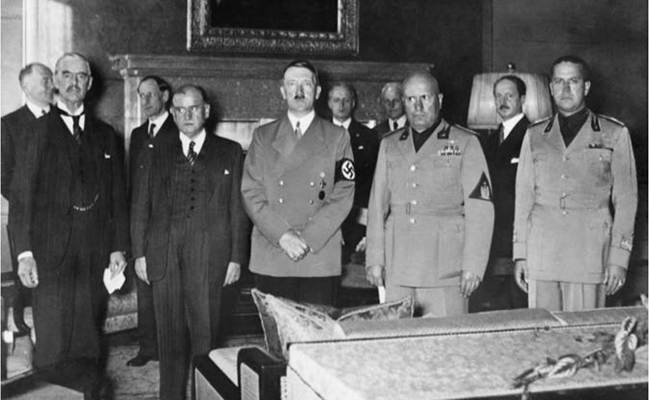
Plate 7.1 Munich Conference, Germany, 30 September 1938. (Left to right) Prime Ministers Neville Chamberlain (UK) and Edouard Daladier (France), Nazi German Chancellor Adolf Hitler, Benito Mussolini (Italy) and Italian Foreign Minister Count Ciano gather to sign the Munich Treaty between Nazi Germany, France, Italy and the United Kingdom, authorizing Hitler to annex Czech territory. (Photo: Staff/AFP/Getty Images)
only way out of the extended crisis of the 1930s. Chamberlain thought that Munich would be the start of a general appeasement that would see Germany rejoin the League and progress towards world disarmament, and an end to autarky. It was a victory for the prime minister’s shuttle diplomacy and, apparently, for the Führer. After all, he had been given what he had demanded so many times in public — the Sudetenland. Hitler was in fact enraged at having been cheated out of his Czech war. On 30 September, Chamberlain had even persuaded him to sign the notorious Anglo-German declaration, which committed Hitler to ‘consultation’ as the normal method of settling disputes. All Hitler ever wanted from the British was to be left alone. Now he would rid Europe of Britain.
Document 7.1
The Anglo-German declaration, 30 September 1938
We, the German Führer and Chancellor and the British Prime Minister, have had a further meeting to-day and are agreed in recognizing that the question of Anglo-German relations is of the first importance for the two countries and for Europe.
We regard the agreement signed last night and the Anglo-German Naval Agreement as symbolic of the desire of our two peoples never to go to war with one another again.
We are resolved that the method of consultation shall be the method adopted to deal with any other questions that may concern our two countries, and we are determined to continue our efforts to remove possible sources of difference and thus to contribute to assure the peace of Europe.
Adolf Hitler
Neville Chamberlain
September 30, 1938
Over the winter of 1938-39, Hitler raised the production targets for the expansion of the Luftwaffe and the German navy — both forces directed against the British. Ties with Tokyo and Rome were to be strengthened to paralyse the British Empire. The prerequisite to Lebensraum was now the subjugation of France. But the Czechs and Poles would have to be dealt with first to safeguard the eastern front. On 14—15 March 1939, under the threat of air bombardment, the Prague government was given no choice but to allow Germany to occupy what was left of the Czech state. Slovakia declared its independence under a German protectorate. Poland was a more complex problem. What Hitler wanted was extraterritorial rights in the Polish corridor, the annexation of the Free City of Danzig
— both of which had been granted in 1919 to Poland to provide access to the sea
— as well as Polish adherence to the Anti-Comintern Pact. In exchange, Hitler and Ribbentrop promised Warsaw territory in Ukraine after Germany turned eastward to deal with the Soviet Union. The implications of the German offer were clear enough: Poland was to become a vassal state of the Greater German Reich. Ribbentrop put the deal repeatedly to Josef Beck, Poland's foreign minister; each time the offer was turned down. On 3 April 1939, Hitler gave the order for war preparations against Poland to begin.
Danzig, Free City of (Polish: Gdansk)
A historically and commercially important port city on the Baltic Sea. In 1919, the Paris peacemakers made Danzig politically independent as a ‘free city' under the League of Nations in order to give the new state of Poland free access to the sea. However, the vast majority of the city's inhabitants were Germans. The return of Danzig to German sovereignty was thus a key issue for German nationalists between the wars. Hitler exploited the Danzig question as a pretext for his attack on Poland in 1939.
After Munich, the British and the French experienced a change in outlook. In London, Chamberlain and his ministers were puzzled over what was happening inside the German camp. In Paris too, politicians and officials wondered where Germany would strike next. Over the winter of 1938—39, the answers came in the form of spine-chilling intelligence, which suggested that the Wehrmacht was preparing a sudden attack on the Low Countries in order to seize bases for bombers. Neither the French nor the British intelligence services detected a slackening in the pace of German rearmament. Furthermore, on 9—10 November, a fierce pogrom against German Jews (Kristallnacht) swelled the sense of moral outrage against the Nazis that many had long tried to suppress. In both capitals, the unwinding of appeasement did not occur overnight, nor was it attributable to any single factor — yet it certainly began before Hitler occupied what was left of the Czech state. Some moved faster than others. Halifax abandoned appeasement more quickly than Chamberlain — although both men were always prepared to fight rather than see Nazi hegemony in Europe. In Paris, Daladier wished to construct a powerful Franco-British alliance, and to restore France's influence in Eastern Europe, while his foreign minister, Georges Bonnet, argued that France should adjust to a subordinate role in Europe.
The trend towards a resolute stand against Hitler was complicated by the fact that Munich had undermined French and British credibility. The solution was to offer firm commitments and guarantees. The process began in February 1939, when Chamberlain offered a public pledge to uphold French security. Conversations between British and French military staffs to draft joint war plans were scheduled. To build a barrier against the German domination of Eastern Europe, France and Britain offered security guarantees in March to Poland, Romania and Greece. Hesitantly, conversations with Moscow about an alliance also began. In May, to put military muscle behind these declarations, peacetime conscription was introduced in Britain. What was striking about this period was the way in which military perceptions altered so rapidly. British and French intelligence now highlighted German weaknesses, particularly in economic readiness for war and in trained manpower, and to underscore Anglo-French strengths as the 1936 construction programmes started to pay off. Rearmament was accelerated, so that British aircraft production would soon overtake German output. French armour, gun and aviation production now began to recover along with the French economy. ‘If it comes to a duel between France and one other nation,' Daladier confidently declared, ‘I would have no mortal concerns for the outcome.' British and French statesmen now knew that they could face the burdens of a protracted war with a united home front — no small thing for the fighting power of democracies. Indeed, Hitler's Prague coup had its greatest impact on the populace. No one relished war, but now there was a grim resolve to resist Hitlerism. It was not, however, public opinion, as some historians still argue, that dragged the ‘peace at any price' men to war. Instead, British and French officials attempted to balance the issuing of credible threats designed to deter what they now perceived to be open-ended Nazi expansionism against the need not to throw away the chances of a German climb-down.
That such a balance should have been struck stemmed from an erroneous understanding of how Berlin worked. British and French diplomats argued that Hitler could be influenced by playing to moderates in his inner circle. In truth, Hitler was not swayed by moderates or extremists. The decisions were Hitler's alone, and the prospects in 1939 of a climb-down were nil. This was the legacy of Munich. If Hitler had gone to war even after Chamberlain had resolved the Sudeten question, then the full extent of his ambitions would have been exposed to the world, and the war could not have been localized to Central Europe. The fears of his military advisers and the downcast response of the German people to the prospect of war had also troubled his thoughts. In 1939, he was determined that he would not lose his nerve again or be drawn into diplomacy. Hitler would not permit ‘at the last minute some Schweinhund [to] make a proposal for mediation'. His craving for violence, his growing aggravation as he tried unsuccessfully to manipulate events and the lack of brakes on his authority, all combined to produce the crucial miscalculations. In April 1939, in response to Poland's refusal to submit to his will and the granting of the Anglo-French guarantees to Warsaw, the Führer denounced the Polish-German non-aggression treaty of 1934 and the Anglo-German naval agreement of 1935. In May, to pave the way for a localized war against the Poles, Germany signed a ten-year alliance with Italy, the so-called Pact of Steel. Ribbentrop now assured Hitler that Britain and France were only bluffing; they would abandon the Poles as they had the Czechs. Hitler did not need any convincing. Dismissing signs of British and French determination and rearmament, he reached for the trump card, Soviet Russia. Actually, neither Hitler nor his commanders took the threat of Soviet arms very seriously in 1939 or earlier. The negotiations between Ribbentrop and Molotov in August were only of consequence because of the effect that a German-Russian treaty might have on Poland's guarantors. A Nazi-Soviet pact, so the Führer believed, would bring down Chamberlain's government, and provide the West with a pretext to desert the Poles. Despite the diplomatic coup, London and Paris firmed up their alliances. Count Ciano, meanwhile, said that Italy did not have the resources to join its Axis partner in a general war. Hitler pulled back, yet only briefly. The German-Polish war scheduled for 26 August was delayed until 1 September.
More on the topic From Munich to European war:
- From European war to World War
- CHAPTER SEVEN The path to European war, 1930-39
- Okinshevych L. Ukrainian Society and Government 1648-1781. Munich, 1978, 145 p., 1978
- How European is the ‘European’ Legal Tradition?
- STEPHANIE SPECK Bundeswehr Institute of Microbiology, Department of Virology and Rickettsiology, Munich, Germany
- This chapter will explore ritual violence in the form of close combat in precolonial western Africa (and the African diaspora) during the period of European contact from the mid fifteenth century until the late nineteenth century, a period which saw an end to the slave trade and the start of European colonisation.
- ‘Roman way of war' in the title of this chapter is a variant of ‘Western way of war', the theory first articulated by Victor Davis Hanson that has been the subject of much critique, and which I do not accept.1
- CHAPTER 9 The War at Home: Toys, Media, and Play as War Work
- STEPHANIE SPECK1 AND J. PAUL DUFF2 1 Bundeswehr Institute of Microbiology, Department of Virology and Rickettsiology, Munich, Germany 2Animal Health and Veterinary Laboratories Agency Diseases of Wildlife Scheme (AHVLA DoWS), Great Britain Wildlife Disease Surveillance Partnership, Penrith, Cumbria, UK
- Capabilities for War and Operations Other than War