Hemispheric unity, internal dislocation
United Nations (UN)
An international organization established after the Second World War to replace the League of Nations. Since its establishment in 1945, its membership has grown to 192 countries.
Rio Treaty (Inter-American Treaty of Reciprocal Assistance)
Signed on 2 September 1947, and originally ratified by all twenty-one American republics. Under the treaty, an armed attack or threat of aggression against a signatory nation, whether by a member nation or some other power, will be considered an attack against all.
In 1945, given that few Latin Americans had participated directly in the Second World War, there were no massive victory parades in Santiago, Caracas or Mexico City. Still, the Latin Americans had high expectations. After all, they had played an important role in the Allied war effort as suppliers of raw materials and foodstuffs and, with minor exceptions, all had formally joined the Allied cause (even Argentina declared war on Germany in 1945). At the same time, the war confirmed the US dominance over the Western Hemisphere. Trade with any other part of the world was now virtually impossible for the Latin Americans, for the war had either destroyed (Germany, Japan, Italy) or severely weakened (Britain) the power of those countries that could have presented any semblance of a challenge to American supremacy in the region. By 1945 the Monroe Doctrine had triumphed as never before.
Nor did the obvious clash between America’s regional interests in Latin America (and the Monroe Doctrine) and the internationalism embedded in the founding of the United Nations (UN) change much in inter-American relations. In February 1945 a pan-American conference in Chapultepec, Mexico, had foreshadowed the formation of a post-war military alliance in the Western Hemisphere. Later in the year, the United States pressed for the inclusion of Articles 51—54 in the UN Charter, giving regional bodies the right to deal with crises without ‘external intervention’.
In the 1947 Rio Treaty the American republics concluded a collective defence pact that created a regional institution — dominated by the United States — which could be used to legitimize American intervention. In effect, from 1945 to 1947 the United States managed to forge a marriage of sorts between its oldest foreign policy principle (the Monroe Doctrine) and its new internationalist emphasis. The Organization of American States (OAS) — a regional body established to settle inter-American disputes — was launched in 1948 and formally established in 1951.However, beneath the surface of this formalized treaty structure lay a growing Latin American nationalism that, given the US dominance of the region, translated into an escalation of anti-Americanism. Continued high levels of poverty, illiteracy and inadequate health care further intensified such sentiments, as did a population explosion not deterred by high infant mortality rates. The structure of dependency and the dominance in the commercial sphere of American-based multinational companies seemed to many to bear responsibility for the stark levels of inequality. Moreover, Washington’s support for right-wing dictatorships, which often ruled with the support of American-trained and armed militias, further fed the antipathy that Central and South Americans felt towards the colossus of the north.
The dependency and inequality in the inter-American relationship can be illustrated with a few simple statistics. In 1950 the gross domestic product of all of Latin America was roughly one-seventh of that of the United States ($41 billion and $287 billion respectively) while the population size was roughly the same (155 million in Latin America and 152 million in the United States). In the same year Latin America accounted for 28 per cent of the total of American exports and 35 per cent of US imports. These figures were particularly stark when limited to the Caribbean basin. The American share of Cuban, Guatemalan and Nicaraguan exports, for example, was between 70 and 80 per cent of these countries’ total exports. In short, the economically weak ‘South’ was clearly dependent on the prosperous ‘North’.
There is little doubt that the emergence of the Cold War was a contributory factor to the continuation of American domination over Latin America. However, during the early post-war years the recovery of Europe quite understandably dominated American thinking, while the civil war in China and the apparent threat of communism in East Asia forced Washington to concentrate on the need to resuscitate Japan’s economy. In such a context there were only limited resources available for aid to South or Central America where the spectre of communism could, or so it seemed, be kept in check by relying on the political stability provided by strong military dictators. In short, there seemed little need, from the perspective of national security, for a Marshall Plan for Latin America. Even though most American observers acknowledged the difficulties that such an approach might produce in the long run, they appeared confident that the best, not to say the least expensive, way of containing communism in the Western Hemisphere was to rely on those locals who saw their interests best served by continued dependency upon the United States.
The situation facing the United States in 1950 was summarized neatly by one of the key architects of the policy of containment, George Kennan, who maintained that the United States needed to take the threat of communism seriously and not be too squeamish about the methods used in fighting it. As indicated in Kennan’s memorandum, which reflected the general US attitude towards Latin American political systems, the Cold War was starting to dominate
Organization of American States (OAS)
An organization formed in 1948 for the purpose of coordinated action in economic, political and military matters. Its members include all countries in the Western Hemisphere.
see Map 16.1
see Chapter 13
Marshall Plan
Officially known as the European Recovery Programme (ERP). Initiated by American Secretary of State George C. Marshall’s 5 June 1947 speech and administered by the Economic Co-operation Administration (ECA).
Under the ERP the participating countries (Austria, Belgium, Denmark, France, Great Britain, Greece, Iceland, Italy, Luxembourg, the Netherlands, Norway, Sweden, Switzerland, Turkey and West Germany) received more than $12 billion between 1948 and 1951.containment
The term coined by George Kennan for the American, and broadly Western, policy towards the Soviet Union (and communism in general). The
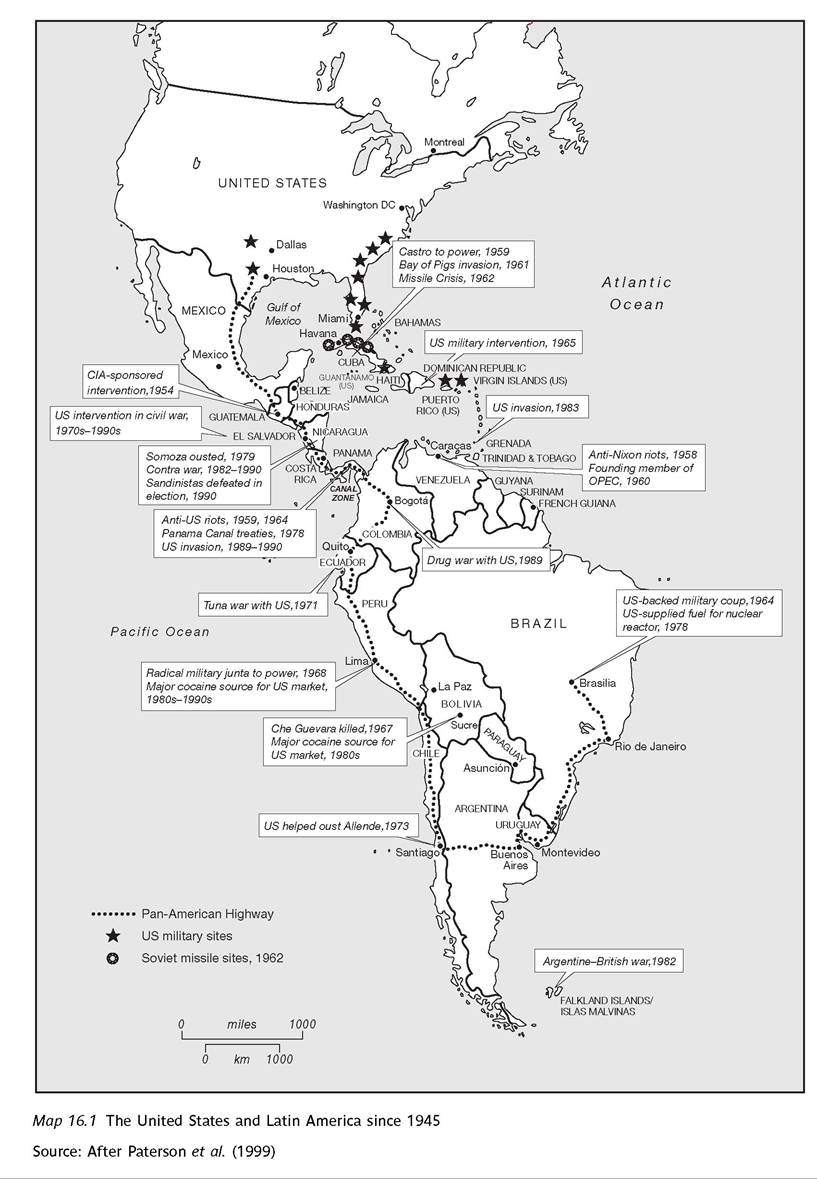
American thinking about Latin American problems. Kennan further reflected the traditions of the Monroe Doctrine: the need (and assumed right) to defend American interests in the Western Hemisphere against an ‘alien’ force: communism. Illustrating this argument, he referred to one particular country where this alien force appeared to be making some headway — Guatemala.
overall idea was to contain the USSR (that is, keep it within its current borders) with the hope that internal division, failure or political evolution might end the perceived threat from what was considered a chronically expansionist force.
Document 16.1
George Kennan on the United States and Latin America, March 1950
We cannot be too dogmatic about the methods by which local Communists can be dealt with... where the concepts and traditions of popular government are too weak to absorb successfully the intensity of the Communist attack, then we must concede that harsh governmental measures of repression may be the only answer; that these measures may have to proceed from regimes whose origins and methods would not stand the test of American concepts of democratic procedure; and that such regimes and such methods may be preferable alternatives, and indeed the only alternatives, to further Communist successes.
Source: George Kennan to State Department, March 1950, in Foreign Relations of the United States, 1950