Imperial Unity
In the aftermath of the wars between 1870 and 1945, the issues raised by the division of 843 and the orientation of Alsace and Lotharingia westward or eastward fostered a perception of the Treaty of Verdun as the “birth certificate of Europe,” while simultaneously signaling the “breakup” of the Carolingian Empire.[1314] Yet the 843 division was succeeded by many other territorial configurations which attempted to accommodate the various claims of different members of the Carolingian dynasty.
Further, the overall territorial coherence of the Carolingian realms after 843 should not be underestimated. It could even be described as a “dynastic commonwealth.”Certainly members of the Carolingian family ceased to hold the throne in the eastern part of the empire, or Germany, as it can perhaps be called after 911. After the death of the last Carolingian, Louis the Child, the magnates first of all elected one of their number, the nobleman Conrad of Franconia, who was replaced on his death by a member of the Liudolfing family, Henry the Fowler. Henry's son Otto succeeded his father in 936 and consolidated his rule with deliberate attention to the Carolingian royal legacy, not least by being crowned in the symbolically powerful Carolingian palace chapel at Aachen. He also maintained many aspects of Carolingian administrative and documentary practice in the importance attached to the written work as well as oral communication.[1315] Subsequently Otto's son and grandson, Otto II and Otto III, and their cousin Henry II maintained this family's dominance in Saxony.[1316] [1317] The Saxon Ottonian dynasty extended the eastern frontiers of their realm further beyond the Elbe in the northeast, consolidated their control in the southeast, and also successfully resisted raids from marauding Poles, Slavs, and Magyars, most notably with the famous defeat of the Magyars at the Battle of the Lech in 955.57
Certainly, too, the area that subsequently became France ceased to be ruled by Carolingians after 987 and the Capetian family finally took over.
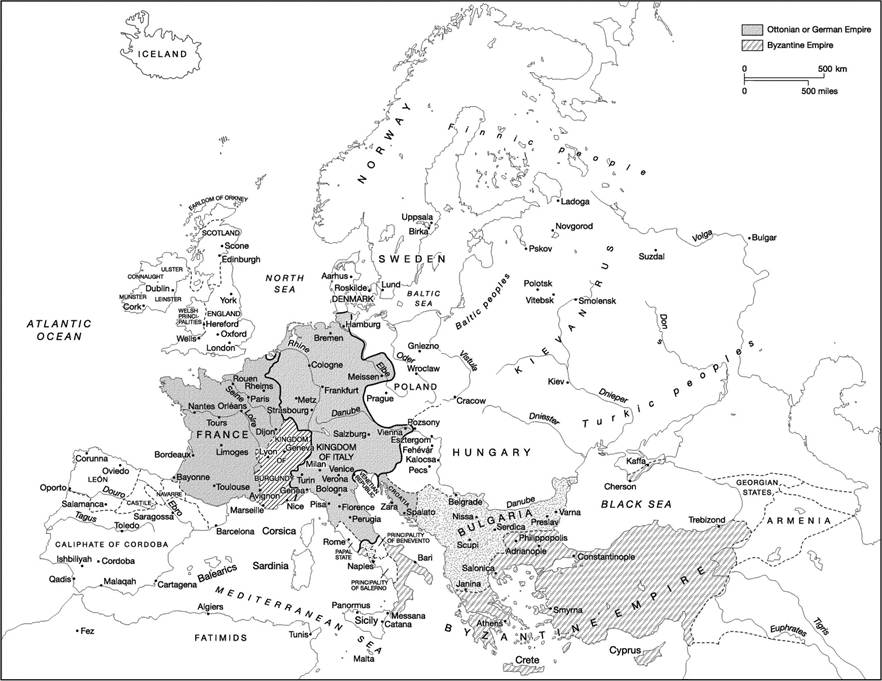
Like their eastern neighbors, they maintained a Carolingian style of rulership as far as the kingship was concerned, but they had also to consolidate a kingdom comprising the territories of strong territorial princes and regional magnates who changed the nature of that kingship in due course.[1318]Similarly, although members of the Carolingian family remained as rulers of northern Italy until the early tenth century, they too were replaced by local dynasties until the marriage between the widow of one of them and Otto I, the enterprising new king of Germany.[1319] [1320] Although Otto was crowned king in Italy in 951 and even emperor in 962, his sovereignty was not fully accepted in Italy until 966.60 Thereafter, even if the German emperors had to contend with local Italian claims to power within Italy from time to time, northern Italy was part of the German realm's interests for some centuries to come.[1321] Contemporary perception, nevertheless, was that all these new kingdoms in western Europe remained part of a larger whole, at first under the control of members of the same family, or at least thereafter connected with each other by marriage and strong diplomatic agreements. The narratives of the mid-ninth century place enormous emphasis on brotherly love, concord, and harmony. Family relations CHARLEMAGNE, THE CAROLINGIAN EMPIRE, AND ITS SUCCESSORS 483 Map 17.3. Europe, ca. 1000. Source: McKitterick, 2001, The Short Oxford History of Europe, The Early Middle Ages, p. 290. Copyright: Oxford University Press. determined the course of political events. At Meersen in 851, for example, the concern was articulated as “the peace, concord and harmony of the three brother- kings: that they should be united by true and not false bonds of love.”[1322] The Emperor Louis II of Italy's famous letter to the Byzantine emperor Basil I in 871 similarly stresses that the western empire was a unified whole because all the rulers were of common blood.[1323] These same ninth-century narratives, the Annals of St. In this context, Nithard's famous account of the quarrels between the sons of Louis the Pious (which he never labels a civil war) represents a dramatization of particular incidents in one phase of longer-term family relationships and a clear statement about unity. Nithard not only invokes the peace and harmony that prevailed between the two brothers Louis and Charles, but also stresses how alike they were—both of medium height, handsome and graceful, bold, generous, prudent, well spoken. They took their meals together, ate and slept in the same house, dealt with public and private matters in the same spirit. They arranged games among the different peoples of the empire—Saxons, Gascons, Austrasians, and Bretons, and they were joined by an immense army of “Bavarians and Alamans.”[1325] The end of the last section of the history brings the kings' elder brother Lothar into this special circle once more, as the division of territory is agreed. As a further symbol of unity, Nithard records how the brothers and their armies swear oaths to each other: Louis in the Roman language and Charles in the language of the people (Lodhuvicus Romana, Karolus vero Teudisca lingua iuraverunt.): For the love of God and for our Christian people's salvation and our own, from this day on, as far as God grants knowledge and power to me, I shall treat my brother with regard to aid and everything else as a man should rightfully treat his brother, on condition that he do the same to me. And I shall not enter into any dealings with Lothar which might with my consent injure this my brother Charles/Louis.[1327] Nithard was obliged to give a positive version of the alliance between Charles the Bald, king of the West Franks, and his older half-brother, Louis the German. His chosen method was to use differences in language symbolically, for the languages were exchanged by the brothers so that Charles, from the west, spoke in German, allegedly the language of the east, when making his oath, but his brother Louis, king in the eastern and German regions beyond the Rhine, spoke in “Roman,” the language supposedly of the west, though their troops spoke Roman and German, re- spectively.[1328] This had the effect of simultaneously enhancing the political difference Nithard wished to stress and the “necessity and essential logic” of their reconciliation.
More on the topic Imperial Unity:
- Unity in Diversity
- What Kind of Unity does Religion Possess?
- Unity of Effort and Interagency Operations
- The Islamic Empire: From Political to Cultural Unity
- Hemispheric unity, internal dislocation
- A unity of diversities: fiqh pluralism and the totality (3L) of the ‘aqd as the performance of God’s will
- Searching for unity and certainty amidst (dis-)embedded systems
- On 6 April 1868, the Meiji emperor proclaimed the Imperial Oath and ‘restored' the imperial rule, beginning the Meiji period (1868-1912).
- Hierarchy and Imperial Rule
- The Imperial Bureaucracy
- The Imperial Self and the Barbarian Other