The Islamic Empire: From Political to Cultural Unity
By 1000 ce, the Caliphate had been split into a number of smaller polities. In its heyday around 800, the Abbasid Caliphate was not only larger than the Carolingian dominion, it also resembled more closely the archetype of a classic empire: taxes were sent from the provinces to the center.
Provincial governors were kept under control and were not hereditary. Only in Andalusia and the Maghreb was imperial control of a more indirect kind, with more autonomous governors. In the second half of the ninth century, provincial governors gradually assumed more and more power, without directly usurping the caliphal title. Even deprived of new taxes coming in from outside Mesopotamia, the caliph was still capable of waging wars,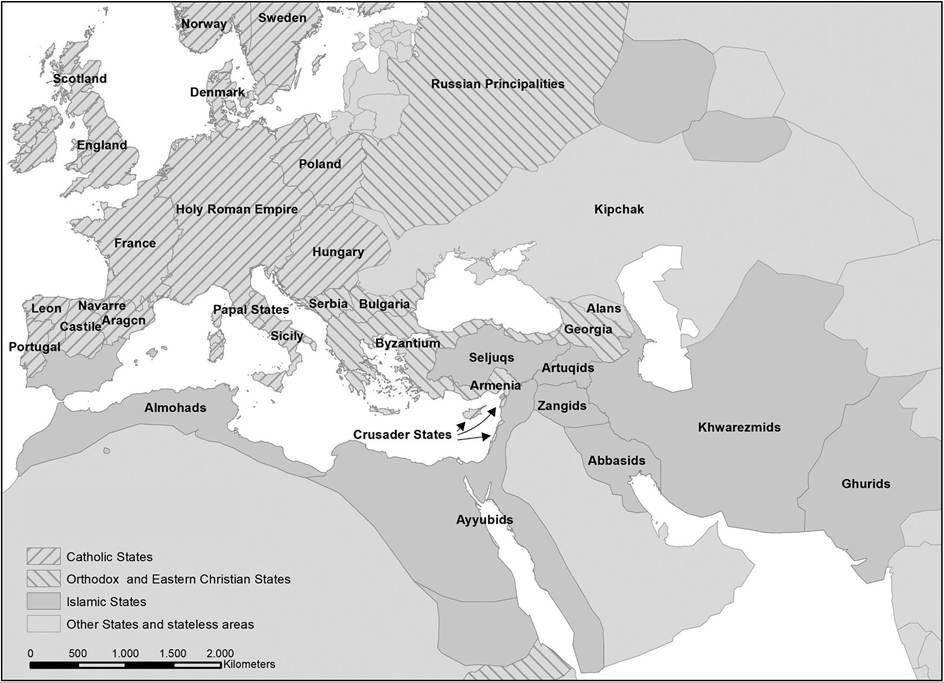
606 JACOB TULLBERG
Map 21.1. The Christian and Islamic Ecumenes in the Early Thirteenth Century ce. Copyright: Jacob Tullberg with Peder Dam.
financed with the money from his immensely rich treasury. The historian Al- Tabari, our main source on the early Caliphate, ends his chronicle in the year 915 ce, with the caliph realizing that the treasury has now run empty.[1588] During the centuries that followed, provincial governors began to style themselves as “sultan.” This word, originally only meaning “authority” gradually became associated with a practically sovereign ruler.
Two of the most ambitious rulers began styling themselves as “caliph.” In both cases, the claims were backed by arguments that were certainly convincing to many Muslims. It was not just ordinary provincial governors who usurped the Abbasid legitimacy.
The first was the ruler of Andalusia, Abd al-Rahman III (caliph 929-961). With a dominion consisting of two-thirds of the Iberian Peninsula and some insecure possessions in North Africa, his claim to universal rule was somewhat ambitious, but he was an Umayyad, a descendant of the caliphs who had been in power before the Abbasids.
He therefore possessed some special political capital to support his promotion. He could, with some justification, claim to be the righteous commander of the faithful. Just as in the cases of Charlemagne in 800 and Otto I in 962, his accession was the culmination of a series of successful campaigns. Obviously, he was not in possession of Mecca and Medina, but at this time neither was the Abbasid ruler in Baghdad. Abd al-Rahman also began to strike gold coins with his own name, a feature that was closely associated with universal rule in both East and West.[1589]The other example of a rival claim to the Caliphate was the Fatimids, controlling at their peak most of North Africa, Egypt, Syria, and the Hedjaz. By emphasizing descent from Muhammad’s daughter Fatima and his cousin Ali, they gained support among those who had always insisted that the caliph should be chosen from the prophet’s own lineage. The first Fatimid only controlled some outback areas in modern Tunisia at the time he assumed the title of caliph in 909.[1590] The expansion that followed bore a lot of resemblance to the process of khaldunian conquest. Egypt was seized in 969 and the holy cities of Islam in the following years. By the eleventh century ce, Shi‘a was developing into a sect, not just support for an alternative dynasty. This development made it almost impossible for the Fatimids to achieve recognition among Sunni Muslims beyond the area directly controlled by them. When they were finally overthrown by the Kurdish warlord Saladin in 1171, the latter did not declare himself caliph, but instead formally recognized the Abbasid ruler in Baghdad as his overlord. It was also around that time that the Abbasids actually regained control over significant parts of Mesopotamia, but they were never able to re-establish direct imperial control over the vast area that by then constituted the Dar al-Islam. After the fall of Baghdad to the Mongols in 1258, a (possible) Abbasid appeared in Egypt and was reinstated as caliph in one of the more curious dynastic arrangements in history.
The Mamluk sultans, at that time the effective rulers of Egypt, kept a string of caliphs in a gilded cage as a sort of legitimacy-producing asset. All new Mamluk sultans were hailed by the caliphs as rulers until the early sixteenth century. When the Ottomans conquered Egypt (and Syria and Hedjaz) in 1516-1517, the last Abbasid caliph was taken to Istanbul as treasure and a new one not appointed. Instead, the Ottoman ruler assumed the caliphate for himself. His predecessors had sometimes used the title, but it became a serious business only after the conquest of Islam's holy cities.[1591] It remained so until after World War 1.From the tenth century, the Caliph had been reduced to a symbolic figurehead, recognized by some, but not all. Truly, the caliphate was in theory held in high esteem since most regional rulers acknowledged the superiority of the prophet's successor.[1592] On the other hand, for regional rulers this was not much more than a token gesture with few practical consequences. There were some exceptions of a more ceremonial kind, like having the caliphal name read in the mosque at the Friday prayer and striking gold coins with his name, but apart from such matters, the sultanate provided the regional ruler with the same prerogatives as the commander of the faithful. One may ask why the caliph did not become a sort of pope with the imperial prerogatives that the Roman pontiff after all did hold in the high Middle Ages?