Similar Trajectories?
Since Montesquieu there has been a tradition in historical sociology for identifying the geopolitical web of European civilization in the Middle Ages and Early Modern Period with middle-sized monarchies and non-European civilization in the same periods with large empires.[1582] This perspective is, however, not fully justified with respect to the Islamic world.
In the centuries between the de facto fall of Abbasid imperial power (ca. 900) and the rise of the Ottomans and the other gunpowder empires, the Islamic world was also consisting most of the time in most places of independent monarchies of medium size. Larger hegemonic constellations like the Great Seljuq Empire were coming and going, but these were not typical representatives of classic imperialism, with polities of vast size and centralized government, provincial governors kept in tight reins, and taxes reaching the imperial treasury. In other words, there was very little of the kind of imperialism that the Abbasids and later the Ottomans had wielded earlier in their heydays. There were certainly attempts in this direction, but the Islamic world in this period suffered from a chronic lack of dynastic stability, with new conquerors coming out of the deserts and steppes all the time. They not only substituted themselves for the existing dynasties, but created whole new polities with new geopolitical configurations. On a lower geographical level, some more stable polities did exist—especially Egypt under the Fatimids and the Mamluks—another example of similarity with Christian Europe, where regional monarchies also were more stable than the larger constellations.[1583]Concerning the absence of stable empires of the classic type, the parallel between Islam and Western Christendom in the period 900-1400 is obvious. After the disintegration of the Carolingian Empire, the northwestern part of the old Roman world did not experience a classic imperialism of the Roman/Abbasid/Ottoman kind.
This does not mean that this part of the world was without large hegemonic constellations. The dominion of Otto I and II in the second half of the tenth century was of the same size as that of Charlemagne if areas loosely subjected are counted. Otto II installed his own man as duke of Southern Italy. Many Slavonic princes to the East accepted Ottonian hegemony, as also King Harold of Denmark and even King Lothaire of the Western Franks did at certain times.[1584] To this we may add that at least the southeastern part of Norway was in a tributary relation to Denmark. Ottonian Europe was very far from being a concert of kingdoms of equal standing. Instead, it formed an ever-changing pattern of hegemonic constellations. On a famous gospel illustration from the reign of Otto III, four women, representing Roma, Gallia, Germania, and Sclavinia, are paying tribute to the emperor (see Figure 21.1). The geopolitical structure of Latin Christendom in 1000 CE was therefore similar to the Islamic world in the sense that the polities at the regional level negotiated their dependence with larger (imperial) powers, and that the latter rarely controlled tightly the vast areas they claimed to dominate.The medium size of kingdoms/sultanates was not the only similarity. If we compare the two civilizations in the early period, in the tenth century, then the instability of the regional dominions is another thing they had in common. Not only were they unstable in the dynastic sense, with the same lineage rarely possessing the throne for more than three generations; but the realms themselves were also often very unstable, with many breakups, reunifications, conquest by foreigners, invasions by “barbarians” and other interruptions.
There are indications, however, that Roman Christian Europe was moving away from this chronic and structural instability after ca. 950. The Hungarians were defeated at Lechfeld in 955 and were no longer capable of sending raiders far into Western Europe.[1585] About that time, the Danes of Northumbria were pacified and incorporated into the English realm.
Archibald Lewis noted a generation ago that one of the major characteristics of high medieval Europe is that this civilization did not share with Islamic and Chinese civilizations their exposure to nomad attacks from the deserts or steppes.[1586] An alternative to the nomads were Scandinavian Vikings or other agricultural “barbarian” peoples with high military participation rates, but after 950, such cultures gradually became integrated into Latin Europe and ceased being barbarians/societies with high military participation rates. In the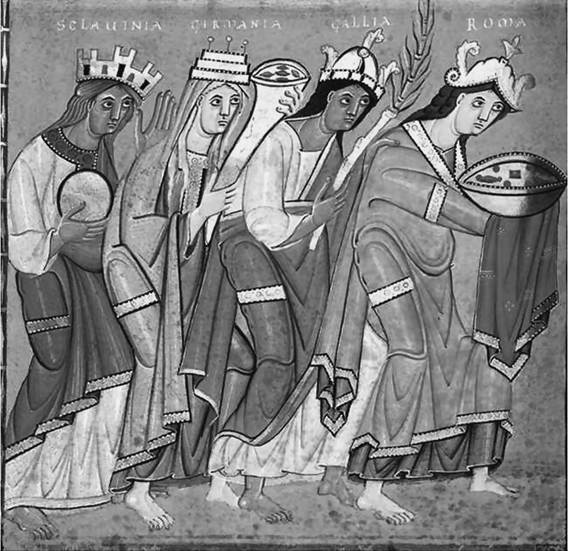
Figure 21.1. Four women, representing Roma, Gallia, Germania and Sclavinia, are paying tribute to the emperor.
From Das Evangeliar Ottos III, Munich, Bayerischen Staatsbibliothek, Clm 4453.
longue duree, many differences between the political structure of Christian Europe and the Islamic Middle East may be at least partly the result of different degrees of exposure to “barbarian” attacks.[1587]
More on the topic Similar Trajectories?:
- Plato
- The Agenda
- The Agenda
- Concluding Remarks
- Carving a Livelihood in Post-conflict Sierra Leone: The Benefits of Bike Riding
- INTRODUCTION
- Emergent Classicality
- UNITED KINGDOM DEVOLUTION IN HISTORICAL PERSPECTIVE
- Taking Stock
- Appendix 6.1: How to evaluate complex and context-specific development programs