India in crisis
One of the chief concerns for the British was that the changing international environment and the instability in Ireland and the Middle East might affect the most important colony of all — India.
In the period before 1914 Britain had already begun to liberalize the political system in India. For example, in the wake of the great revolt of 1857 the government established representative bodies, such as the viceroy's advisory council, provincial legislatures and municipal councils. Such bodies were necessary in order to legitimize the higher taxation that followed from the increased cost of policing and administering India. In addition, by allowing Indians limited power at the local level, the British sought to win over the political elite, thus turning them into collaborators. To a degree this latter aim worked, for the leading voice of Indian nationalism, the Indian National Congress (hereafter Congress), which was established in 1885, tended to pursue a moderate agenda. However, the British policy also created problems for the future, for, in an effort to conciliate the Muslim community, it was given votes for its own reserved seats. By such actions the British exacerbated the growing sense of religious communalism within India. This was dangerous, because already factors such as the activities of Christian missionaries had helped to stimulate a Hindu revival and interest among Muslims in the Islamic resurgence. The result was that radical politicians, such as Bal Gangadhar Tilak, began to use Hindu imagery in their efforts to construct a more assertive form of Indian nationalism. Meanwhile, in response, Muslim leaders created their own national organization, the Muslim League, in order to counter Congress, which was already largely Hindu dominated, and to create a common identity for India's many disparate Islamic communities.Congress
Shorthand for the Indian National Congress, a nationalist party first formed in India in 1885.
Congress played the most important role in bringing about Indian independence in 1947 and since then has been one of the major political parties in Indian politics.The first stage in India's political evolution culminated in the Morley-Minto reforms of 1909, which allowed for Indian majorities in the provincial legislatures. But if Britain had hoped that this would be enough to quieten India, then the First World War and the general imperial instability precipitated by that conflict proved it wrong. As noted above, India played a substantial role in the fighting, and the government was forced to raise income tax and tariffs to meet its defence expenditure. The heavy burden placed on the Indian people naturally led to unrest. The degree of discontent was demonstrated in 1916 when the Muslim League and Congress overcame their antipathy and signed the Lucknow Pact, in which they agreed to push forward a common reform programme. In order to appease this latest wave of agitation, the British government in 1917 declared its intention to steer India towards responsible ‘self-government' within the empire. Accordingly, in 1919 the Montagu-Chelmsford reforms were introduced which devolved more powers to, and increased Indian representation at, the provincial level. Britain's largess was, however, not enough to satisfy Congress. Inspired by the unrest in Egypt and Ireland, and in association with Indian Muslims affected by the Khalifat Movement, Congress in 1919, under the leadership of the British- trained lawyer Mohandas Gandhi, launched the first of its non-cooperation campaigns calling for an end to British rule.
The first non-cooperation campaign witnessed the start of the struggle for Indian independence that would end in 1947. However, in the period before 1939, although the Indian issue proved to be a heavy burden for the British government, neither side proved strong enough to vanquish the other. The British attempted to control the situation through a dual policy of concession and repression.
In the field of political reform it continued to try to assuage moderate Indian opinion by incrementally making moves towards full representative government at the provincial level, while at the same time maintaining its own strict control over military and financial matters at the political centre. In particular, it hoped that, by allowing Indians to exercise power at the provincial level, it could tame local politicians and divide them from the national-level leaders, such as Gandhi and Jawaharlal Nehru. At the same time, whenever it was necessary, it used repressive legislation to break up outbreaks of non-cooperation, and periodically detained tens of thousands of Congress members. However, aware of the potential for criticism from the Left in Britain and from anti-imperial opinion elsewhere in the world, and fearful of provoking even greater dissent within India, the government was careful to act within the letter of the law. The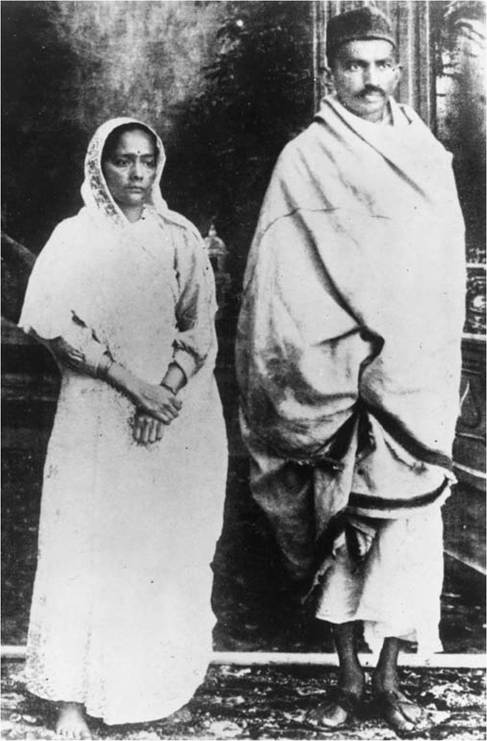
Plate 4.1 Indian nationalist leader and organizer of the Indian National Congress's campaign of passive noncooperation, Mahatma Gandhi, with his wife, shortly before his arrest for conspiracy, January 1922.
result of these policies was that they were enough to slow down Congress’s progress but not to defeat it.
Meanwhile, Congress similarly proved unable to defeat the British. Given Britain’s hesitation about using excessive force, it might be argued that Congress should simply have tried to make India ungovernable by organizing a mass insurrection. The problem here, however, was that Congress was not an organization capable of mounting such a challenge. In part, this can be seen as a moral problem, in that the sort of protest necessary to dislodge Britain would require violence, which was unacceptable in principle to Gandhi and his supporters. However, there were other motives at play. As with many other nationalist organizations in the decolonization period, the ideas espoused by Congress primarily reflected the interests of the educated urban bourgeoisie and the rural landlords.
Accordingly, it backed away from the potential dangers of mobilizing the whole population for revolution. Indeed, it is noticeable that when, during the 1930s, socialists within Congress called for the construction of a mass party that would take up class issues, this was decisively rejected in favour of an allnation approach. Also important in this respect was that Congress was financed by Indian industrialists, who clearly had little interest in seeing a mobilized proletariat. Another problem was that Congress saw itself as the sole legitimate voice of Indian nationalism. It was therefore temperamentally disinclined to cooperate with other political parties, such as those representing Muslims or the ‘untouchables', and thus found it difficult to construct a coalition of forces opposed to British rule. It is, for example, noticeable that there was very little Muslim involvement in the second non-cooperation campaign of 1930—34.import substitution
The process whereby a state attempts to achieve economic growth by raising protective tariffs to keep out imports and replacing them with indigenously produced goods.
The competition between Britain and Congress was not, however, a complete stalemate, for over time the need to appease Indian opinion led to a steady weakening of ties between Britain and India. Apart from reasons of imperial prestige, India was important to Britain for two reasons — its economic value to the British economy and as a source of military manpower. However, the need to assuage Indian opinion steadily eroded India's contribution in these two areas. The problem was that as the British gradually allowed Indians to take a role in provincial government and to be consulted about central government matters, this led to greater Indian interest in both revenue collection and expenditure. Accordingly, the government in India found itself forced to raise duties on imports, even on goods from Britain, to finance its rule, as this was preferable to causing problems by raising taxation. This naturally had a deleterious effect on the export to India of British goods, in particular the cotton textile products of Lancashire. Further exacerbating this problem was that the customs duties provided a wall behind which India could establish import substitution industries. The British and Indian economies thus began to diverge. In addition, Indian opinion was increasingly vocal in its criticism of Britain's widespread use of the Indian army to police the empire in Asia at India's expense. The situation therefore was that, while Britain engaged in its trial of strength with Congress, the foundations of British rule were already eroding.