Empire and nationalism in the Middle East
see Map 4.2
The other major new challenge to empire was the extension of British and French influence into the Middle East. Here too, the European imperial Powers faced the task of dealing with an upsurge of nationalist sentiment.
This might seem surprising when one considers that much of the region had only recently been conquered by Britain and France from the Ottomans. However, the unfortunate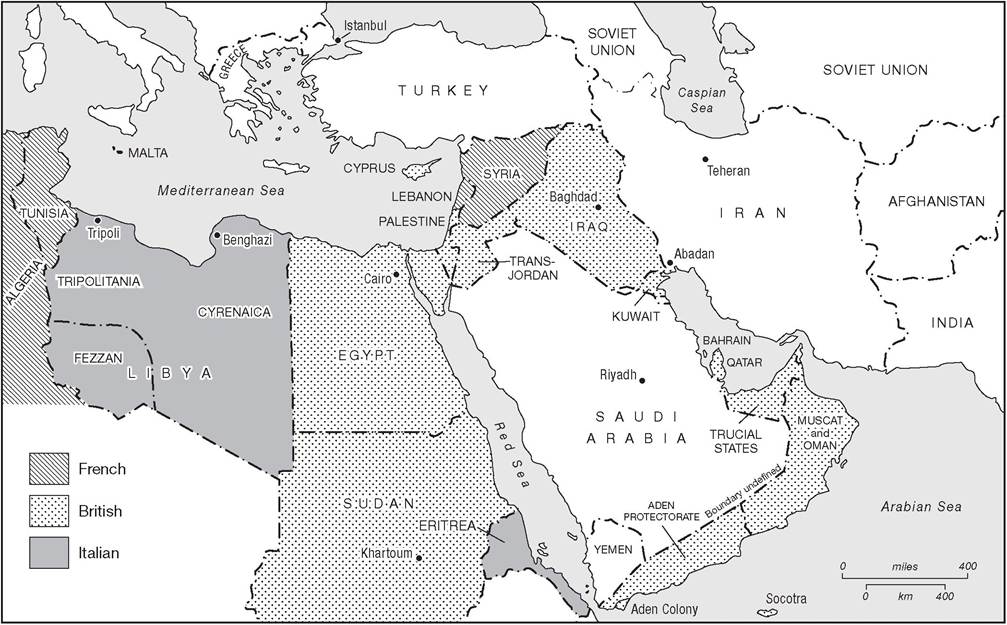
Map 4.2 The Middle East in 1922
fact was that, by taking control of this area, they inherited the anti-colonial dynamic that had already risen in opposition to Turkish control.
Arab nationalism
The belief that all Arabicspeakers form a nation that should be independent and united.
By the turn of the twentieth century the Ottoman Empire was in its last throes. This gave rise to two distinct developments: first, increased European interest in Ottoman territories in the Middle East and, second, the emergence of local nationalisms, most notably Arab nationalism. The European interest in the declining Ottoman Empire was driven by colonial and hegemonic competition dating back to Napoleon’s abortive occupation of Egypt, which had clearly revealed the inability of the Ottoman army to protect its own territory. This triggered further European intervention, such as the French occupation of Algeria, Tunisia and Morocco from the 1830s onwards, the British occupation of Egypt in 1882, and the Italian invasion of Libya in 1911. This scramble for territory was propelled by the power imbalance between the Ottoman Empire and the European states but, at the same time, it was regulated by the intra-European balance of power in what came to be known as the Eastern Question.
see Chapter 19
pan-Arabism
Movement for Arab unity as manifested in the Fertile Crescent and Greater Syria schemes as well as attempted unification of Egypt, Syria and Libya.
The combination of Ottoman weakness and steady European penetration created the environment for the rise of Arab nationalism, the belief that all Arabicspeakers form a nation that should be independent and united. The movement has its origins in the nineteenth century. It started among intellectuals in different geographic centres such as Cairo, Beirut and Damascus, drawing upon a variety of intellectual traditions, secular and religious, but also a shared history dating back to the Arab conquests following the death of the Prophet Muhammad in 632. Muslim intellectuals such as Rifaa Rafi Tahtawi, Jamal al-Din al-Afghani and Muhammed Abdu saw the Arab national revival through Islam. In fact, the latter two emerge as the ‘fathers’ of modernist or reformist Islam. Many Christian intellectuals such as Butrus al-Bustani, Shibli Shumayyil and Farah Antun promoted secular nationalism, focusing on the Arab language and culture. Another facet of the emerging nationalist debate was the territorial unit. For example, Ahmed Lufti al-Sayid advocated a distinctly Egyptian nationalism while Muhammed Rashid Rida promoted pan-Arabism. Until the First World War notions of Arab autonomy within an Ottoman framework competed with notions of independence.
Ottoman centralism and European colonialism influenced Arab nationalism in no uncertain terms. The relationship between European colonialism and Arab nationalism can best be described as one of love and hate in that Arab nationalism embraced some European ideas passionately while, at the same time, fervently opposing European domination. Ultimately European colonialism strengthened the sense of Arab national identity. No matter how much progress and modernization were introduced by the colonial administrations, self-government was still preferable to foreign rule. However, the European portrayal of Islam as backward also planted the seeds of self-doubt. Ironically, this resulted in the retarding of social transformations, as nationalists often felt compelled to defend religious and cultural traditions they would otherwise have reformed on the sole basis that they were indigenous and non-European.
However, it also resulted in the rejuvenation of Islamic thought.In the same way that Arab nationalism adopted anti-European characteristics, it also developed anti-Turkish ones. In fact, it could be argued that the Arab nationalist debate began with the demand for greater autonomy for the Arabicspeaking provinces of the Ottoman Empire rather than in reaction to contact with the West. This becomes clear when examining the institutional origins of the Arab nationalist movement, which lie in a number of small and often secret societies formed in opposition to the Turkification policies of the Ottoman central government from 1875 onwards. They sought Arab autonomy, the recognition of Arabic as the official language and the restoration of Arab pride, and even went as far as rejecting the sultan's claim to be Caliph as a usurpation of Arab rights.
One event which had a profound impact on Arab nationalism was the 1908 Young Turk revolution. The reorientation from the Ottoman dynasty to the Turkish nation in the long run strengthened those Arab nationalists who sought independence rather than autonomy, for it encouraged many Arabs to think about their future in their own nationalist terms. This also had implications for the intellectual direction of Arab nationalism in the sense that, just as the Turks rewrote their history books, toning down the Ottoman characteristics, Arab nationalists reached back to the pre-Ottoman days of the Arab Caliphate, when the Middle East had flourished under Arab-Islamic civilization. Finally, the Young Turk revolution also marked the point when Arab nationalist ideas ceased being the property of a few intellectuals and started to spread to the general population, truly becoming a mass movement. A key example of this was the convening of the first Arab Congress in Paris in 1913, which brought together Arab nationalists from different intellectual traditions ranging from Egypt to Iraq.
Thus, when the First World War led to the final disintegration of the Ottoman Empire, the victorious European states found that Arab nationalism was already a potent force.
This was to cause great problems, for Britain and France had hoped that their increased influence in the Middle East would provide both strategic and economic benefits, and their initial intention was to exert close control over both their existing colonies and protectorates and the new mandates. The strength of Arab nationalism was, however, to force them to tailor their ambitions to local circumstances.Under the League of Nations' mandate system, France added the Levantine states of Syria and Lebanon to its existing North African possessions of Morocco, Algeria and Tunisia, while Britain increased its sphere of influence, hitherto limited to Egypt, Aden and the Gulf states, by receiving responsibility for Palestine, Transjordan and Iraq. The mandate system involved an interesting contradiction. On the one hand, in a spirit of realpolitik, it stipulated that the Ottoman Empire, as the losing party, should lose its ‘overseas' territory to the victors, thus reducing it to the ‘rump' state ofTurkey. It then divided the mandates between Britain and France in line with the secret Sykes-Picot Agreement of 1916, a treaty that was as cynical an exercise in balance of power politics as could be imagined. And, finally, the League, by deeming that the Ottoman territories were not ready for independence, gave credence to beliefs in some European quarters that empire rather than independence was the ‘natural' condition in the Middle East. Yet, on the other hand, the League also endorsed Wilson's fourteen points, which included the right to self-determination, and made it clear that it was the duty of the mandate powers to prepare the population for independence and to aid with institution- and state-building. It therefore set the mandate Powers on a collision course with the indigenous populations.
Young Turks
Name given to a group of young army officers who in 1908 pushed the Ottoman Empire towards reformist policies and a more overtly Turkish nationalist stance.
Caliphate
The office of the successor to the Prophet Muhammad in his political and social functions. The Caliphate was abolished by the Turkish president Mustafa Kemal Ataturk in 1924 after the dismemberment of the Ottoman Empire and the establishment of the Turkish Republic.
fourteen points
A speech made by the American president Woodrow Wilson on 8 January 1918 in which he set out his vision of the post-war world. It included references to open diplomacy, self-determination and a post-war international organization.
see Chapter 5
Empire might still have been the natural state of affairs in European thinking, but as far as the Arabs were concerned, they had just been cheated out of independence. After all, they too had joined the fight against the Ottomans, and had received promises of independence, in writing, in the 1915—16 Hussein— McMahon correspondence. Britain and France were therefore faced with a difficult challenge for, in acquiring the mandates, they were put in charge of territories which had been on the verge of independence and had established nationalist movements, and where the inhabitants saw themselves as equals not subjects. Not surprisingly, friction quickly emerged between the European administrators and the Arab populations. The worst case was Palestine, where both Arabs and Jews believed that their aspirations for statehood had been sacrificed at the altar of British imperial interests. This sense of betrayal was shared by the Kurds, who had been promised a state of their own at the Lausanne Conference only to find that it did not serve British interests to fragment the Iraqi mandate, especially if it threatened the disputed oil-rich area of Mosul.
Hashemites
The family of the Sharifs of Mecca who trace their descent to the Prophet Muhammad.
Influenced by their strategic and economic interests, Britain and France attempted to find local collaborators with whom to share power. In the French mandates and Palestine, France and Britain used partition as a tool to assure the dominance of key allies.
In its territories France carved Greater Lebanon out of Ottoman Syria, transforming it into a multi-ethnic and multi-religious republic under Maronite Christian hegemony, while, even before the mandates had been granted, Britain partitioned Ottoman Palestine along the Jordan River to create a wholly new entity, Transjordan. This was placed under the rule of Emir Abdullah, the son of the Hashemite Sharif Hussein of the Hejaz on the Arabian peninsula. Meanwhile Britain put Abdullah’s brother, King Faisal, on the throne of Iraq, which in 1932 became the first of the mandates to become an independent state.The effort to assert control over the newly acquired mandates was further complicated by the parallel struggle for independence in the ‘old’ colonial possessions such as Egypt, Algeria and Tunisia. Egypt had come under formal British occupation in 1882 and was a colony in all but name until the First World War. With the Ottoman entry into the war, Britain severed Egypt’s formal ties to the Ottoman Empire and transformed it into a British protectorate. During the war, British administrators attempted to reform Egypt by establishing a bicameral legislature in which the British effectively constituted the upper house. Not surprisingly, this met with resistance from the elites upon whom the British traditionally relied. This fuelled Egyptian nationalism, with the result that, at the end of the war, British authority was challenged by the Wafd Party and by rioting in the major cities. As in Ireland, Britain was forced to concede and in 1922 Egypt became a ‘sovereign’ independent country, although it was forced to sign an Anglo-Egyptian agreement to cover the protection of British imperial communications in Egypt, Egypt’s defence against foreign aggression, protection of foreign interests and minorities in the country, and control of the Sudan. Apart from these reserved points, Egypt embarked upon reform, drawing up a con-
stitution based on that of Belgium, setting up democratic institutions and, in 1923, holding its first free elections. However, the continued British presence remained a thorn in Egypt's side. Relations were renegotiated in 1936 and, again, in 1954, two years after the Egyptian monarchy had been overthrown and an Arab nationalist regime had taken power. But it was not until the 1956 Suez Crisis that Egypt was finally to rid itself of the last colonial vestiges.
see Chapter 18
Suez Crisis
The failed attempt by Britain and France in 1956 to take advantage of a war between Israel and Egypt by seizing control of the Suez Canal and bringing down the government of Gamal Abdel Nasser. It is often taken as a symbol of the collapse of European imperialism and the rise of the Third World.
ulama
Clerics or Islamic scholars who are learned in theology and the sharia.
The French experience in Algeria and Tunisia was similar, in that the elites of these two colonial possessions started to turn from co-operation with the colonial power to rallying against it in the name of nationalism and independence. Before the First World War both Algeria and Tunisia had seen outbreaks of violence against French rule. They were popular in nature, were often sparked by religious incidents, and placed the ulama in leadership positions. In the inter-war period the nature of the challenge changed with the appearance of distinctly nationalist political parties led by the intellectual elites, who were inspired by acts such as the Turkish resistance to the European Powers. In Algeria a number of small political groups emerged but at this stage posed little threat to French rule. In Tunisia resistance to the French was embodied by the Destour (‘Constitution') Party which pursued independence from a combined Tunisian nationalist-Islamic platform in the 1920s, and then by the Neo-Destour Party with a secularnationalist agenda from 1934.
The situation in the Middle East in the inter-war period was therefore one of lingering unrest and instability. Rather than adding unconditionally to the power of the European empires, their commitments in the region proved to be expensive and time-consuming. Moreover, the virulence of Arab nationalism proved, as with Ireland, to be an inspiration to other ethnic and religious groups elsewhere in the empires who were seeking independence from imperial rule.
More on the topic Empire and nationalism in the Middle East:
- in a recent book on the Slavonic peoples in the Middle East, the Russian Orientalist and historian Dmitrii E. Mishin examined a major but little- studied aspect of the historical relations between eastern Europe and the Middle East in Sakaliba (Slaviane) v islamskom mire v rannee srednevekove (Saqaliba:
- Europe has always had an interest in and fascination with the part of the world today called “the Middle East,” the lands to its south and east, which have since the seventh century been the heartlands of the Realm or House of Islam (Dar al-Islam).
- Nationalism and independence in South-East Asia
- 27 Islam in the Middle East
- Coercion and Violence in the Middle East
- The Turning Point of the Middle East
- the first stages of Ukrainian travel to the Middle East were dominated by pilgrims visiting the Holy Land and other such places of interest.
- CHAPTER TWO From the “Emir” to the Metropolitan: Middle East Travel (1800-1914)
- CHAPTER ONE From Abbot Daniel to Count Potocki: Middle East Travel to 1800
- The Challenge of Nationalism and the Last Efforts to Save the Empire
- The Middle East region, comprising the Arabian Peninsula, Mesopotamia and the Levant, contains within it the three earliest centres of Islamic civilisation:
- Prymak T.. Ukraine, the Middle East, and the West. Montreal: McGill-Queen’s University Press,2021. — 306 p., 2021
- Part IV Domestic Violence and Sharita∖ a Comparative Study of Muslim Societies in the Middle East, Africa and Asia
- Coercion and violence have played a decisive role in the shaping of the Middle East and affected all aspects of social life throughout the postSecond World War decades.
- The years around 1850 represented a watershed in American religious history, for they marked the onset of a series of waves of immigration from Asia, Africa, Latin America, Europe, and the Middle East
- The Dawn of Empire in the Near East
- Part II Gentlemanly Capitalism and Informal Empire in East Asia
- The three centuries that preceded the formation of East Asia's first unified empire were known as the Warring States period,
- Theme 10. The National Revival and Economic Modernization of the Ukrainian Lands under the Austrian (Austro-Hungarian) Monarchy of Habsburgs and the Russian Empire from the Middle 19th to the Early 20th Centuries