Nationalism and independence in South-East Asia
As in other areas of the world, the Second World War had a profound effect on South-East Asia. In particular, the humiliating defeats that Japan inflicted on the imperial Powers in 1941—42 dealt a severe blow to European prestige.
This effect was then compounded by Japan's ambivalent record as an occupying power, which saw it offering nominal independence to the local elites in Burma, the East Indies and the Philippines, while at the same time ruling with such a harsh hand that it stimulated the rise of nationalist-based resistance movements in all the countries it subjugated. In this environment the nationalist movements, which had struggled to make much impact in the pre-war period, began to flourish.When the war ended in 1945 the strength of indigenous nationalism meant that it was extremely difficult for colonial rule to be re-established. Even Britain, the strongest of the European Powers, did not find the task easy. Building on the precedent set in India in 1947, in January 1948 it granted independence to Ceylon (Sri Lanka) and Burma, both of which had made substantial constitutional progress in the inter-war period. In the case of Burma, it was clear that any other choice would have involved Britain in a debilitating effort to maintain order, which the decreasing economic benefits derived from controlling the colony would not warrant. Meanwhile in Malaya, which was of much greater economic importance owing to its position as one of the empire's major dollar earners through its exports of rubber and tin, Britain attempted to make its rule more efficient through constitutional reform. In 1948 it introduced a new federal governmental system that provided for strong central government control over security and finance, but also a degree of local autonomy for the Malay-dominated sultanates.
Holland and France proved to be less accommodating to the forces of nationalism than their British counterparts.
Both had suffered a marked loss of prestige during the war, both in Europe and in Asia, and therefore saw the restoration of their possessions in South-East Asia as vital to their national rehabilitation. Both, however, met with strong resistance when they attempted to reassert their control. In the Dutch East Indies the Japanese had directly encouraged Indonesian nationalism by liberating leaders such as Sukarno and Hatta from Dutch custody and allowing the development of an indigenous militia. When the Japanese surrendered in August 1945 the nationalists were therefore ready to take advantage of the power vacuum to establish a Republic of Indonesia and were determined to stop the Dutch from returning. In Indochina, the opposition to the French came from the Viet Minh, a communist-led resistance movement against the Japanese, which in September 1945 declared the independence of Vietnam. In both areas the uncompromising attitudes displayed by both colonialists and subjects meant that a mutually acceptable political settlement was impossible, and thus wars of national liberation broke out.These two conflicts had a significant effect on the region. Britain had hoped that, in the aftermath of the Pacific War, it could use its position as the predominant Power in the region to encourage economic integration in South-East
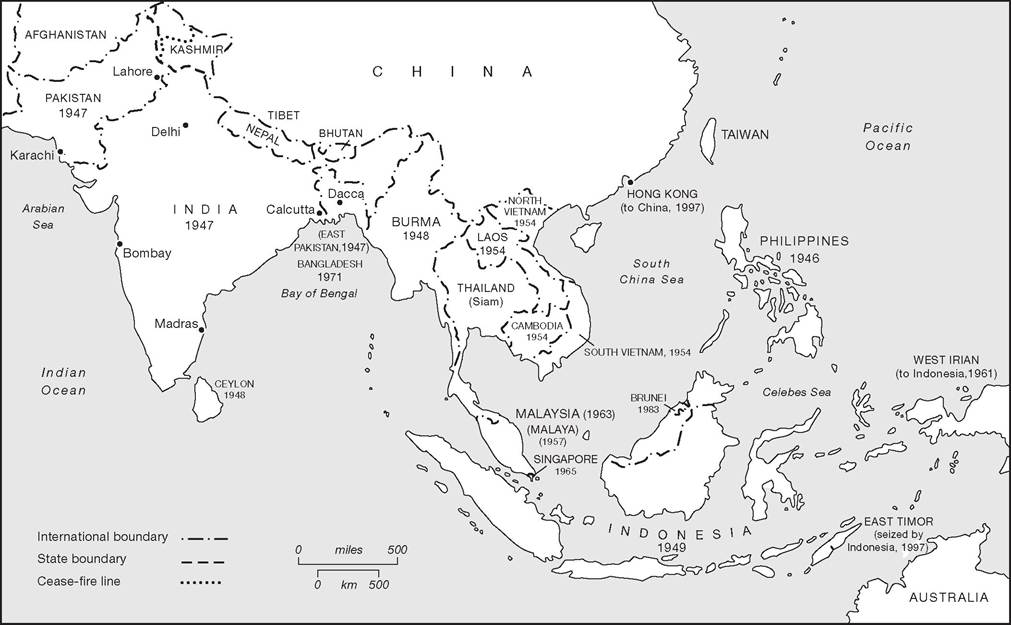
Map 10.1 Decolonization in South and South-East Asia
Source: After Brown and Louis (1999)
Asia. It believed that this would produce stability and a quick restoration of the region's favourable trade balance with the United States, which would, in turn, assist the economic recovery of the colonial Powers themselves. However, the fighting in the East Indies and Indochina frustrated this process and, as SouthEast Asia's economy and food distribution system remained mired in chaos, political disturbances soon spread throughout the region. The most disturbing aspect of this growing unrest was that in 1948 indigenous communists outside Indochina began to take advantage of the situation. In March communists plunged newly independent Burma into civil war, in June the Malayan Communist Party began an armed struggle against British rule, and in September the Indonesian Communist Party launched a failed coup in Java against Sukarno's government.
The region thus appeared to be on the edge of political breakdown.This was, not surprisingly, a matter of great concern for the colonial Powers, but it also became a worry for the United States. Since 1945 the Truman administration had attempted to distance itself from events in the region, merely indicating a general, if vague, desire that the European colonial Powers should allow greater self-government following the American example in the Philippines, which had been granted its independence in July 1946. However, in 1948 American thinking began to shift drastically. This was due largely to the realization that the raw materials, such as rubber and tin, that the region exported to the United States acted as one of the few ways in which key European states such as Britain and France could earn American dollars. The stability of South-East Asia therefore became linked to the main priority of the United States, the economic revival of Western Europe. Accordingly, when communist insurrections began in Burma, Malaya and Indonesia, American policy-makers assumed that these were not merely responses to local conditions but rather a co-ordinated campaign directed by Moscow designed to strike at one of the West's weakest links.
As a result of such thinking, the United States began to take a higher profile in a region that it had previously been content to see under British tutelage. Its main aim was to stem the communist tide. This involved it in what might seem to be contradictory policies, for in some areas it acted to expedite decolonization but in others it helped to perpetuate colonialism. The main focus of its effort to encourage decolonization was the Dutch East Indies. By 1948 the Dutch had still not come to terms with Indonesian nationalism, but their attempts to strangle the Republic of Indonesia had only succeeded in alienating world opinion and wasting their own scarce resources. Believing that the Dutch were involved in a fruitless and dangerous exercise, Washington's solution to this problem, safe in the knowledge that the Indonesian leaders were anti-communist, was to urge the Dutch to withdraw.
In April 1949, after American threats to end economic and military aid, Holland finally conceded defeat and Indonesia moved towards full independence.In regard to Indochina the United States took a very different tack, which was to put it firmly on the side of the imperialists rather than the forces of Asian nationalism. The situation in Indochina was not as simple as in Indonesia, for France was a vital European ally that could not be coerced in the same way as Holland. Moreover, the Viet Minh, although nominally a united front, was clearly under the control of the communists. American policy therefore tolerated the continuation of the French presence and even, albeit reluctantly, paid lip service to the latter's half-hearted gesture towards Vietnamese nationalism in the shape of the nominally autonomous Bao Dai regime.
The situation in South-East Asia in 1949 was therefore that, although much of the region had achieved independence, in one key area — Indochina — the advance of Asian nationalism had been thwarted. It was not, however, only the reverberations of the developing Cold War in Europe that had led to this outcome, for South-East Asia's destiny was also being moulded by events far closer to home. Already by the late 1940s East Asia was developing into a second front in the Cold War, a process that was completed in 1949 with the emergence of a communist regime in China.