The Chinese Civil War
In order to understand the development of the Cold War in Asia, it is first necessary to look at the respective interests of the superpowers in the region. At the end of the Second World War, both the United States and the Soviet Union sought to provide themselves with greater security in the East Asian and west Pacific regions.
For Stalin, this meant a reversal of the outcome of the Russo- Japanese War, that is, the return of the southern half of Sakhalin, possession of the Kurile Islands, the re-establishment of a sphere of influence in Manchuria and use of naval bases in Korea. The United States, for its part, tried to ensure that there would be no more ‘Pearl Harbors'. It therefore established trusteeships over what had been the Japanese mandates in the west Pacific, and most importantly, through its occupation of Japan, sought to transform its former enemy into a demilitarized and democratic state that would never again threaten the international order.Manchuria
The three north-eastern provinces of China and home of the Manchu people. From 1932 to 1945, with the addition of Jehol province, it became the Japanese puppet state of Manchukuo.
mandates
The colonial territories of Germany and the Ottoman Empire that were entrusted to Britain, France, Japan, Australia and South Africa under the supervision of a League of Nations Commission.
To a degree, the security concerns of the superpowers contained within them the seeds of strategic competition, particularly in regard to the future of Japan and Korea. In the case of the United States, one could even say that by occupying Japan it inherited the strategic concerns that had led the latter to become so sensitive about the balance of power in North-East Asia. The crucial factor, however, in determining whether the Cold War would spread to Asia was the fate of China. On the one hand, if reconciliation could be achieved between the GMD and the CCP in China, then the country could become a stabilizing influence.
However, on the other hand, if the victory of one of these parties led to the Chinese tilting decisively towards one of the superpowers, it would have a significant effect on regional security.The position in China at the end of the Pacific War was undeniably tense. At the start of the war against Japan in 1937, the GMD and the CCP had agreed to create the Second United Front, thus putting aside their mutual hostility in order to concentrate on resisting Japanese aggression. However, the two parties remained largely independent of each other, making war in parallel rather than engaging in a joint effort. Neither side was willing to move towards a true coalition for fear that the other would betray it in a repeat of the bloodshed that had accompanied the collapse of the First United Front in 1927. The Second United Front was therefore a fragile alliance that was not expected to last beyond the end of the war and, indeed, as early as 1941, clashes, such as the New Fourth Army Incident, were taking place between GMD and CCP forces.
New Democracy
The reformulation of Marxism-Leninism by Mao in the late 1930s and early 1940s in which he ‘sinicized’ communism and argued for the need for an alliance of classes, including both the proletariat and the peasantry, to bring about socialism.
The problem for Jiang Jieshi as the war progressed was that the CCP based at Yan’an in north China became increasingly strong, particularly if contrasted with its dilapidated state after the tribulations of the Long March. The CCP gained strength in a number of ways. In the military sphere, it adopted the principle of ‘protracted war’, which involved using guerrilla warfare to wear down the Japanese through attrition. This strategy proved successful and over time the CCP built itself a strong base in the rural areas of north China. Implicit in its use of guerrilla warfare was the need to work in the political sphere to foster good relations with the rural population, which it relied upon for food and intelligence.
It did this by stressing its nationalist credentials and establishing relatively efficient local government. Moreover, in order to encourage the development of an anti-Japanese ‘united front’ of classes, it moderated the radical land reform policy it had followed in the early 1930s, so that it would not alienate rich peasants or small-scale landowners. Ideological justification of this policy was provided by Mao’s ‘sinified’ reformulation of Marxism-Leninism, the ‘New Democracy’ movement, which argued that socialism could only be achieved through the proletariat leading a broadly based alliance of classes. Military success, popular support and a coherent ideological programme led to the CCP’s expansion from 40,000 members in 1937 to 1.2 million in 1945. Moreover, despite this rapid growth, party discipline was ruthlessly enforced. The CCP thus emerged as a potential challenger to the GMD’s monopoly on power.In contrast to the rise in the CCP’s fortunes, the Nationalists encountered many problems during the war against Japan. The fall of Shanghai and Nanjing in 1937 meant that the GMD lost its wealthy power base in the lower Yangtze valley and, accordingly, was denied the main source of its income. In order to sustain the war effort, officials resorted to increasing the money supply, but this sparked spiralling inflation, which in turn undermined support for the government. In addition, the descent of the GMD into corruption and factionalism and the Nationalist Army’s tendency to engage in forced conscription and requisition of goods without payment alienated the general population. Some of these excesses might have been excused had the Nationalists fought well against the Japanese, but Jiang’s war record was far from impressive, reaching its nadir in 1944 when his armies collapsed during Japan’s Ichigo offensive in south China. This lack of effective resistance led in turn to damaging speculation, fuelled by CCP propaganda, that Jiang was keeping his best forces intact for a post-war reckoning with the communists.
The GMD’s reverses were, however, balanced by other factors. The strongest card that Jiang held was that the outbreak of the Pacific War strengthened his ties with the United States. After Pearl Harbor, Washington saw China as a crucial theatre in the conflict with Japan and therefore increased its military and financial support for the Nationalists. In military terms the results of this sponsorship were distinctly advantageous, as the GMD's forces were boosted by the arrival of American advisers and, from 1944, increasing amounts of Lend-Lease material. In addition, American interest in China had the effect of raising the country's, and therefore by implication Jiang's, international standing. During the war Roosevelt became interested in the idea that, when peace was restored, China should become the dominant regional power in East Asia and one of the ‘four policemen' of the world. In order to achieve this goal, the United States and Britain agreed in 1943 to relinquish the last of their imperial privileges in China, bar the British possession of Hong Kong. Moreover, Roosevelt supported Jiang's demand for the return of all the territories that Japan had seized since 1895, and lobbied successfully for China to become one of the five permanent members of the UN Security Council. In addition, Jiang was able in August 1945 to build a diplomatic bridge to the Soviet Union by signing a treaty accepting the terms laid down by the ‘Big Three' at Yalta for Russian entry into the Pacific War. In essence, this meant that the Nationalists accepted Russian economic and military privileges in Manchuria, but in return they received from Stalin the promise of Soviet disinterest in Chinese internal affairs, in other words a commitment not to support the CCP.
The position therefore at the end of the war with Japan was that the GMD, although it faced a formidable CCP challenge, still remained relatively more powerful. It controlled more territory, had more party members and its army was numerically far greater than that of the communists and possessed better equipment.
Moreover, Jiang, through his diplomatic manoeuvres, had managed to isolate the CCP internationally, having committed the Soviet Union to neutrality and won the outright support of the United States. The problem for Jiang, however, was how to use this advantageous position to eliminate the CCP threat. On the surface it might appear that immediate renewal of the civil war was the best option, but in late August 1945 Jiang moved instead to open negotiations with the CCP. One reason for this surprising decision was that the GMD needed a period of peace in which to regain its Yangtze stronghold and have its forces airlifted into north China by the Americans. In addition, Jiang knew that Washington desired GMD—CCP negotiations in the hope that they would lead to a democratic coalition government, and to have started a war in such circumstances would clearly have been unwise. Also, there was always the possibility that an isolated CCP might be willing to reach a political compromise, for it too was under pressure from Stalin to negotiate.From August 1945 China thus entered into a twilight period in which negotiations, marked by grave suspicion on both sides, took place in Chongqing, while in the rest of the country the two parties vied for position. Not surprisingly, the talks soon became deadlocked. Frustrated by this lack of progress and fearing that the Soviets might take advantage of the situation, the Truman administration attempted in December 1945 to break the impasse by sending General George Marshall to mediate a general settlement. Marshall achieved an early success when he negotiated a cease-fire in January 1946, but in reality he faced an almost impossible task, neither side being willing to make any substantial concessions. The only hope lay in the prospect that each party feared that if it broke off the talks and renewed hostilities, it risked the prospect of losing both international and domestic support.
Lend-Lease
With the Lend-Lease Act of March 1941, the US Congress empowered the president to lease or lend arms and supplies to any foreign government whose defence the administration considered essential to US national security.
The programme, originally intended to rescue Britain, was eventually extended to more than thirtyeight states fighting the Tripartite Pact Powers.United Nations (UN)
An international organization established after the Second World War to replace the League of Nations. Since its establishment in 1945, its membership has grown to 192 countries.
The fragile peace in China was undermined finally by two factors. The first was that by early 1946 the United States and the USSR were increasingly at odds. This was important because it propelled Jiang towards the conclusion that American support was guaranteed if he should go to war against the CCP. He therefore turned away from a political solution and looked for a suitable justification to renew hostilities. This then links to the second factor, which was the situation in north-east China. In the last few days of the Pacific War the Soviet Union had invaded Manchuria, thus honouring its commitment at Yalta to enter the war against Japan. After the Japanese surrender its troops remained in occupation and, despite the treaty signed with Jiang in August, allowed CCP forces to enter the region in the autumn of 1945 and take control of the rural areas. This greatly alarmed Jiang, for Manchuria was a rich prize following its industrialization under Japanese rule. Therefore when, in April 1946, the Russians withdrew from Manchuria, he ordered the airlift of GMD troops into the region in an effort to prevent the CCP from seizing complete control. With this move the cease-fire broke down and China quickly descended into civil war.
In the first year of fighting the GMD's superior numbers led to a series of victories in Manchuria and north China. This apparent success was misleading, for the CCP once again engaged in a ‘protracted war' strategy, which was designed to encourage Jiang's forces to overstretch themselves and thus increase their vulnerability. By the autumn of 1947 the CCP was strong enough to go on the offensive in Manchuria, and from then on the tide of the war swung irrevocably in its favour. The victory of the CCP was also due to its broad level of political support. It gained the solid adherence of the peasantry owing to the popularity of its land requisition policy, and acquired the backing of many Chinese ‘liberals' as a result of the continuation of ‘New Democracy' and its reputation for discipline and incorruptibility. This contrasted with the GMD, which remained mired in factionalism and graft, and proved unable to do anything to control the increasing economic chaos. Indeed, in the midst of the civil war, the Nanjing government continued to introduce reforms designed to modernize the country and centralize power, even though such measures proved to be entirely counter-productive.
Another important miscalculation on Jiang's part was his belief that the United States would fully support his efforts to eradicate communism. In reality, Washington proved reluctant to act. Many in the Truman administration felt that Jiang had miscalculated when he had gambled on war, and believed that he should have concentrated instead on domestic reforms in order to undermine the CCP's appeal. Scepticism about Jiang and his regime became particularly noticeable after Marshall returned to Washington to take up the position of secretary of state in January 1947. Marshall had not been impressed by Jiang's regime, noting its corruption and lack of commitment to democratic values, and held that the United States should not commit itself irrevocably to the GMD's survival. Moreover, although, as Jiang had predicted, serious tensions developed between America and Russia in 1946—47, even this did little to help his cause, for the architects of containment policy in Washington considered China to be economically weak and thus not a vital asset that must be denied to the Russians.
In 1949, after a series of catastrophic defeats, the GMD regime was forced to flee to Taiwan and the CCP proclaimed its victory by establishing the PRC on 1 October in Beijing. On taking power the CCP made it clear that the ‘new China' would pursue a radically different path to its predecessor. At home it maintained
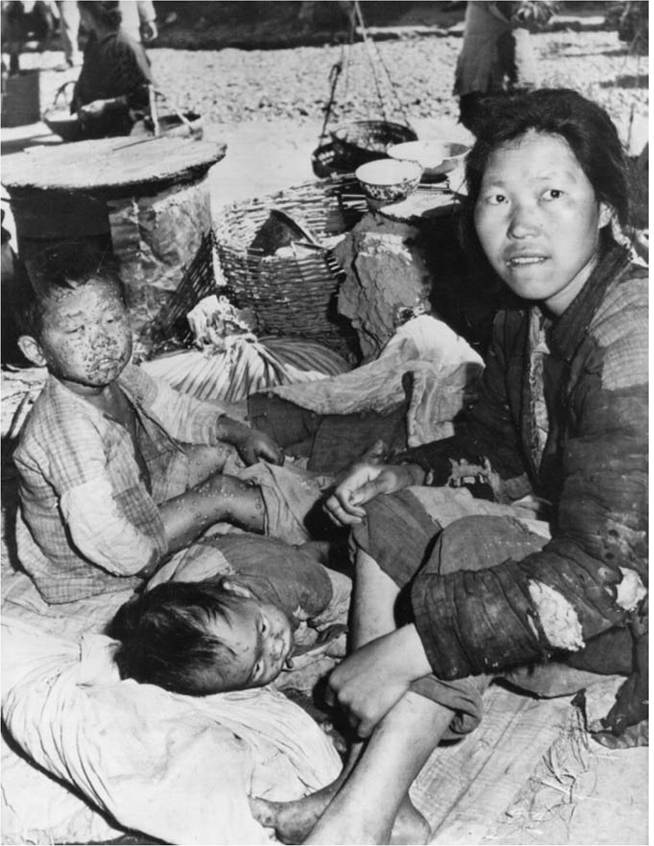
Plate 10.1 China, May 1946: a refugee family from one of China's famine areas lies on the side of the road during the civil war. Both of the children are suffering from smallpox. (Photo Bob Bryant/Keystone/Getty Images)
its ‘New Democracy' approach to government, and in line with this pursued the continuation of land reform, the eradication of anti-social practices, such as corruption and prostitution, and the gradual introduction of socialist economic planning on the Stalinist model. It was, however, in the field of foreign policy that it had its greatest impact.
More on the topic The Chinese Civil War:
- The Reconstruction of White Supremacy in Post-Civil War America
- After the Civil War: Manifest Destiny Re-evaluated
- Civil Affairs Missions in Operations Other Than War
- The Directory, Civil War, and the Bolsheviks
- The Directory. Civil War, and. the Bolsheviks
- during the russian-ukrainian war, which began in early 2014 and was somewhat misrepresented in Western media as a kind of Ukrainian “civil war,” rather than a Russian invasion, there emerged a number of supposedly new images of Ukrainian warriors.
- In a pamphlet published in 1637, the Jesuit Guido Aldeni reported that his Chinese friends, when told about the many kings in Europe, asked how Europeans could avoid war.
- The Nguyen-Trinh Divide: A Civil War Subdivides
- Racial Violence in the United States since the Civil War
- Almost seven years of war and civil strife had left the Bolshevik-controlled parts of the former Russian Empire in shambles.
- CHAPTER 1 Gilt Epaulettes for a Gilded Age: Citizen Volunteers and Martial Culture in Post-Civil War New York
- After the Bolshevik coup, the revolution turned into a civil war. Gone were the euphoria, the feeling of solidarity, the massive demonstrations, tumultuous assemblies, and heated debates of 1917.
- War made the state and the state made peace,’ says Ian Morris, changing Charles Tilly’s famous dictum.1 Morris’ main examples of this are the great empires, particularly the Roman and the Chinese.
- In the early seventeenth century Japan transitioned from a period of prolonged and nationwide internecine civil war (the Warring States period, 1467-1600) to an era of extended peace during the early modern, or Tokugawa, period.
- Chinese nationalism and the Northern Expedition
- Christianity and Chinese Culture
- 8 Chinese Religions: Confucianism and Daoism
- Chinese versus Muslims
- Chinese Religions and the Environment
- Traditions of Violence in Chinese Religion