The three centuries that preceded the formation of East Asia's first unified empire were known as the Warring States period,
in which a handful of large states organized on the basis of universal military service engaged in sustained, large-scale warfare in pursuit of political domination and, ultimately, total unification.
These states were able over the centuries to eliminate the old aristocracy, and to fashion a new style of polity based on the direct administration of individual, landholding peasant households that provided military service and taxes. The registration and supervision of these households lay in the hands of officials appointed by an autocrat who increasingly became the centralized locus of power. In the course of the wars between these emergent territorial states, Qin in the far west—which boasted a superb geographic position, a martial tradition developed in its wars with the alien Rong and Di peoples, an agriculture enriched by some of the largest hydraulic works of the period, and the most systematic realization of the Warring States agro-military program—emerged as the most powerful state.In 221 bce Qin succeeded in destroying its last rival and for the first time brought the entire Chinese cultural sphere under the control of a single state. Unification achieved through force of arms, however, was only the first step to the creation of a true, unified empire. Failing to adjust its policies, institutions, and values to the new circumstances created by the end of permanent warfare, the Qin state foundered within two decades, and it remained for the subsequent Han dynasty to introduce the institutional reforms and cultural innovations that were able to truly realize the vision of an enduring world empire. This chapter will focus on how the Qin and Han political and social order was adapted to the new reality created by conquest. It begins with the imperial vision and programs of Qin, and the reasons for their failure. It then examines how the Han created a new form of polity, a state that coincided with the limits of its own civilization.1
When the fall of his last rival in 221 bce left the king of Qin master of the civilized world in East Asia, he and his court were well aware of the unprecedented nature of their achievement.
As one courtier remarked, they had surpassed the greatest feats of the legendary sages of antiquity, and the king of Qin (now the First Emperor)1 This chapter is essentially a distillation of Lewis 2007.
Mark Edward Lewis, The First East Asian Empires In: The Oxford World History of Empire. Edited by: Peter Fibiger Bang, C.A. Bayly, Walter Scheidel, Oxford University Press (2021). © Oxford University Press. DOI: 10.1093/oso/9780197532768.003.0008.
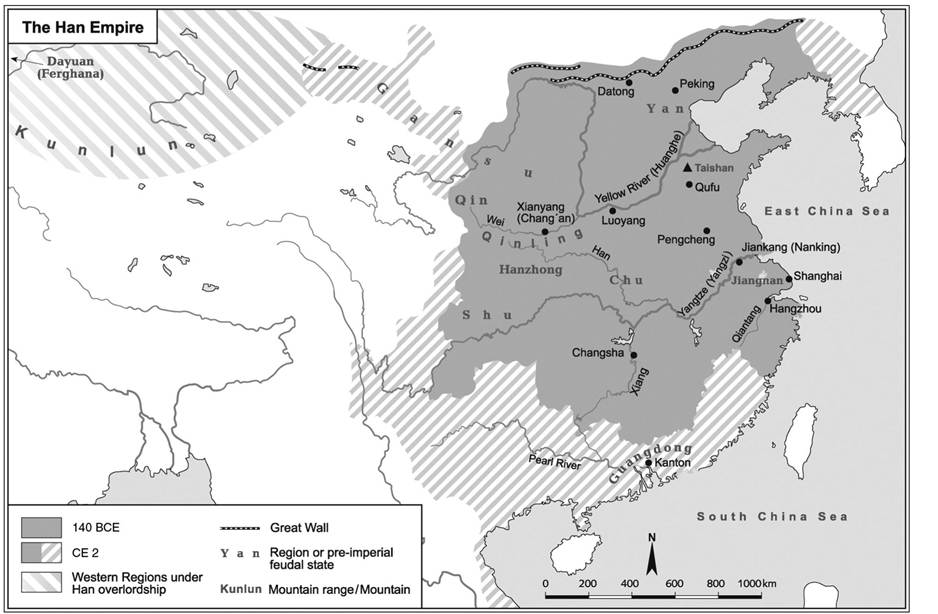
Map 8.1. The Han Empire, ca. 2 ce.
Source: Scheidel, 2014, State Power in Ancient China and Rome, p. xvii. Copyright: Oxford University Press.
THE FIRST EAST ASIAN EMPIRES: QIN AND HAN 219
seems to have clearly understood his achievement as beginning an entirely new era in human history.2 Qin launched a dramatic, visionary set of reforms designed to celebrate and institutionalize the beginning of this era, the era of total unity. Yet as an astute critic would remark a few decades after its ultimate fall, the Qin dynasty collapsed precisely because it did not change.3 Despite its proclamations of making a new start in a transformed world, Qin carried forward the institutions of the Warring States era, seeking to rule a unified realm with the techniques they had used to conquer it. The Qin institutional reforms, linking as they did grandiose visions of total transformation with an inability to come to terms with the true extent of the sea change that had taken place, suggest the scale of the problems that confronted the first attempts to create an imperial order in East Asia.4
The first change carried out by Qin was to create a new title for the ruler to symbolize the new political order. Recognizing that he had far outstripped the powers of the earlier Shang and Zhou rulers who had been called “kings” (wang), the king of Qin claimed for himself the title of huangdi, which we inadequately translate as “emperor.” The literal meaning of this title suggests the extraordinary extent of the elevation of the status of the autocrat.
Di had been the name of the high god of the Shang people, but by this time its meaning had changed. First, the earliest of the great culture-hero sages of antiquity who had created human civilization were called di; the title thus suggested the semi-divine power of the sage-kings. At the same time, the di, now four in number corresponding to the points of the compass and thus spatially embodying the entire world, were the high gods of Qin religion. In claiming the title of di, the new emperor asserted his divinity. This assertion was strengthened by the addition of the adjective huang, which meant “shining” or “splendid” and was usually an epithet of Heaven. Declaring himself to be the first huangdi, Qin Shihuang (“the First Emperor of Qin”) saw himself as the initiator of a new era, the progenitor of a second, a third, and a fourth huangdi, a dynasty that would reach to the end of time, just as his realm reached to the ultimate limits of space.The cosmic claims of the title were elaborated and extended in several ways. First, the new emperor made a series of tours of his new realm, and as part of these processions he left stone inscriptions commemorating his achievements on the peaks of several mountains. The texts of six of these inscriptions have been preserved, and in them he spoke of how his blessings had been bestowed upon all within the four seas, reaching even to the beasts and the plants. In this claim of the universal range of his power and beneficence, he cast himself as the human equivalent of Heaven, bestowing life and blessings upon all creatures. Brief extracts from these inscriptions were copied onto vessels and mirrors in order to disseminate the message to a wider audience. Second, a great synthetic philosophical work sponsored by his first chief minister, Lu Buwei, was structured according to the pattern of the calendar, and it articulated the principle that the ruler modeled his activities and policies on the cyclic actions of Heaven. Third, the First Emperor
2 Pines 2014.
3 Watson 1993, 74-83.
4 Bodde 1986, 52-72. was apparently the first ruler to claim that a cosmic cycle, the so-called Five Phases cycle, underlay his rise to power, which thus became an inevitable consequence of natural law. Fourth, he launched a major building program in his capital that sought to transform the city into a microcosm of the universe, with his new palace patterned on the North Star and the Big Dipper, the fixed center of the sky; with great statues cast from the confiscated weapons of defeated states to represent the various constellations; and with replicas of all the palaces of his conquered rivals to serve as a microcosm of the earth. Finally, he initiated the feng and shan sacrifices in which he ascended the peak of Mount Tai to communicate directly with the highest god in order to transcend his human condition and become an immortal.[582]
These ceremonial and architectural claims to divine status were accompanied by political measures and institutional reforms that sought to extend the political unification attained through conquest to all aspects of life. First, to abolish the old state divisions that had separated China into multiple competing polities, he moved the rulers and leading families of the other states to his capital, tore down the walls that had separated some states, attempted to confiscate all weapons in non-Qin hands, and uniformly imposed throughout the empire the Qin administrative system based on prefectures and commanderies staffed by the ruler's appointees. He also constructed a new system of imperial highways to link together his far-flung realm, building an estimated 4,250 miles of roads. A single system of unified metal currency was established, along with standardized, empire-wide measures of length, weight, and volume. In addition, the width of cart and chariot axles was also to be standardized, supposedly assuring ruts in the roads (which were largely unpaved) of a uniform width that minimized difficulties of transport.
The most important measures of unification, however, were cultural. First, whereas each of the earlier Warring States had employed its own distinctive writing system, the Qin government created a new, simplified script for the entire empire. This reform not only imposed a script which became a crucial means of transcending variations in local dialects and thereby facilitating communication across ever vaster distances, but also contributed to the swifter and easier writing with brush and ink that were important for bureaucratic record keeping. Moreover, the newly simplified script and the standardized measures were employed in a massive propaganda campaign in which elements from self-celebratory edicts of the First Emperor were inscribed on artifacts employed in the markets, thereby disseminating his achievements and reforms among the common people.[583]
The second great measure of cultural unification was the infamous “burning of the books.” Persuaded that the creation of a unitary empire entailed the establishment of unified beliefs across a previously divided realm, and that the emperor ought to be the sole fount of truth and wisdom as well as of laws and honors, the Qin government sought to control critical or political thought. While utilitarian texts on such matters as divination and medicine were left untouched, writings pertaining
222 MARK EDWARD LEWIS
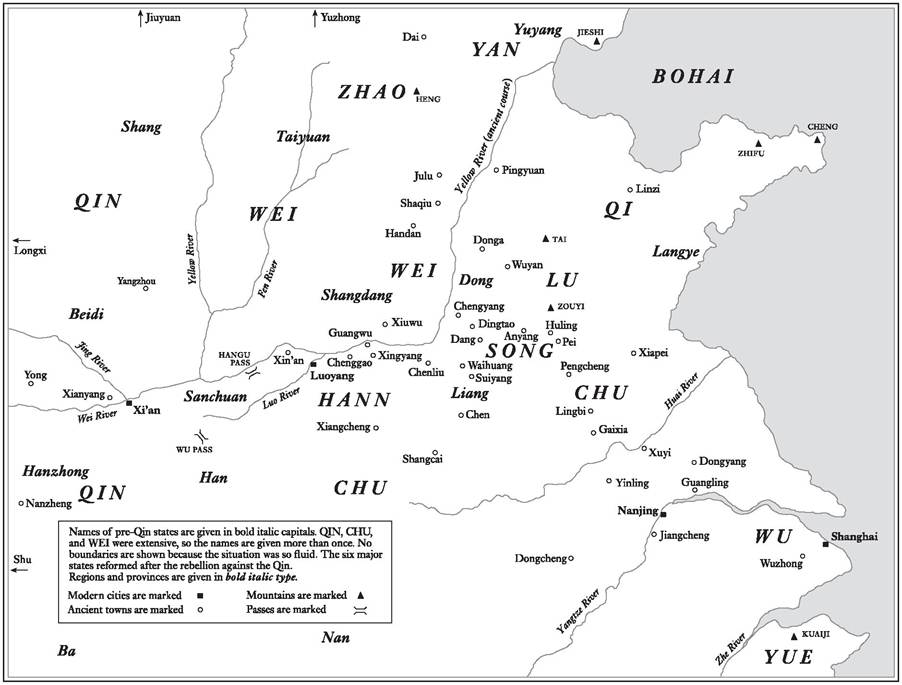
Map 8.2. Pre-QinStates.
Source: Sima Qian and Brashier, 2009, The First Emperor: Selections from the Historical Records, p. xl. Copyright: Oxford University Press.
to history or the social order were to be preserved solely in the imperial library in the hands of court-appointed erudites, who were to be the only permitted teachers. Privately held philosophical books were to be confiscated and destroyed, and some scholars who resisted the decree were executed. While it is unlikely that this policy could be effectively carried out in the short period of Qin's rule, and later accounts, in an attempt to vilify Qin, undoubtedly exaggerated the numbers of those executed, it remains significant as the first form of all later versions of an imperial literary policy.
However, for all the ambition of the Qin reforms, with their vision of a vast, unitary empire where all standards, measures, laws, honors, and philosophical truths flowed from a single source, the state carried the institutions and programs of the Warring States virtually unchanged into the new, world empire. The direct administration of peasant households who were all registered for military service continued to be the organizing principle of the state, with a large pool of servile labor being created by those who violated any of the detailed strictures of the Qin legal code. No longer necessary for the financing and prosecution of interstate warfare, this giant machine for extracting military and labor service had become a tool in search of a use. Qin's armies were launched on massive and ultimately pointless expeditions to the south (where they conquered what are now Fujian, Guangdong, and Guangxi provinces), the north (where they pushed the Xiongnu out of the bend of the Yellow River), and the northeast (where they colonized what is now Korea). In addition to the colossal projects of building roads and refashioning the capital, armies of conscript laborers were dispatched to the northern frontier to link old frontier defenses into the first Great Wall. While this construction of packed earth was not comparable to the later Ming dynasty brick wall so familiar to modern people from photos and visits, and may not have reached all the way to the sea, it was still a major construction project that absorbed huge amounts of labor and wealth. The military expeditions to the south also resulted in extremely high casualties due to the new diseases encountered in that hot and humid region.
The Qin state thus engaged in an orgy of expansion and building which had little purpose except keeping in use Warring States institutions that had been rendered obsolete by their own success. A state created for battle and expansion, Qin wasted its strength—and alienated its newly conquered subjects—in continuous campaigns of expansion when there were no useful worlds left to conquer. While this pushing of wars beyond the point of their utility was largely an expression of the distinctive institutions of the Qin state, it could also be compared with other cases—such as Alexander the Great or Napoleon—in which the sheer momentum of successful conquest seems to impel the victor to press on until he meets disaster. Ultimately, mutinies by labor gangs led to a general conflagration in which even many of the Qin state's own officers and people turned against their rulers. The first Chinese empire consequently went down in flames only 15 years after it was created.[584]
Following a four-year civil war, order was finally restored by the newly established Han dynasty, which was officially inaugurated in 202 bce. Operating in the shadow of the disaster of Qin's rapid fall, and dependent on the support of numerous allies who had aided his rise to power, the Han founder enfeoffed his most important followers as kings, while reserving for his own rule only the key strategic area of Guanzhong (the Wei River Valley), which had been the old Qin heartland. He soon, however, devised pretexts to destroy his former allies one by one and replace them with his own kin. Nevertheless, for the first half century of Han rule, more than half the empire remained under the rule of semi-independent kings, and only after the suppression of the feudatories following a rebellion in 154 bce did the Han recreate a unitary empire comparable to that of Qin.[585]
Limitations of space do not permit here a detailed treatment of all the institutional reforms and social developments during the four centuries of the Han dynasty.[586] I can only offer a thematic treatment of the five central changes by which the Han created a new social and political order that turned the fact of political unification through conquest into an enduring reality that became the basis for the later imperial formations that dominated continental East Asia for more than two millennia. The five changes are as follows: (1) the elaboration of the role of the emperor as supreme ruler, high priest, center of the political world, and cosmic linchpin; (2) the abandonment of universal military service and consequently of the associated direct rule of the peasant population; (3) the drawing of nomadic peoples into the Han state order (entailed in the military reform cited as #2) and the linked partial inclusion of the steppe and then of Central Asia into an expanded world order; (4) the definition of the role of the state as the patron of a cultural ecumene, which was above all defined through the wisdom embodied in a stipulated set of texts in an archaic language that existed only in writing; and (5) the development of a new elite that combined aspirations to state service with local power bases in the form of land ownership, market-oriented agriculture, small-scale craft production, moneylending, and social networks fashioned through charity and leadership provided to their poorer neighbors.
This new elite not only provided the pool for recruitment to offices, but more importantly, the families that constituted it acted as intermediaries between local society and the imperial court, maintaining order in the former and disseminating the programs of the latter without being directly in its employ. This emergence of a semi-formalized public sphere that lay outside the political state but was essential to its functioning was articulated in a reformulation of the discourse on honor and shame that in the Qin and early Han had focused entirely on state servants and scholars, but which over the course of the Han came to celebrate households and writers who were separate from, and sometimes opposed to, the imperial court, but still helping create a public order.[587] The emergence of an intermediate stratum of powerful families that acted as the central link between localities and the imperial center, while at the same time pursuing their own political and material interests, was central to all later empires in continental East Asia, and indeed was typical of most pre-modern continental empires.[588]
The Han carried forward the Qin practice of focusing the state on a semi-divine autocrat who ideally was to be the fount of all wealth, prestige, and authority. This policy was muted in the early reigns, for the first emperor of the Han had risen from the ranks of commoners, and his power was limited through the aforementioned policy of enfeoffing his former allies. However, the Han founder began to exalt the position of the emperor through building palaces, instituting more elaborate court rituals, and establishing temples for the imperial ancestral cult throughout the empire. The second emperor was a child, the third was a youth who was set on the throne by powerful courtiers after a brief civil war between the followers of the founder and those of his widow, and the fourth emperor still lived in an uneasy compromise with cousins who ruled as feudatory kings through much of eastern and southern China. Only with the fifth emperor, Emperor Wu (ruled 141-87 bce), did a Han ruler achieve the unitary, unchecked power of the Qin emperor, and it was Emperor Wu who created much of the legal and ritual precedent for the authority of the emperor in Han China.[589]