Introduction
On a transition from middle to late Iron Age period we encounter a transformation of the central European society which was represented especially by the new settlement forms—the oppida.
They appeared as a part of a socio-economically advanced environment, together with a distinctive intensification of settlement patterns. When they emerged, being understood as “deliberate foundations rather than a gradual evolution” (Collis 2000), they represented complex systems with multiple functions. However, no issue is as variable at the same time as the oppida and range of their activities, functions and social hierarchies (for the discussion on some of them (Collis 2000)).The central European oppida share the dynamics of their occupation: according to the archaeological record the population density increased from the beginning of the occupation (half of the 2nd century BC), peaked around the end of the 2nd century/beginning of the 1st century BC, and then, within two generations or so, it decreased again. This decrease seems to have been quite rapid and the final population might have been even five times smaller than during its highest density. This massive change in the first half of the 1st century BC was not restricted to the oppida only, but reflected also on settlements in the countryside even in wider European context (Haselgrove and Guichard 2013).
Causes for gradual trend of depopulation can be seen in several factors endogenous and exogenous. However, their greater exploration is obstructed by the
K. Stekerova (is)
University of Hradec Kralove, Hradec Kralove, Czech Republic
e-mail: kamila.stekerova@uhk.cz
A. Danielisova
Institute of Archaeology of Academy of Sciences of the Czech Republic,
Prague, Czech Republic
© Springer International Publishing Switzerland 2016 335
J.A. Barcelo and F. Del Castillo (eds.), Simulating Prehistoric and Ancient Worlds, Computational Social Sciences, DOI 10.1007/978-3-319-31481-5_12 overall lack of detailed archaeological data. In this situation we suggest to use agent-based models.
Our aim is especially to ascertain the resilience of the food production system (i.e. carrying capacity) of the oppida under the dynamically changing (increasing/decreasing) population.In next sections, after summarizing purpose of agent based-modelling and knowledge on economics and society in the Late Iron Age we introduce our models in NetLogo (Fig. 12.1). The first model of the population dynamics generates data on synthetic populations within alternative depopulation scenarios. The following food production and land use model is used for estimating the carrying capacity of the oppidum with respect to alternative agricultural scenarios. The last workforce model is used for studying labor input of agro-pastoral tasks during the harvest season under different weather conditions, overproduction and ratio of non-producers.
Notice here, that when thinking about modelling the Iron Age society and landscape, either we could start with the population data and explore the predicted site catchment or we could use the landscape data and estimate the likely population in the given area. Our approach was to develop the population dynamics model firstly, including alternative depopulation scenarios, and apply population data as input in subsequent models of land use and workforce allocation. Therefore the three models are designed to enable experimenting with alternative scenarios and strategies with the aim
• to test upper limits of self-subsistence (i.e. the highest possible population size, the largest manageable area of fields and maximum acceptable length of the harvest season with respect to available workforce) and
• to verify general theoretical hypotheses related to the functioning of the oppida within particular landscape environment and the ecological and economic rules that were shaping them.
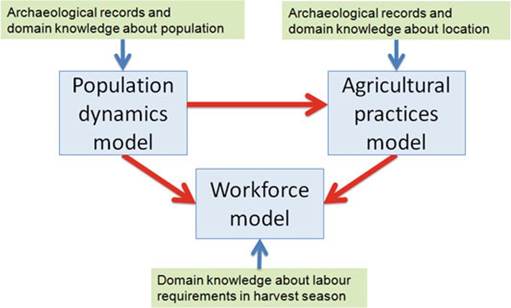
Fig. 12.1 Overview of models
12.2
More on the topic Introduction:
- 1 Introduction
- Introduction
- Introduction
- 19 Introduction
- Introduction
- Introduction
- INTRODUCTION
- Introduction
- Introduction
- Introduction
- Introduction
- Introduction: Hegel, Marx and the Dialectic
- INTRODUCTION: OVERVIEW OF COMPLICATIONS ASSOCIATED WITH HIV THERAPY
- Introduction
- Introduction
- Introduction
- Introduction