Island Melanesia and the labour trade
The Coral Sea islands functioned as a reserve of labour for plantation interests, which gradually led to subdivision of the islands into European colonies. The Coral Sea became central to recruiting for plantations, farms, mines and pearl-shell and beche-de- mer fisheries operating in Queensland, German New Guinea, British New Guinea/ Australian Papua, British Fiji, German Samoa and French New Caledonia.
Including eastern New Guinea, around 270,000 labourers were recruited up until the 1910s, about half before most formal territorial annexations took place onwards from the 1880s. After the 1910s the labour trade continued but largely internal rather than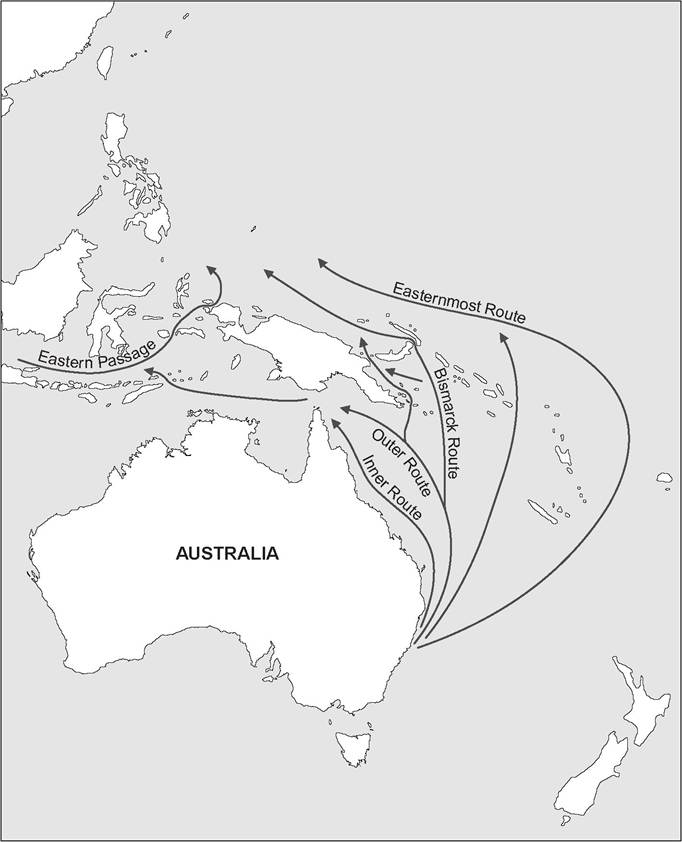
Map 10.2 Australia-Pacific trade routes through the Coral Sea in the nineteenth century.
external to the Pacific colonies, forming the basis of the copra (the smoke-dried flesh of coconuts used mainly in the soap industry) in New Guinea, the Solomon Islands and the New Hebrides. Indigenous labour numbers climbed much higher after the annexations, with around 500,000 indenture contracts in place before the Second World War.2 While contracts did not equate with individuals—many labourers recruited more than once—this circular labour migration constituted a key element of colonialism in New Guinea and Melanesia. With the establishment of European settler societies in Australia, New Zealand and New Caledonia, capital was attracted and mobilised. However, the mobilisation of indentured labour was indifferent to political boundaries and indeed entrepreneurs moved first, followed by public authorities attempting to bring some regularity to an unpoliced maritime frontier.
Most labour recruits were young men aged between 15 and 35; only a very small proportion were women.
Historians agree that the first decade of recruiting was largely by kidnapping and deception, but as the trade progressed the next generation followed into the labour trade schooners lured not so much by beguiling recruiters but by Melanesians’ desires for European manufactured goods and the chance to better themselves on return to their home societies. The labour trade became a rite de passage, a circular migration which both preserved and changed Melanesian society while linking the islands into the world economy.Early irregularities were sometimes extreme, including kidnapping and violence. Whipped up by missionaries, British humanitarians campaigned against the labour trade, particularly after the death of an Anglican bishop in the southern Solomons in 1871 as a direct reprisal for labour trade activities. Naval ships began to patrol the recruiting process, British legislation was introduced in the 1870s to control the labour trade, and government agents began to accompany all British labour vessels. Debates raged about the nature of the labour trade: was it all despicable and close to slavery, or did the Islanders participate willingly? With slavery abolished in British territory only in the 1830s, emotions still ran raw. When colonial partition of eastern New Guinea and island Melanesia occurred in the 1880s and 1890s, one prime British motivation was to ensure that accusations of illegality ceased and the labour reserve was more legally policed.3