Later Period
Violent figural scenes from the princely cycle and depictions of heroes from the legendary past continued to be depicted on portable objects made in the period after 1250. Tiles from the palace built at Takht-i Sulayman in northwestern Iran in the 1270s, for example, display hunters, heroes and magical creatures such as the dragon and the simurgh, a winged creature with a lion's head and long flowing tail.[1097] But the florescence of illustrated manuscripts in this later period, especially in Iran and Central Asia, provides for far more exhaustive depictions of violence.[1098]
On the most basic level, these manuscript illustrations provide detailed information about the implements used to wage war and carry out other acts of violence.[1099] Such information is immensely practical, as these were turbulent times.
The Mongols, for example, used conquest and warfare to create the largest contiguous land empire in world history, stretching across much of Eurasia. The paintings made for the Ilkhanids, the branch of the Mongols who ruled Iran and Iraq from 1256 to 1353, provide some of the best visual information we have about the specific weapons and tactics used in the mighty Mongol military organisation.[1100]The most valuable of these images illustrate copies of the world history known as the Jami‘ al-tavarikh (‘Compendium of Chronicles') compiled for the Persian vizier Rashid al-Din (1247-1318) in the early fourteenth century. Several manuscripts made under the author's supervision survive, with the most vivid scenes of warfare illustrating an Arabic copy of the volume containing the history of the non-Mongol peoples that is now divided between Edinburgh University Library and the Khalili Collection in London.[1101] In addition, other illustrations showing warfare have been detached from the volume on the history of the Mongols and are now mounted in albums in Istanbul and Berlin.[1102] For example, a double-page composition in the Staatsbibliothek in Berlin (Diez A, fo.
70, S. 4, right, and S. 7, left) that depicts the Mongol capture of Baghdad prominently displays the lamellar armour, trebuchets, bows, quivers, shields and war drums used to terrify and subdue the enemy (Fig. 28.7).[1103] Another detached image in the same collection (Diez A, fo. 70, S. 19, no. 2) shows horsemen leading away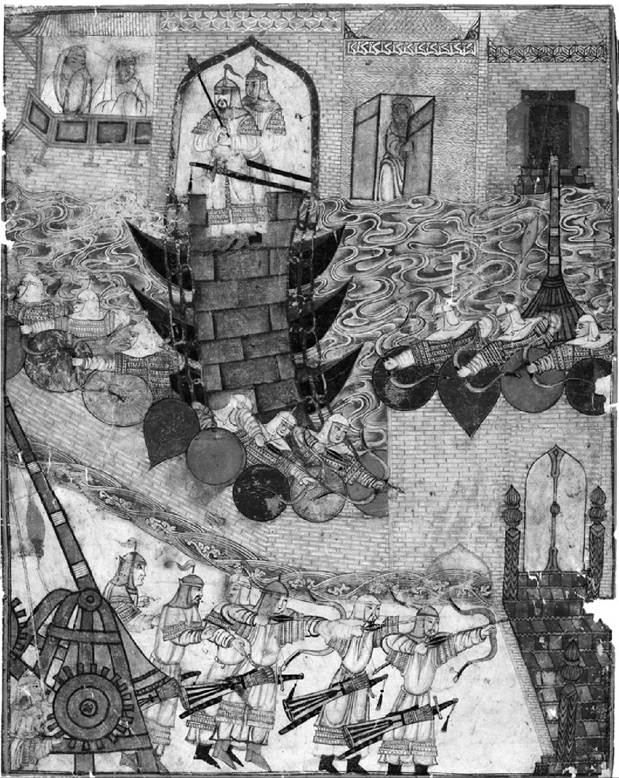
Figure 28.7 ‘Siege of Baghdad' from Rashid al-Din's Compendium of Chronicles, Tabriz, early fourteenth century.
prisoners trapped in a two-pronged wooden shackle, an unusual Persian device called a dushkha (literally, ‘two-branched’).[1104]
These images, then, literally illustrate the history of warfare. They can be used to reconstruct different sorts of weaponry that have not survived, such
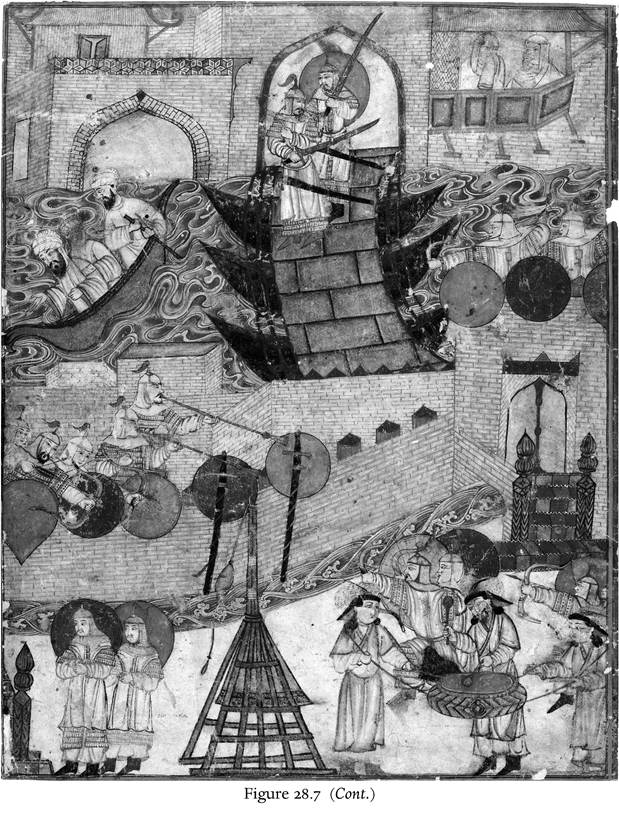
as the variety of arrowheads ranging from narrow ones for armour-piercing arrows to wide blades for slicing and blunt arrows for stunning opponents.[1105] These scenes are important furthermore for siege and combat not only in West Asia but also in China, where painting produced during the Mongol
period was typically more concerned with building civic society or encouraging individual exemplary conduct.[1106]
Such weaponry was obviously new and intriguing to the Persians to whom it was introduced by the Mongols. This is evident from the unique copy of a dispersed Persian manuscript entitled Mu'nis al-ahrarfi daqa'iq al-ash‘ar (‘The Free Men's Companion to the Subtleties of Poems') completed at the city of Isfahan in central Iran in February-March 1341.[1107] The poetic anthology once contained six illustrated folios that were detached and sold separately. In addition to a section on signs of the zodiac, the illustrated folios contain a second section with a curious poetic device matching individual words with images that function like visual glosses.
The reader was supposed to recite the first line of each couplet and then supply the rhyming words of the second verse by looking at the pictures. Most of the illustrations depict regalia, jewellery and gems, birds and animals, plants and trees, musical instruments and other exotica, but several paintings show weapons, including a spear, a sword, a javelin, a corselet, a helmet, an acton (a padded coat), a shield, a mace, a dart, a crook, an arrow and an axe. These illustrations provide a rare correspondence between words and images that helps us to identify the names for weapons used during the Mongol period. The images also show that such words for weapons of violence had become part of the vocabulary of an erudite reader in fourteenth-century Iran.The metaphoric role of violent feats in overcoming supernatural beasts and adversaries is clear from the so-called Great Mongol Shahnama, arguably the finest and most ambitious manuscript produced during the fourteenth century and one of the greatest copies of the Persian national epic ever made.[1108] The large two-volume manuscript, probably produced in the 1330s for the Ilkhanid court at Tabriz in north-western Iran, originally had some 200 illustrations. The most heavily illustrated cycle was that of Alexander (Iskandar), which once had seventeen illustrations on fifteen folios, of which twelve illustrations survive.[1109] The cycle is framed by two images showing Alexander's enthronement and the bereavement over his coffin. In between are six illustrations ofhis travels to strange lands, two illustrations of him combatting ferocious supernatural beasts (a horned wolf-like monster and a dragon), and two illustrations of him defeating the King of Hind. In one, Alexander cleverly terrorises the Indian army of elephants by assembling a cavalry of iron riders and horses mounted on wheels, filled with naphtha and set aflame. The Indians flee in terror in face of the relentless onslaught.
In the other, Alexander administers the coup de grace after a clamour and cloud of dust arose from the ranks and caused the Indian king to avert his head. These are some of the most striking and emotional images of warfare and violence produced in the Persian tradition, far from the ballet-like corps favoured in fifteenth-century copies of the epic.The choice to illustrate this particular cycle so heavily in this royal copy of the Persian national epic was not surprising, as the Ilkhanid ruler was metaphorically dubbed the ‘Alexander of the Age' (iskandar-i zaman). The paintings serve to legitimate the Mongols, who like Alexander were foreigners ruling Iran. The scenes emphasise conquest, military prowess and might, all themes that occur in other illustrations in the manuscript, which show equally stunning scenes of legendary heroes such as Bahram Gur hunting and killing wild animals and savage beasts. Violence pervades this copy of the epic. In addition to the standard scenes of warfare showing battles, combats, sieges and prisoners, the illustrations include striking depictions of death and mourning, including one in which a grieving father cradles his son's severed head. Several scenes show murders, beheadings and executions as well as a poisoning, a castration and a flaying, many of them examples of the public spectacles of pain designed to create a sense of legitimacy in this highly militarised period (Figure 28.8).[1110] Art here is propaganda in service to the Mongol court, and the pictures reflect the turbulent times in which this stunning manuscript was produced.
This deluxe manuscript also seems to have set the precedent for another, equally ambitious copy of the epic produced two centuries later for the Safavid ruler of Iran, Shah Tahmasp (r. 1524-76).[1111] The massive volume has 258 illustrations, many stressing different aspects of warfare. The choice of
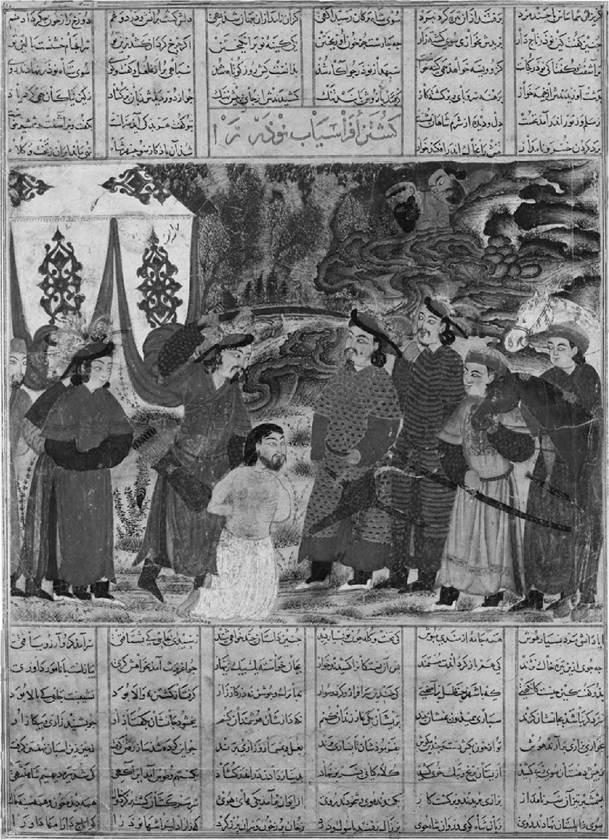
Figure 28.8 ‘Afrasiyab executes Nawdar', painting from the Great Mongol Shahnama made at Tabriz in the 1330s.
subjects to be illustrated may again have been engendered by the contemporary historical realities and political chaos, as the Safavids, themselves riven by civil war, were threatened by the Ottomans on the west and the Uzbeks on the east.[1112] These military and political tensions clearly moved beyond the battlefield to shape the cycle of illustrations in this ambitious copy of Firdawsi's epic.
These images made in Iran post-1250 were part of a new visual language that was disseminated widely in this period through the use of designs on paper.[1113] Images of warriors, hunters and combat worked out on paper for manuscripts were repeated in other media, including inlaid metalwares, ceramics, textiles and other portable arts produced not only in the region but also elsewhere. Most of the metalwares produced for the Mamluks, a sequence of sultans who ruled Egypt and Syria from 1250 to 1517, are decorated with inscriptions, but one superb inlaid bronze basin is enveloped with images of people and animals set against a dense vegetal scroll.[1114] Known today as the Baptistere de Saint-Louis, the basin was probably made in Egypt or Syria in the 1330s or 1340s and then made its way to the French court where it was used from the seventeenth century for baptism. Originally it was probably part of a set with a matching ewer for hand-washing, a function underscored by the fantastic fishpond inhabited by crabs, eels, tortoises, frogs, a lizard, a wild duck, a pelican, a crocodile and two harpies that decorates the bottom of the interior.
The panels decorating the sides of the Baptistere include a variety of scenes that can be divided into groups. The four panels on the exterior show processions, two of Mamluk amirs and two of native servants who can be distinguished from the amirs by dress, hairstyle and facial type. The panels on the interior show amirs hunting savage animals and battling their enemies.
One prominent figure, probably an unidentified Mamluk sultan, wears lamellar armour over a quilted garment and a helmet with long ear flaps, the lower part of his face covered by an aventail. He has just discharged an arrow which lodges in the neck of his adversary who sports a flat turban surmounted by a pompon and who is mounted on a horse with distinctive harness. He may represent a defeated Mongol. The second battle scene is more tumultuous, with three riders armed with a lance, a bow and a sword.The ferocity of the encounters between the two enemies is clear from the dismembered limbs and heads that litter the ground around them, including one severed head with a flat turban and pompon. Like their Mongol counterparts, the Mamluks saw combat and war as sources of legitimation, but without any reference to an epic past.
Most of these objects were made for daily use, but occasionally religious subjects could serve as the foundation for images of violence. The Qur'anic description of heaven and hell inspired a range of extra-Qur'anic literature, particularly cultivated by poets and mystics.[1115] The most startling images of torture illustrate a copy of Mir Haydar's Mi‘rajnama created c. 1430 at Herat or Samarkand in Central Asia.[1116] The text in eastern Turkish describes the ascension of the Prophet Muhammad from Jerusalem on his human-headed beast, Buraq. During his miraculous journey the Prophet passes through the seven celestial spheres to Paradise before descending to hell, and this copy of the text contains sixty-one fantastic paintings of the journey lavishly painted in gold and other brilliant pigments. The scenes of hell in particular captured the imagination of the artists, who devoted sixteen paintings to the tortures of hell versus a mere five more tranquil scenes of Paradise. These grisly scenes show adulterous women suspended by hooks through their breasts, wine drinkers with poison pored down their throats, the proud locked in boxes and tormented by snakes and scorpions, and similar subjects with red- tipped flames engulfing the sinners (Figure 28.9). To create these startling images of hell and torment, the painters had to search for models beyond the conventions of Persian painting to the imagery of Central Asia and the nomadic shamanistic life there.
This world of the steppe can be glimpsed from a group of bizarre images and individual leaves depicting nomads, dervishes, shamans and monsters, many mounted in two albums in the Topkapi Palace Library in Istanbul (H.2153 and H.2160).[1117] Several paintings were later inscribed ‘work of Muhammad Siyah
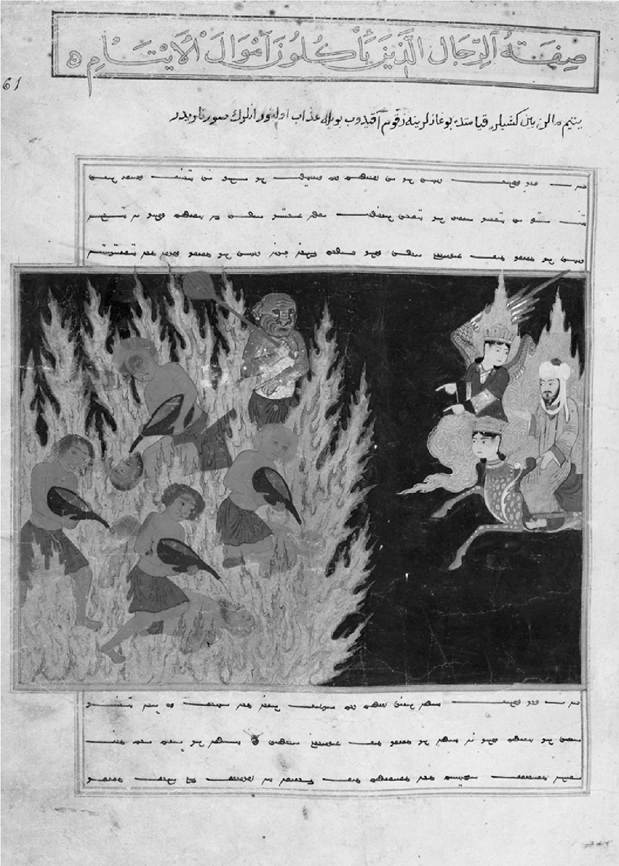
Figure 28.9 ‘Those who squander the inheritance of orphans', from Mir Haydar's Book of Ascension made in Central Asia, c. 1430.
Qalam’ (‘Muhammad of the Black Pen’), although they are not all by a single hand, and the epithet should be taken to refer to a style, not a person. Painted
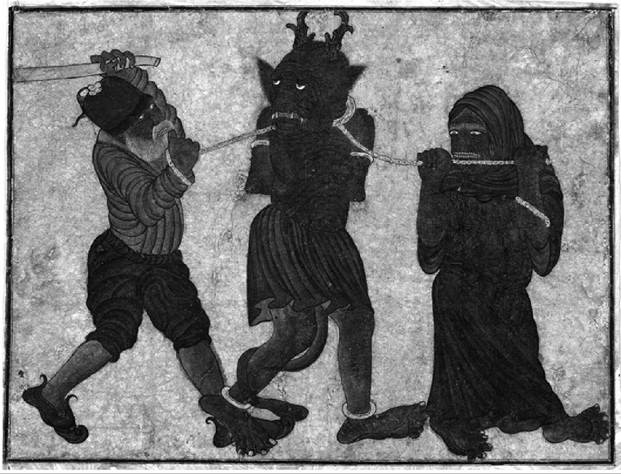
Figure 28.10 ‘Demon in chains', detached painting from a group, many of which were attributed to Siyah Qalam.
with heavy outlines in sombre colours, mainly red, blue and brown, the figures are set against the coarse unpolished paper without any indication of landscape, setting or text. Many of the figures represent demons, with exaggerated gestures, distorted faces and enormous gnarled feet with prominent toenails. Some figures are half-naked, wearing only a knee-length skirt rendered with thick and heavy folds. Some are enchained (Figure 28.10); others dance ber- serkly. One set sacrifices a horse, with the demons tussling over the dismembered limbs. These weird figures seem to derive from an oral tradition of storytelling and allude to a strange place beyond the civilised world, but the exact attribution of these paintings is controversial: they have been assigned variously to western or eastern Iran or Central Asia in the fourteenth or the fifteenth century. Their meaning is equally allusive.