Middle Period
Whereas mosaics and murals preserve the best evidence for scenes of violence from the early period, portable objects offer a particularly rich source of imagery for the middle period.
The production of such objects blossomed at this time, notably in Iran during the late twelfth and thirteenth centuries, but also in Iraq, Syria and Egypt. Such scenes occur on inlaid metalwares and ceramics made in a variety of new forms including candlesticks, ewers, buckets, bowls and other utensils.[1090] Some individual vignettes can also be found on textiles and glassware. Many are brilliantly coloured. Unlike the courtly palaces from the early period, these items were produced mainly for non-royal though certainly well-to-do patrons, and attest to the urbanisation of Muslim society in this period.Exploiting a variety of techniques, these objects display refined designs whose striking use of human and animal figures suggests a meaningful system of visual images. At least three themes have been identified. In addition to astronomical subjects with apotropaic meanings and a cycle of love or meditation, the most important theme - and the one most pertinent to depictions of violence - is the princely cycle, an umbrella term that covers a wide range of events including combat and hunting. These scenes belong to the ancient Iranian theme of razm-o bazm (fighting and feasting), which included battles, duels and the hunt alongside banqueting, both indoors and out.1[1091]
Most metalwares display a number of individual, discrete scenes. One of the showiest examples is a small (ht 18 cm) bucket of cast bronze inlaid with silver and copper made for a prosperous merchant in 1163, probably at Herat in western Afghanistan (Figure 28.4).[1092] The bulbous body is decorated with five horizontal bands, three containing Arabic inscriptions alternating with two of figural scenes.
The second band from the top shows vignettes of entertainment such as drinking, making music, playing games including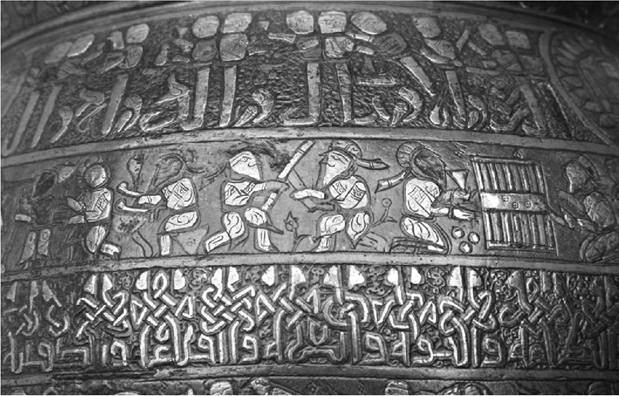
Figure 28.4 Detail of fighting with sticks on the Bobrinsky Bucket, made at Herat in 1163.
backgammon, and facing off with sticks. The fourth band shows scenes of horsemen hunting and fighting. Even the handle is decorated with fierce animals: the middle section displays four lion heads, and the loops show leaping lions on the outside and snake-like dragons on the inside. The panoply of individual scenes does not present a narrative but, like the decorative inscriptions that accompany them, may have been intended to convey good fortune and prosperity to the recipient of this object, which seems to be a fancy version of an ordinary pail to hold and dispense water for washing in the bathhouse. It was a gift for the man who had everything, with the decoration, including the scenes of fighting and hunting, intended to magnify his stature.
The westward dissemination of the inlay technique allowed metalworkers in Iraq to decorate their wares with even more elaborate scenes of hunting, fighting and other violence. One centre of inlay production was Mosul. The most important object made there is the so-called Blacas ewer dated April 1232.[1093] Its pear-shaped body and tall neck are decorated with genre scenes set in friezes and medallions against a geometric ground. The varied scenes include enthroned rulers, musicians, hunters and soldiers. One scene can be identified as the legendary hero Bahram Gur: he is mounted on a camel with his consort seated behind him carrying her harp; in front of them runs a gazelle with its ear and hoof pinned together by Bahram Gur's arrow. The figural band on the widest part of the body with swordsmen, warriors and fierce animals is an animated inscription, but the figures have so overwhelmed the letter shapes that the words are virtually illegible.
Like the vignettes on the bucket made for the merchant in 1163, the scenes on this anonymous ewer were probably intended to glorify the owner.Painted ceramics allowed artists more latitude for depiction. A few objects display a single scene of violence intended to commemorate a particular historical event. The best example is a large (diameter 47.8 cm; now in the Freer Gallery of Art) enamel-painted plate whose front side shows the successful siege of a castle in a rocky landscape (Figure 28.5).[1094] An army of horsemen, foot soldiers and a tan elephant attack from the right, while the leader of the besieged castle plummets to his death, his falling body pierced by two arrows. The ground is littered with dismembered bodies. Labels around the heads and bodies identify the seven major attackers, probably Turkish amirs, and the remains of a readily readable, if only half intact, inscription around the rim implies specific narration, with the identification of an event (the battle) and a place (Khalkhal on the south-eastern border of Azerbaijan). While the left side summarises the progress of the battle, the right encapsulates the decisive moment of victory. The scene suggests that the plate was intended as a trophy or piece of memorabilia designed to celebrate the victors of a particularly fierce battle.
The specific historical image on the front of the siege plate contrasts with the generalised scenes on the back. The back rim is inscribed with a band containing the standard good wishes written in a stylised and difficult to read script. The sloping sides show four feats of hunting: slaying a dragon, shooting a quadruped, clubbing what appears to be a feline and shooting a griffin. Two other hunters are also shown, including one who leads a cheetah and carries an ox-headed mace. The imaginary animals and the attributes such as the ox-headed mace show that these are not ordinary mortals like those depicted on the front but epic heroes such as Bahram Gur, Faridun,
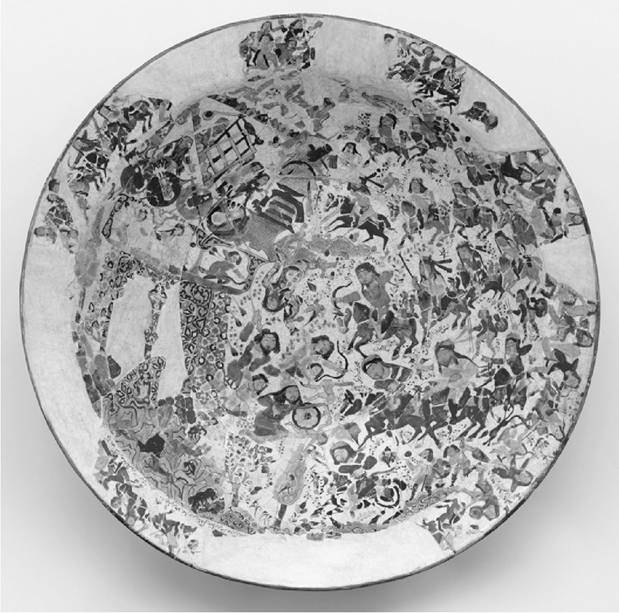
Figure 28.5 ‘Siege of a castle', painted on a plate made at Kashan in central Iran, c.
1200.Rustam, and similar protagonists from the Shahnama and other tales. The images are presumably meant to link the prowess of the warriors named on the front to the feats of legendary heroes.
At least one enamel-painted ceramic shows a continuous narrative from an epic tale: a beaker also in the Freer Gallery of Art (Figure 28.6).[1095] Despite its small size (ht 12 cm), the beaker illustrates the ancient love story of Iranian hero Bizhan, who accidentally meets the beautiful Turanian princess Manizha. Decorated in strips of images that unfold like those in a comic
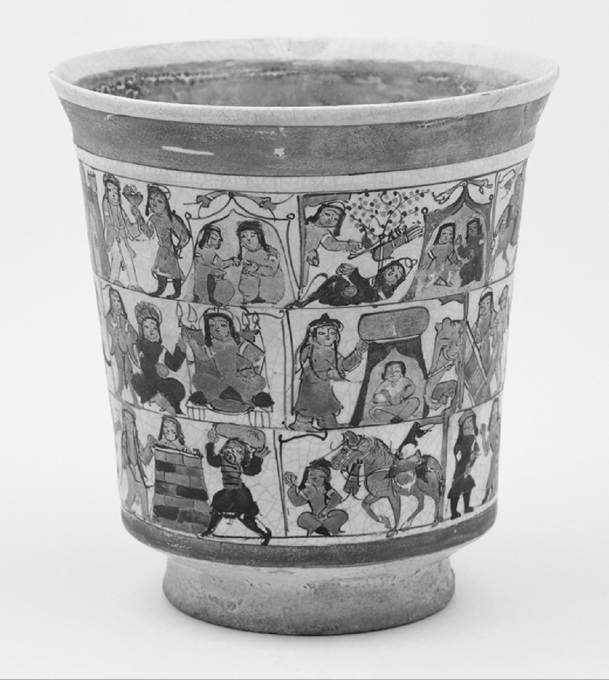
Figure 28.6 A beaker painted with scenes from the tale of Bizhan and Manizha; Kashan, c.
1200.
book, the beaker has twelve scenes arranged in three registers of small linked panels. The episodes begin with the lovers' tryst and discovery. Bizhan is then captured, led off half-naked in shackles, and imprisoned in a pit sealed with a boulder. Manizha entreats the hero Rustam to rescue her lover, and while she looks on, Rustam lifts the giant boulder and releases the prisoner.
Like the murals at Panjikent (see Figure 28.3), the scenes on the beaker are designed to link the user to the heroic exploits of legend. At Panjikent the murals would have framed the owner of the private house and been visible to his assembled guests, whereas the tiny scenes on this beaker (each register measures only 2.6 cm) would have been visible only to the owner, who must have held it in his hand and rotated it counter-clockwise three times to ‘read' the whole episode. It carried a far more private message.
The images on these objects played a range of functions and conveyed an array of meanings. Cosmically charged, they symbolised power and victory, with the figures serving as agents in the constant struggle between good and evil. The scenes also functioned as allusions, abbreviated narrative signifiers that were immediately recognisable to contemporary viewers.[1096] They were visual clues for mental reconstruction. As the heroes depicted on the objects were esteemed as much for their attributes as for their accomplishments, the images served as exemplars for proper behaviour. They are visualisations of the literary genre known as ‘Mirrors for Princes', books that were intended to instruct kings or lesser rulers on aspects of rule and behaviour and more broadly to create royal images for imitation or avoidance. The images show how the pervasive monarchical metaphor of dominance had become part of the daily visual landscape in a time of constant political upheaval and shifting allegiances and ethnicities.
More on the topic Middle Period:
- Module 1. The History of Ukraine in the Middle Ages and the Early Modern Period
- Torture and Public Executions in the Islamic Middle Period (Eleventh-Fifteenth Centuries)
- Until relatively recently, historians of psychiatry were inclined to view the Christian Middle Ages as a medically primitive era, and the period before 1200 was considered particularly bleak.[646]
- In the early seventeenth century Japan transitioned from a period of prolonged and nationwide internecine civil war (the Warring States period, 1467-1600) to an era of extended peace during the early modern, or Tokugawa, period.
- in a recent book on the Slavonic peoples in the Middle East, the Russian Orientalist and historian Dmitrii E. Mishin examined a major but little- studied aspect of the historical relations between eastern Europe and the Middle East in Sakaliba (Slaviane) v islamskom mire v rannee srednevekove (Saqaliba:
- The period covered in this chapter, from the death of Herod the Great, King ofthejews, in 4 все to the end of the secondjewish war with Rome in 135 ce, is a period of lingering and terminal crisis in the history of Israel
- This chapter will explore ritual violence in the form of close combat in precolonial western Africa (and the African diaspora) during the period of European contact from the mid fifteenth century until the late nineteenth century, a period which saw an end to the slave trade and the start of European colonisation.
- Middle Ear
- The Middle Ages: An Introduction
- Empire and nationalism in the Middle East
- Taking the Middle Road
- A Sea at the Crossroads of the Middle Ages