Early Period
Muslim rulers in the Umayyad period (661-750) occasionally used visual imagery depicting violence as an official statement of both religion and state. For a brief time between 693 and 697 (AH 74-77), mints in Syria issued a small number of gold coins showing the standing figure of the caliph dressed in fine robes with his hand resting on the hilt of his sword and an unexplained knotted cord hanging from his waist.
As Luke Treadwell noted in his careful analysis of these coins, the image was a fitting testament to the caliph's new-found authority, resulting in part from his military success in putting down other claimants, and to the power of the religion on which his status as caliph rested.[1076] These coins, however, were a limited issue, and from the hijra year 77 (696-7) the Umayyads adopted a new type of coinage that was strictly epigraphic, without human or other images on it, a standard that has remained current until the present day.In contrast to the coins, which were struck for a short time in a single region, the remains of palaces in Syria and Central Asia offer richer material with figural decoration from a wider area during the early period when Islam spread from the Arabian peninsula west across North Africa to the shores of the Atlantic and east across the Iranian plateau to the steppes of Central Asia. Glass or stone mosaic floors, typical around the Mediterranean, usually show single scenes, while painted stucco, which was common everywhere, allowed not only for individual vignettes but also for multi-frame scenes decorating the interiors of rooms. In all cases, these images continue local traditions, but with new permutations and multiple interpretations.
The evidence from the Syrian steppe comes from a group of country residences and estates (Arabic qasr/qusur), often with associated bathhouses, that date from the reign of the Umayyads or slightly later.[1077] Two examples, both attributed to the libertine prince al-Walid II in the decades before he became caliph (r.
743-4), are particularly relevant for the discussion about depictions of violence.[1078] The first is Khirbat al-Mafjar, a ruined site north of Jericho with a square residence, a bath complex and a mosque, all grouped around a courtyard with a spectacular fountain.[1079] The most lavish part was the bath. The floor of its small audience room (Arabic diwan) is decorated with a splendid mosaic pavement, showing a lion attacking a gazelle on the right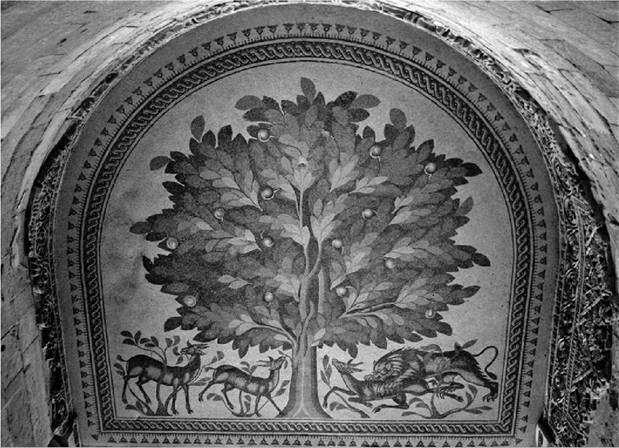
Figure 28.1 Floor mosaic in the audience hall at Khirbat al-Mafjar near Jericho.
side of a pomegranate tree while two other deer graze peacefully on the opposite left side (Figure 28.1).[1080]
The second important princely residence from the early period in greater Syria is Qusayr ‘Amra, an estate 61 kilometres east of Amman that was discovered in 1898, cleaned in 1974 and the subject of an interpretive monograph in 2004.[1081] The bathhouse there preserves a complete programme of fresco paintings. In addition to depictions of six kings, bathing beauties, dancing girls, signs of the zodiac and other subjects, the frescoes in the main room depict a ferocious hunt. The long panel along the east wall shows salukis pursuing onagers, culminating in several figures slitting the throats and disembowelling the carcasses of their prey, some of them oryx. The upper side of the west wall
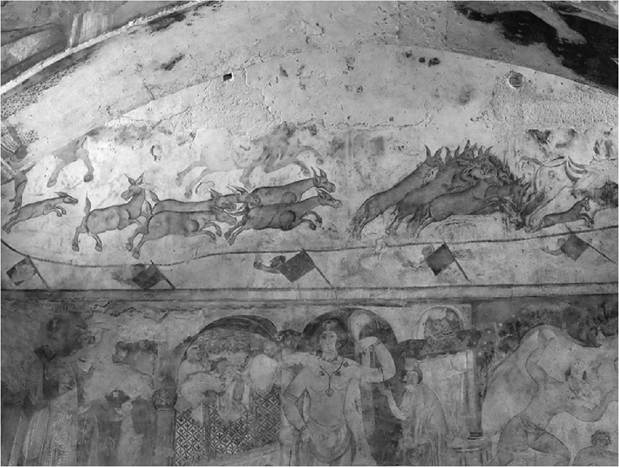
Figure 28.2 Mural on the west wall of the main hall at Qusayr ‘Amra in Jordan, showing a herd of animals being corralled in a roped-off enclosure at the top, above a scene of a bathing beauty.
preserves a long scene of horsemen pursuing a herd of onagers into a net (Figure 28.2).
These animal scenes reflect a long tradition in the region.[1082] [1083] The depiction of a lion attacking a weaker animal dates back millennia, possibly with astrological overtones of the triumphant lion as Leo.11 The format with the animals posed next to a tree was common in the classical world: the spandrels over the fountain in the nymphaeum of the first-century ce House of Neptune and Amphitrite at Herculaneum display a similar scene of dogs attacking stags. Large-scale hunts in fenced parks are also a frequent theme in the region, and one that continued into Islamic times, as attested by the extensive enclosure or reserve (Arabic hayr) found at the ninth-century site of Samarra in Iraq.[1084] One of the most spectacular examples depicting such a hunt covers the walls of the rock-carved grotto at Taq-i Bustan just east of Kirmanshah in Iran, where reliefs on the side walls of the large iwan (a barrel- vaulted space open at one end) show the king hunting, probably the last great monarch of the Sasanian dynasty, Khusraw II Parviz (r.
590-628). The lively reliefs depict fenced parks enclosing hunt scenes. The right side shows a stag hunt; the left, an elaborate boar hunt in the marshes. Men on elephants beat the quarry towards the king, who stands erect in a boat accompanied by courtiers, musicians and ladies, while the carcasses are being carted off on elephant back at the far right. 1[1085]The hunting scenes common in the desert estates of the early Syrian steppe can be interpreted in several ways.1[1086] One explanation for their ubiquitous presence is that they depict a pastime enjoyed by the patrons, but they also display the patron's wealth as shown by his ability to organise large-scale hunts. The vignettes, especially the violent slaughter of animals, also underscore the patron's generosity and open-handedness. The scene of a lion attacking a deer, found at both Umayyad sites, may also have had erotic overtones, as the lion in Arabic poetry represents the strong impulsive lover while the gazelle is the fair maiden being pursued.[1087] Such an erotic interpretation is strengthened by the frequent depiction in other parts of the baths of females, often naked or half-dressed. These hunting scenes may also represent the triumph over nature, a theme evoked by similar scenes in late Roman architecture, in which landscape expresses the powers of nature and the gods, challenging human control of the natural world and implicating the viewer in the dangerous world of myth.[1088]
Narrative tales including scenes of battles and punishment shown in frescoes from contemporary Central Asia reinforce such interpretations of the triumph over nature and the power of myth. The interior of one of the larger private houses constructed in the eighth century at Panjikent near Samarkand in Central Asia had a strip-like sequence of murals showing the
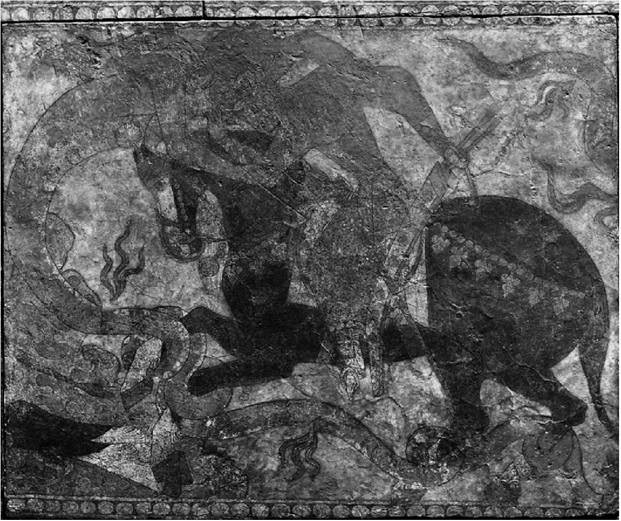
Figure 28.3 ‘The legendary hero Rustam battling a dragon', mural from a residence in Panjikent, Central Asia, now in the Hermitage Museum, St Petersburg.
eastern Iranian hero Rustam of Sistan battling divs (demons).[1089] Rustam, astride his trademark chestnut stallion Rakhsh, wrestles and lassoes his enemies; he slays a serpent-like she-dragon (Figure 28.3). The murals depicting the mythical hero, who reappears as one of the central characters in the Shahnama, the Persian national epic compiled by the poet Firdawsi in the early eleventh century, were no doubt intended to glorify the owner of the house and link him to the epic past. But they also evoke the transitory nature of life, the possible loss of power, and the ever-present revolution of the wheel of fortune. The role of the viewer is ambiguous, as voyeur, participant and potential victim.
More on the topic Early Period:
- In the early seventeenth century Japan transitioned from a period of prolonged and nationwide internecine civil war (the Warring States period, 1467-1600) to an era of extended peace during the early modern, or Tokugawa, period.
- Early Classic Period Maya Warfare
- The Early Urban Period
- Intrusions and Transitions in the Early Modern Period
- Violence against Women in the Early Islamic Period
- Module 1. The History of Ukraine in the Middle Ages and the Early Modern Period
- Bhayro Siam, Rider Catherine (eds.). Demons and Illness from Antiquity to the Early-Modern Period. Leiden, Boston: Brill,2017. — xiv, 434 p., 2017
- Although Vietnamese have been fighting among themselvessince even before recorded history, the early modern period saw arguably the most significant levels of violence until the second half of the twentieth century.
- From a very early period, Roman law had recognized that pre-adolescent children whose paterfamilias was dead were vulnerable to deceit and manipulation by those with designs on their property.
- Among the many images created by Europeans in the period of the abolition of the slave trade in the late eighteenth and early nineteenth centuries is one undoubted masterpiece,
- The advent of the Early Historic period in northern India in the sixth and fifth centuries bce saw the emergence of monarchical and oligarchic states and the beginnings of a sustained discussion of the relationship of kingship with violence and non-violence.
- As demonstrated in the preceding chapters, Ja'far alSdiq's legal thought fell very much within the general legal discourse of late Umayyad and early Abbasid times. It was common for the judges and jurists of the period to maintain sharp differences of opinion and to disagree on just about every point.
- This chapter examines robbery at sea as a long-standing global phenomenon, tracing patterns of waterborne violence as they developed in eastern and western seas from ancient to modern times, with an emphasis on the early modern period.
- The Qing Empire (1636-1912) was one of a set of very large, long-lived Eurasian empires ofthe early modern period, and like any ofits contemporaries the empire raises a number of questions regarding the sources of its stability, expansion, and durability.
- Vasilii Kliuchevsky, the dean of Russian historiography at the turn of the twentieth century, defined Russian history from the early seventeenth to the mid-nineteenth century as an 'all-Russian' period, in opposition to the earlier age, which he called Great Russian and Muscovite.
- The period covered in this chapter, from the death of Herod the Great, King ofthejews, in 4 все to the end of the secondjewish war with Rome in 135 ce, is a period of lingering and terminal crisis in the history of Israel
- This chapter will explore ritual violence in the form of close combat in precolonial western Africa (and the African diaspora) during the period of European contact from the mid fifteenth century until the late nineteenth century, a period which saw an end to the slave trade and the start of European colonisation.
- Early modern European warfare features prominently in several important discussions of early modern violence, notably the debate on the Military Revolution and its variants,
- Middle Period