Although Vietnamese have been fighting among themselvessince even before recorded history, the early modern period saw arguably the most significant levels of violence until the second half of the twentieth century.
Prior to the sixteenth century, most large-scale warfare featuring Vietnamese participants was directed against external forces - most prominently the Chinese and to a lesser extent the Chams to the south.
There had been several dynastic transitions during that period; however, they had taken place without significant amounts of internal warfare. The only exception had been the Le dynasty's rise to power, but that involved not a civil war, but a decadelong struggle against a Ming (Chinese) occupation, which ended in Le Loi's victory in 1428.Beginning in around 1500, however, significant changes began to appear in this dynamic. While there was still some involvement from external powers, the majority of conflicts consuming Vietnamese populations were now internal, with a corresponding increase in the amount of internecine violence. This was a period that saw three highly contested dynastic transitions, the emergence (in middle of the sixteenth century) of multiple competing and autonomous realms, three large-scale civil wars, and, finally, a series of popular rebellions that dominated the historical landscape of the eighteenth century. The last of these rebellions transformed into a civil war and then brought a new dynasty to power. During this time there were no fewer than five major families who at one time or another made and sustained political claims to statehood: the Le, the Trinh, the Nguyen, the Mac and the Tay Son. While the Le dynasty ostensibly endured through virtually this entire period (it is conventionally regarded to have ended in 1788 /9), the reality was that each of the other claimants to power achieved significant measures of de facto or de jure political authority over large portions of the Vietnamese realms. It is an era that Keith Taylor has recently characterised as a succession of decades-long struggles lasting seventy (1530-1600), fifty (1627-72) and thirty years (1772-1802) respectively.[683] These large-scale and violent wars pitting major political forces against each other constituted the backdrop to life in Vietnam through much of the early modern period.
Indeed, it is partly because of these conflicts that it is difficult to label this space in the early modern period. The territory that had once borne the labels Dai Viet or An Nam (from the Chinese perspective) now began to break down into contending polities, and vernacular terms like Dang Ngoai (the Outer Region) and Dang Trong (the Inner Region) emerged to designate the northern and southern states respectively.The conflicts of this era often began as rebellions, and while most remained limited in scope, several escalated into full-scale civil war. The Tay Son Uprising (1771-1802) is a good example of a rebellion that morphed into a civil war. Its leaders launched their movement with limited and exclusively military objectives, slowly transforming the territorial space into a state with gradually expanding political and military capacity, which in turn allowed it to sustain its struggle against rival states to the north and south. Whether rebellions or civil wars, what these events had in common was a ferocity that frequently made life extremely difficult for those who lived in the path of roaming rebel forces, or were caught between the warring parties in larger-scale civil wars.
In particular, this chapter looks at the consequences of the Vietnamese realm's division in the early 1600s between two rival families, the Trinh and the Nguyen, each nominally serving a sitting but politically powerless Le emperor. This division, which spurred substantial amounts of violence, was one of the most significant developments of the early modern era. Both internal and external factors contributed to the conflicts of this era, and pitted these two states against their own subjects as well as against marginalised ethnic minority populations and even overseas allies ranging from Siamese armies, Chinese pirates and the Qing court to European missionaries and mercenaries. This complex cast of characters contended or cooperated in the context of political and economic instabilities that generated numerous instances of large-scale violence in the context of rebellions, some lasting for decades, and some, like the Tay Son Uprising, succeeding in toppling ruling houses.
The contours of the frequent and violent upheavals of this period were determined by a combination of factors, including internal political tensions, the expansion of Vietnamese state interests into new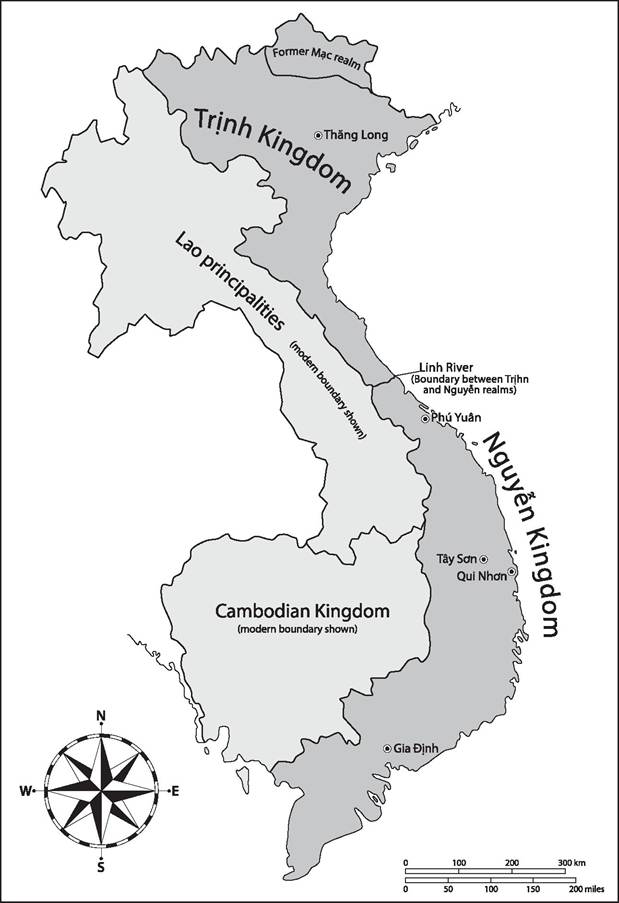
Map 22.1 Vietnam, c. late eighteenth century.
territories, questions of dynastic legitimacy and ultimately economic hardships caused in part by a collapse of foreign trade and currency fluctuations. Violent rebellions were a prominent feature of these events, some driven by inter-family rivalries among elites, and others sparked by economic woes afflicting rural populations. The effects of these numerous challenges to state authority were profound. Large-scale dislocation of populations was a common element, as were forced military and labour service that only caused further discontent among peasant farmers. It was, in short, a historical landscape of frequent violence encompassing significant portions of the Vietnamese population.
More on the topic Although Vietnamese have been fighting among themselvessince even before recorded history, the early modern period saw arguably the most significant levels of violence until the second half of the twentieth century.:
- For three and a half centuries Europeans extended the bounds of their overseas possessions. In the half century that commenced in the 1770s the scope of imperial holdings shrank dramatically.
- Antony Robert, Carroll Stuart, Pennock Caroline D. (eds.). The Cambridge World History of Violence. Volume 3: AD 1500-AD 1800. Cambridge University Press,2020. — 710 p., 2020
- As the colony that gave Europe its archetype of tropical cannibalism and consumed more African bodies than any other American slave system, Brazil warrants a central place in the history of early modern racial violence.