Modelling Language Shift
The study of language evolution and language shift has become a field of interest for many disciplines in the recent times, including the application of computational and mathematical methods to model these processes.
A fruitful area for the application of computational methods to linguistics has been the study of the emergence of internal linguistic changes leading to language birth—lexical emergence and diffusion, phonetic change, appearance of grammar structures—through the application of approaches such as game theory or probabilistic inference (Wang et al. 2004; Baronchelli et al. 2008; Nowak et al. 2002; Bouchard-Cote et al. 2013). In general, many of these applications can be of interest both for the study of current language evolution as well as to the historical events of linguistic divergence and language birth, although several studies are particularly focused on historical linguistics. The work by Bouchard-Cote et al. (2013) is precisely devoted to the reconstruction of protolanguages by means of probabilistic inference of sound change over time, producing results very close to those obtained through manual reconstruction by linguists. Another important line of computational research, related to historical linguistics and process of language birth, has been the inference of language trees through the application of phylogenetic methods. Such methods have been applied to infer linguistic relationships and to estimate chronologies of language divergences for the Celtic languages (Forster and Toth 2003), the Indo-European languages (Gray and Atkinson 2003), and even to the Eurasiatic macrofamily (Pagel et al. 2013).
Language displacement has also been an important topic of research both for computational and mathematical modelling, although the substantial difference between the mechanisms leading to the shift in language described above affects significantly the applied models.
In the demography/subsistence mechanism, the means to the language shift is mostly related to population displacement. Therefore, an appropriate modelling approach here would be the application of wave-of-advance models (Ammerman and Cavalli-Sforza 1973). Indeed, such models have been widely applied to the spread of the Neolithic in Europe (Ammerman and Cavalli-Sforza 1973; Fort and Mendez 1999; Fort 2012)—which seems to have been related to the expansion of the Proto-Indo-European language (Renfrew 1987; Gray and Atkinson 2003). However, the Neolithic expansion in Europe was not a purely demic process in the whole continent, but in some regions agriculture was also transmitted by an acculturation process (Fort 2012). In those regions language may have or may have not been transmitted alongside agriculture —Refrew (1987) suggests that the assumed pre-Indo-European languages such as Basque or the now extinct Etruscan, may have survived in those processes of cultural transmission. But if in some areas language was indeed transmitted as well, it must have been part of the whole “Neolithic package,” rather than a simple linguistic shift, and thus the process may be well described by demic-cultural models devised to describe the Neolithic transition as a whole (Fort 2012). The colonization of North America—with the subsequent spread of the English lan- guage—has also been successfully described with a wave-of-advance model modified to include the colonizing intent (Fort and Pujol 2007).Language displacement may also take place in situations where there is little or no population movement. These would be the cases for the mechanisms of elite dominance and neighbouring acquisition. Although the reasons behind the language shift differ, after the new elite is established in the first mechanisms, both cases can be assumed mostly equivalent for modelling purposes. Both mechanisms lead to a competition for dominance between two languages, one of which having a higher status—either because it is the language of the elite, or because the neighbouring language is seen as more advantageous for some reason—within a population that is mostly unchanged.
Of course, a linguistic imposition in the case of elite dominance may accelerate the displacement process, or on the contrary, it may cause a resistance effect giving a higher status to the indigenous language; such effects can be easily included into a language competition model by means of adapting the parameter values.Therefore, language competition models are a good approach to model language displacement when there are no important changes in the population density due to immigration, or to an increase in the population density that is sustainable. In the recent years, several authors have developed mathematical and computational language competition models (for a review, see Kandler 2009). In 2003, Abrams and Strogatz (2003) developed a simple two-population model to describe the competition for speakers between two languages, A and B, coexisting in the same region, and which has been the basis for several other studies on linguistic shift (Patriarca and Heinsalu 2009; Fort and Perez-Losada 2012). This model describes the evolution in time of the fraction of speakers of each language (pA and pB), with the fraction of speakers defined as the ratio between the number of speaker of a given language over the total population (e.g., pA = NA/N = NA/(NA + NB), and therefore pA + pB = 1). The evolution over time, represented by the time derivative, is expressed mathematically according to the following equations (Abrams and Strogatz 2003),
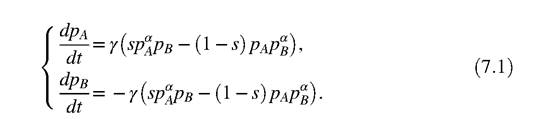
In broad lines, this equation shows that the evolution of the fraction of speakers of each language follows the same dynamics as the other one, though with an opposed sign; this means that the speakers lost by one language become speakers of the other one. In addition, the minus sign before (1 — s) indicates that a language may lose or gain speakers depending on the fraction of the population speaking each language, as well as the values of the of the parameters.
In the model by Abrams and Strogratz (2003), y is a parameter that scales time, so it accelerates or decelerates the process; s, with a value between 0 and 1, reflects the status of language A relative to B; and a determines the relative importance of the population fractions in attracting speakers to language A.Although this model has been applied rather successfully to describe language evolution (Abrams and Strogatz 2003), it yields some problems when trying to extrapolate the model beyond the data over which they applied the model. From a mathematical point of view, these problems arise because of the existence of stable and unstable equilibrium points, depending on the parameter values (see a detailed mathematical discussion in Isern and Fort 2014). To put it in more general terms, we shall describe one of the possible problematic outcomes. Depending on the parameter values chosen, the language with a higher status displaces the other one until it is nearly extinct in the region, and then the process stops. This means that the model predicts that, without adding any extra particularity (such as part of the population living in a very secluded area), the language will remain alive as the main language for a reduced part of the population forever.
Such behaviour is historically unrealistic, and for this reason we opt for an approach conceptually simpler and which does not present the same extrapolating problems (Isern and Fort 2014). This alternative model also describes the dynamics of the transfer of speakers between two languages A and B in competition, one of which is seen by the population as being socially or economically more advantageous. This model is described as follows (Isern and Fort 2014)
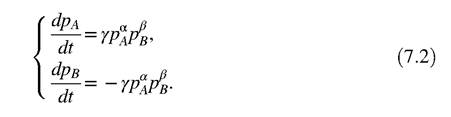
As with the model by Abrams and Strogatz (2003), the temporal evolution of the population fraction (described mathematically as a derivative), depends on the population fraction speaking each language, pA and pB, and the values of three parameters.
y is a parameter that scales time, so it accelerates or decelerates the process. The parameters a, fi > 1 are related to the attraction or perceived value of each language. Since pA,pB < 1, a and fi may be regarded as a measure of the difficulty of language A to attract speakers (a), and the resistance of language B to lose speakers (fi).Note that, again, the speakers lost by language B become speakers of language A (both equations have the same form but with a minus sign in the second equation). However, with this model, only one of the languages can gain speakers and the other loses them; in particular, A is the language seen as more advantageous and thus gaining speakers and displacing language B. In general, this is a reasonable simplification for processes where a foreign language is displacing the indigenous language in a given region. It is true that it cannot directly describe all historical situations, such as the case of the Norman invasion of Britain, where the French initially gained speakers, but the English language eventually recuperated its prevalence (Clairborne 1990); though neither can it be directly described by the model in Eq. 7.1. A reasonable alternative would be to divide the whole period into two subperiods, each with a different language defined as the high status one; after all, the status of the language is defined by the subjective perception of it by the population, rather than its political position.
Therefore, the new model in Eq. 7.2 is conceptually a reasonable approach to model processes of language displacement when a language is perceived by the population as being more advantageous socially or economically. Such cases could be related to processes of language shift due to elite dominance or neighbouring acquisition or combinations of both (for example, when the new elite come from an adjacent region, which may describe the situation of minority languages in current times when they are co-official in their territory, or even not officially recognized).
The process of language displacement after a situation of system collapse mentioned in the previous section may take place in many different ways, with or without population movement, with a change in the dominant elite, etc. and for this reason we may not propose specific models of application in such event.
7.4